
The bond market is where governments, companies, and other issuers raise debt capital and where existing debt securities trade between investors. Bonds define contractual claims on interest and principal, while market prices and yields change as rates, inflation, credit conditions, liquidity, and risk appetite change.
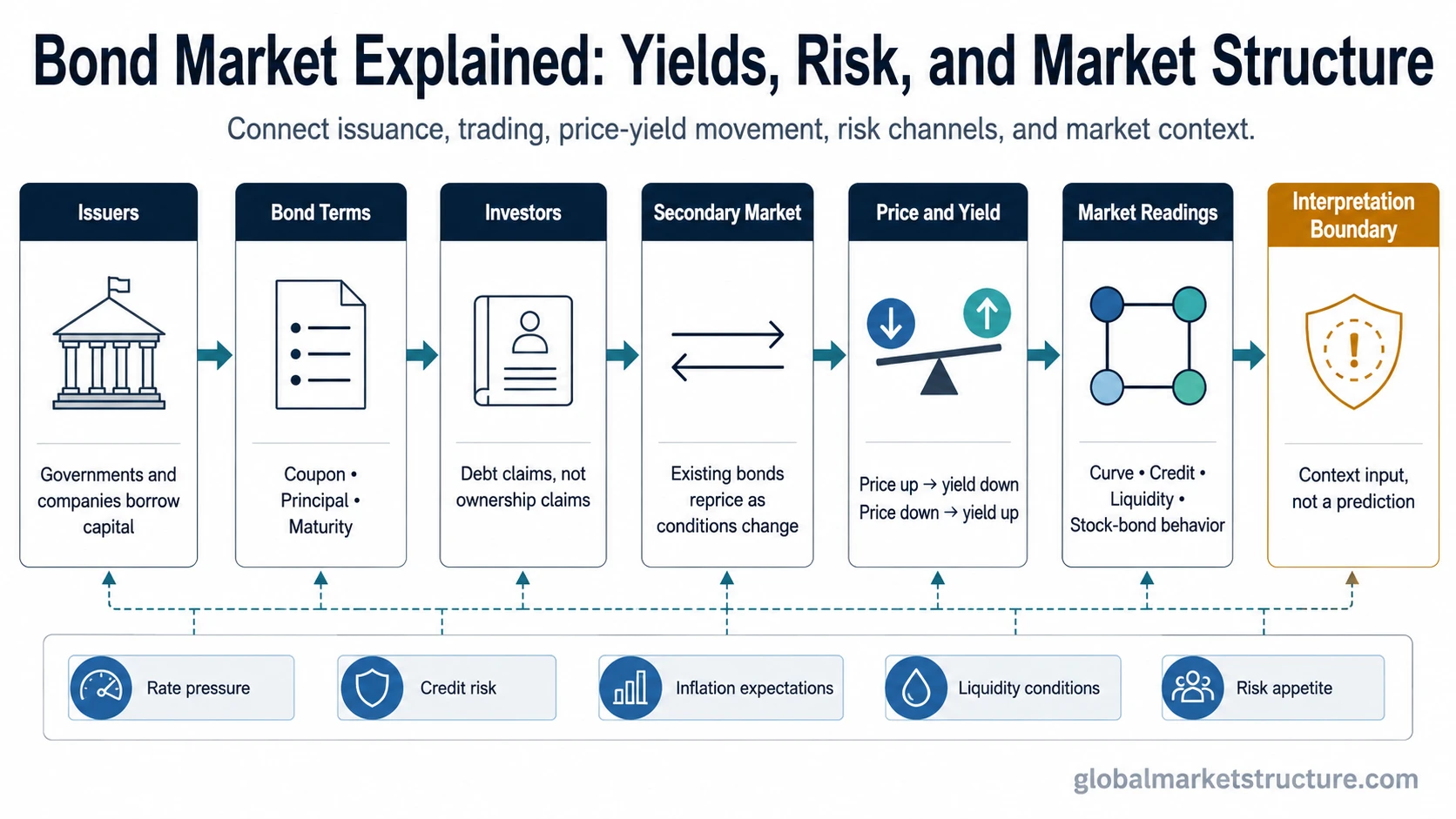
How the Bond Market Works
An issuer borrows by selling a bond. The investor receives a debt claim defined by the bond’s terms, including its coupon structure, principal amount, and maturity. After issuance, changing market conditions can reprice the bond even though its contractual payments have not changed.
New bonds are sold by issuers to raise capital. The transaction creates the debt security and establishes its initial terms.
Existing bonds change hands between investors, and their prices adjust as required yields, credit conditions, liquidity, and risk preferences change.
Many U.S. corporate, agency, and securitized debt transactions occur outside national securities exchanges. FINRA’s TRACE system reports eligible over-the-counter fixed-income transactions, but TRACE itself is not an execution venue. This helps explain why bond-market liquidity and price discovery can differ from listed equities.
Why Bond Prices and Yields Move in Opposite Directions
Holding a bond’s promised cash flows constant, a lower market price implies a higher yield and a higher price implies a lower yield. If market yields increase, older bonds with lower coupons generally need lower prices to remain competitive with newly issued debt. Falling market yields can have the opposite effect.
Price sensitivity is not the same across all bonds. Maturity, coupon structure, and the timing of cash flows affect how strongly a bond reacts to a yield change. Detailed sensitivity belongs on bond duration, while the market exposure created by adverse yield moves belongs on duration risk.
Major Bond-Market Segments
Government bonds are issued by sovereign or public authorities. Corporate bonds are issued by companies. Municipal or local-government bonds exist in some markets, while securitized bonds are backed by pools of assets or cash flows.
These segments can react to different forces. Short-maturity government debt may respond mainly to policy expectations and the perceived risk-free-rate path. Lower-quality corporate debt can be more sensitive to credit spreads, refinancing conditions, and risk appetite.
Bond-Market Risk Channels
Interest-rate risk appears when changes in yields move bond prices. Credit or default risk reflects the possibility that an issuer may not meet its obligations. Inflation can reduce the purchasing power of fixed future payments, while liquidity risk appears when trading requires a larger price concession.
These pressures can overlap without carrying the same message. Rising government yields can reflect policy or inflation repricing while credit spreads remain calm. A simultaneous widening in credit spreads can point to a different risk environment.
Bond Market vs Stock Market
The bond market is a debt market, while the stock market represents ownership claims. Bondholders lend capital under defined terms. Owners of equities hold residual claims whose value depends more directly on future earnings, valuation, and business outcomes.
The broader comparison belongs on stocks vs bonds. On this page, the distinction matters because the same macro pressure can move debt claims and ownership claims through different channels.
Observable Bond-Market Signals
Bond-market interpretation becomes more useful when several signals are read together. A yield move can come from growth expectations, inflation, expected policy, real-rate pressure, term premium, credit stress, or liquidity conditions.
| Signal | What it can help interpret | Why it is not enough alone | Related concept / route |
|---|---|---|---|
| Yield level | Borrowing-cost pressure, discount-rate pressure, and the return available on fixed-income assets. | The same yield level can mean different things depending on inflation, growth, policy, and credit context. | risk-free rate |
| Yield curve shape | Market expectations around short-term policy, long-term growth, inflation, and term compensation. | Different curve moves can come from short-end policy shifts or long-end repricing. | Yield curve and rate-regime interpretation |
| Real vs nominal yields | Whether yield pressure is coming from inflation compensation, real-rate pressure, or both. | Nominal yields alone can hide whether the market is repricing inflation or real return requirements. | Real-yield and nominal-yield pressure |
| Credit spreads | How much extra compensation investors demand for credit risk compared with safer benchmarks. | Spread moves need to be compared with growth, refinancing, and liquidity conditions. | Credit-risk and risk-appetite context |
| Term premium | The extra compensation investors may require for holding longer-maturity bonds. | It is not the same as expected policy rates, and estimates can vary by methodology. | Long-end rate interpretation |
| Market liquidity / depth | Whether bond markets can absorb trading without large price impact. | Poor liquidity can amplify price moves without establishing a single macro cause. | Liquidity and market depth |
| Stock-bond correlation | Whether equities and bonds are diversifying each other or moving under the same macro pressure. | Correlation can change across inflation, growth, policy, and stress regimes. | stock-bond correlation |
When Rising Yields Carry Different Information
- Government yields rise.
- Credit spreads remain relatively calm.
- Market liquidity remains stable.
- Equity participation stays broad.
The move may be more consistent with growth, policy, inflation, or real-rate repricing than with an immediate credit-stress signal.
- Government yields rise.
- Credit spreads widen.
- Liquidity becomes thinner.
- Equity breadth weakens.
The same yield direction now sits alongside tighter financial conditions and deserves a more defensive interpretation.
How Bond Yields Connect to Equity Valuation
Bond yields change the return available outside equities and can alter the discount rates applied to future cash flows. The valuation mechanics connect to discount rate and equity risk premium. The broader cross-asset transmission is covered in how bond yields affect stocks.
Yields, curve shape, real-rate pressure, credit spreads, liquidity, and stock-bond behavior can point in different directions. The stronger reading comes from identifying which part of the bond market moved, what may be driving it, and whether surrounding markets confirm the same interpretation.