
Risk-on describes a market environment where investors are more willing to hold risk-sensitive assets because the broader backdrop appears supportive for risk taking.
The label is a reading of risk appetite, not a buy signal, forecast, or proof of a new bull market. It becomes more useful when equities, credit, volatility, liquidity, breadth, policy, and macro context point in the same direction.
What Risk-On Means
Definition: Risk-on is a market-environment condition in which investors show greater comfort with uncertainty and a higher willingness to hold assets that depend on growth, confidence, liquidity, and risk tolerance.
In a risk-on environment, market participants may favor equities, cyclical assets, high-yield credit, emerging markets, or speculative assets. That behavior still needs context because different assets can rise for different reasons.
A narrow rally, a short squeeze, or a one-day rebound can look risk-on without proving that the broader environment has changed.
Why Risk-On Is a Market Environment, Not a Trade Signal
Risk-on belongs to market regime interpretation. It helps describe whether markets are rewarding risk exposure or demanding more caution, safety, and liquidity.
The term does not mean that every risk asset should rise. It also does not replace asset-specific analysis, valuation, liquidity, positioning, or risk management. A risk-on reading is strongest when several evidence channels confirm the same direction rather than one asset moving sharply by itself.
What Risk-On Usually Looks Like Across Markets
Risk-on behavior often appears as stronger demand for assets tied to growth, earnings confidence, liquidity, and lower perceived stress. Equities may strengthen, credit conditions may look calmer, volatility may fall, and market breadth may improve.
Those patterns are not mechanical. A rally in speculative assets can reflect positioning, policy expectations, short covering, or a temporary liquidity impulse rather than durable improvement in the broader risk environment.
Evidence Channels for a Risk-On Reading
| Risk-on evidence channel | What it may suggest | What can weaken the reading |
|---|---|---|
| Market breadth | Participation is broadening beyond a small group of index leaders. | A narrow index rally can hide weak participation beneath the surface. |
| Credit conditions | Credit markets are becoming less stressed and risk compensation is stabilizing. | Widening spreads can contradict equity strength and point to fragile risk appetite. |
| Volatility | Lower volatility can reflect calmer risk pricing and less demand for protection. | Volatility can stay low before stress returns, especially when positioning is crowded. |
| Liquidity | Less restrictive liquidity can make risk-taking easier across markets. | Tightening liquidity can leave price strength dependent on positioning rather than durable risk appetite. |
| Yields and DXY context | Rate and dollar conditions may support or pressure global risk appetite. | Rising real yields, dollar stress, or unstable rate expectations can change the interpretation. |
| Policy and macro backdrop | Supportive growth, inflation, and policy expectations can increase willingness to hold risk. | Policy uncertainty, inflation pressure, or growth deterioration can make the move fragile. |
| Risk appetite | Investors are more willing to accept uncertainty in exchange for potential upside. | Risk appetite can fade quickly if credit, liquidity, volatility, or macro evidence deteriorates. |
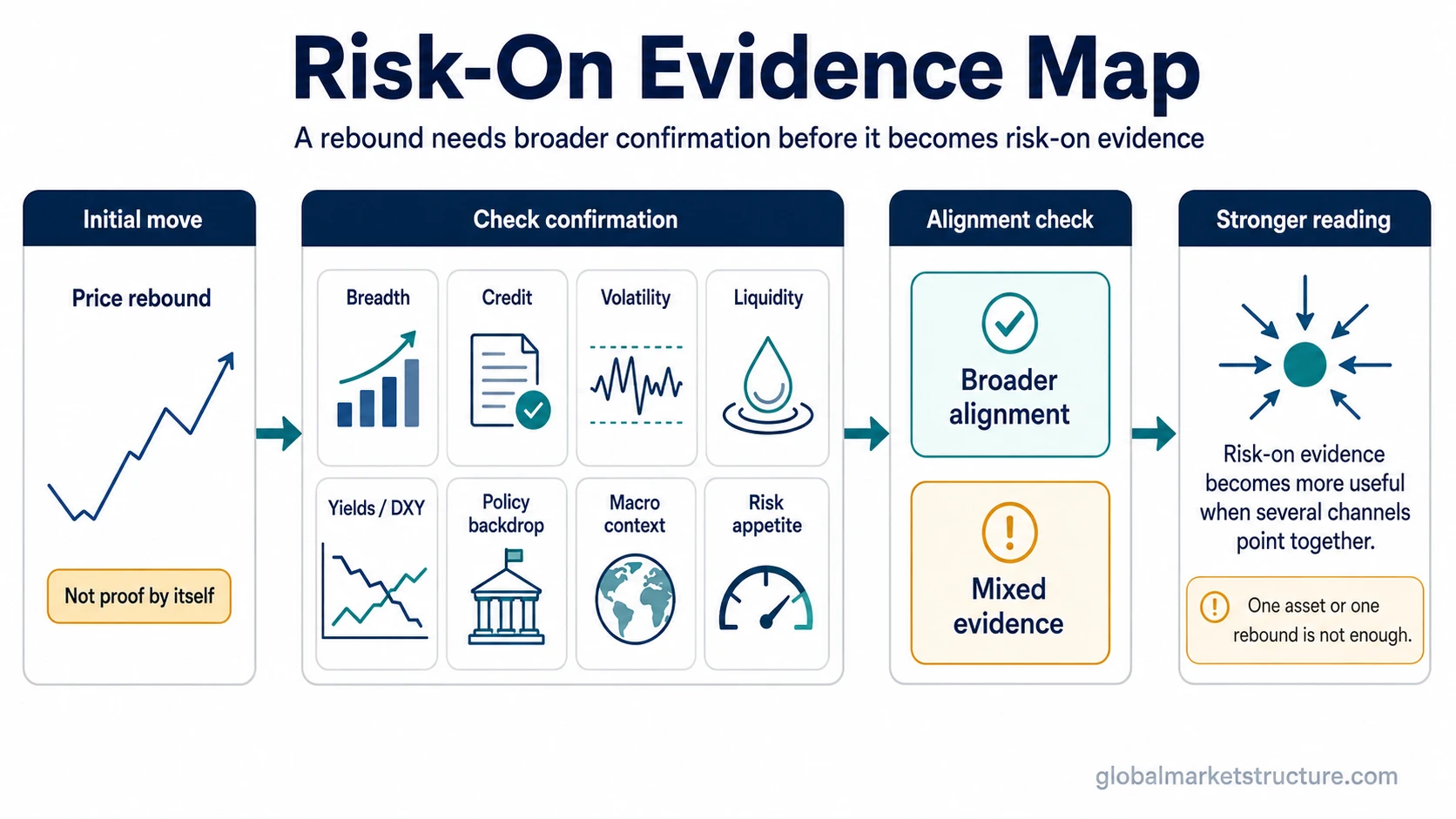
Common Mistake: Treating One Rally as Risk-On Confirmation
One rally is not enough to classify the broader environment as risk-on. A sharp rebound can come from short covering, positioning unwinds, policy headlines, a technical bounce, or relief after heavy selling.
The risk-on label becomes more defensible when the move is supported by broader participation, calmer credit, lower stress, healthier liquidity, and a macro backdrop that improves the willingness to hold risk-sensitive assets.
A Simple Risk-On Scenario
A rebound carries more risk-on evidence when participation broadens beyond a few large stocks, credit stops deteriorating, volatility demand fades, and liquidity conditions look less restrictive at the same time. The move then has support from several risk channels, not only from price recovery.
The reading is weaker when the rebound remains narrow, credit spreads keep widening, volatility stays elevated, or defensive assets continue attracting demand. That pattern can describe temporary relief after stress rather than a durable improvement in risk appetite.
Risk-On vs Risk-Off
Risk-on describes a market environment where investors are more willing to hold risk-sensitive assets. Risk-off describes the opposite environment, where safety, liquidity, and capital preservation become more important.
The distinction matters because the same asset move can mean different things under different conditions. A falling defensive currency or calmer volatility can support a risk-on interpretation, but only when the broader evidence also aligns.
Risk-On vs Bullish
Risk-on and bullish are related, but they are not the same. Bullish usually describes a positive directional view on a specific asset, market, or trend. Risk-on describes the broader willingness of investors to accept risk across the market environment.
A bullish move in one asset can happen without broad risk-on confirmation. A risk-on environment can also be temporary, uneven, or vulnerable if breadth, credit, liquidity, volatility, or macro evidence starts to weaken.
Risk-on can support a bullish interpretation, but it does not confirm a bull market by itself. For the direct environment-level contrast, the broader risk-on versus risk-off distinction is more useful than treating risk-on as a synonym for bullish.
What Can Weaken a Risk-On Reading
A risk-on reading becomes weaker when market evidence starts moving in different directions. Strong index performance can be less convincing if breadth narrows, credit spreads widen, volatility rises, liquidity tightens, or defensive assets remain in demand.
The broader environment can also shift when policy expectations change, growth data weakens, inflation pressure raises rate uncertainty, or the dollar and yield backdrop becomes more restrictive for global risk appetite.
Related Concepts
Risk-on is easier to interpret when defensive behavior is also understood. Safe-haven currencies add a useful boundary because defensive currency demand often becomes more important when markets move away from risk appetite and toward liquidity preference.