
Risk off is a market condition in which investors become less willing to hold riskier exposure and more likely to prefer perceived safety, liquidity, or defensive behavior. It is a risk-appetite context, not a forecast, trading signal, portfolio allocation rule, or conclusion that can be confirmed by one market indicator alone.
Simple definition: risk off means market participants are reducing risk appetite and placing more emphasis on capital preservation, liquidity, and perceived safety as uncertainty or stress rises.
A risk-off environment can appear when equities, credit, volatility, currencies, rates, commodities, and defensive assets begin telling a similar story. The condition becomes more credible when several inputs align. It becomes weaker when only one asset moves, when safe-haven behavior conflicts, or when the move reflects a local event rather than broad market stress.
The opposite condition is risk on, where investors are generally more willing to hold cyclical, growth-sensitive, or riskier assets. Risk off is not simply the mirror image of that condition. It usually needs confirmation from stress, liquidity, credit, volatility, and cross-asset behavior rather than a single red day in equities.
What Risk Off Means in Markets
Risk off describes a broad shift in market behavior. Participants become more sensitive to uncertainty, more selective about exposure, and more focused on assets or structures that are perceived as safer, more liquid, or less dependent on strong growth expectations.
That does not mean every investor is selling all risk assets or that every defensive asset must rise. Market behavior can be uneven. Some assets may react to liquidity stress, others to interest-rate expectations, and others to growth fear. The useful question is whether the broader pattern shows a decline in risk appetite across more than one market.
For example, a weak equity index alone does not prove a risk-off environment. The reading becomes stronger if credit spreads widen, volatility rises, funding conditions tighten, defensive leadership improves, and perceived safe-haven demand appears at the same time. It becomes weaker if equities fall while credit remains calm, volatility is contained, and liquidity conditions remain stable.
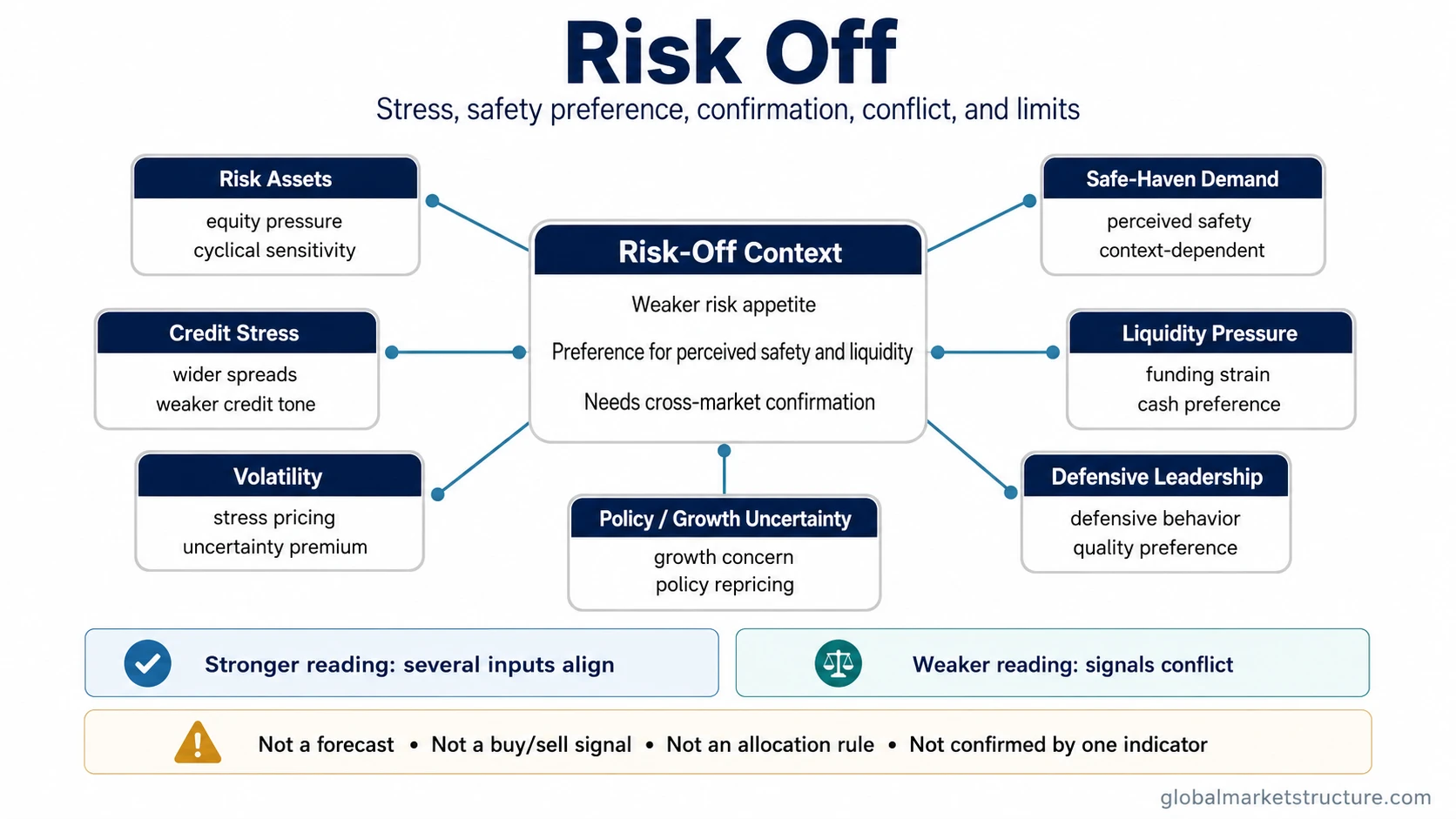
Risk-Off Components
Risk off is best read as a component stack. Each input can add context, but no single input should be treated as complete proof. The strongest readings usually come from alignment across risk assets, credit, volatility, liquidity, defensive behavior, and macro uncertainty.
| Component | What it can show | Why it is not enough alone |
|---|---|---|
| Risk asset pressure | Equities, cyclical assets, speculative assets, or high-beta areas may weaken as risk appetite falls. | A local selloff can come from valuation, earnings, positioning, or sector-specific news rather than broad risk-off behavior. |
| Credit stress | Wider credit spreads can suggest that investors are demanding more compensation for default or liquidity risk. | Credit can move for issuer-specific or sector-specific reasons, so it needs confirmation from broader market behavior. |
| Volatility | Rising volatility can show greater uncertainty, hedging demand, or disorderly price movement. | Volatility can rise briefly around events without turning into a durable risk-off environment. |
| Safe-haven demand | Demand may shift toward perceived safety, such as cash, high-quality bonds, reserve currencies, or defensive assets. | Safe havens do not always behave the same way. Inflation, rates, currency pressure, and liquidity needs can change the reaction. |
| Liquidity and funding pressure | Tighter funding, weaker market depth, or forced deleveraging can make investors reduce exposure faster. | Liquidity pressure can be hidden until stress rises, and it may affect some markets before others. |
| Defensive leadership | Less cyclical or lower-volatility areas may hold up better when investors become more cautious. | Defensive leadership can also reflect lower rates, sector rotation, or earnings stability rather than broad stress. |
| Policy or growth uncertainty | Macro uncertainty can reduce willingness to hold risk, especially when growth, inflation, rates, or policy paths are unclear. | Uncertainty is common in markets, so it matters most when it changes actual positioning and cross-asset behavior. |
| Conflicting evidence | Mixed signals can show that the market has not reached a clear risk-off state. | A partial reading should remain a cautionary context, not a conclusion. |
Strong Risk-Off Readings vs Weak Risk-Off Readings
A strong risk-off reading usually requires agreement between several market inputs. The point is not to find a perfect checklist. The point is to avoid treating one visible move as a complete market regime.
| Reading quality | Typical pattern | Interpretation boundary |
|---|---|---|
| Stronger risk-off reading | Risk assets weaken, credit stress rises, volatility expands, liquidity becomes more fragile, and perceived safety demand appears. | The environment may show broad risk aversion, but it still does not create a forecast or a trading instruction. |
| Moderate risk-off reading | Several inputs deteriorate, but one or two key areas remain calm or contradictory. | The market may be cautious, but the evidence is not fully aligned. |
| Weak risk-off reading | One market falls or one stress indicator rises while credit, liquidity, and volatility remain stable. | The move may be local, temporary, or event-specific rather than a broad risk-off condition. |
| False or incomplete reading | Safe-haven assets fail to confirm, credit remains calm, or the move reverses quickly after a short volatility spike. | The label should be withheld or treated as provisional until broader confirmation appears. |
Risk off should be interpreted as a context condition. It can help describe the market environment, but it does not tell a reader what to buy, sell, hedge, or avoid.
Risk Off vs Bearish Market
Risk off and bearish are related, but they are not the same thing. A bearish market view is usually a directional view about price. Risk off is a broader description of risk appetite, stress, and defensive behavior across markets.
A market can have a short risk-off episode inside a larger uptrend. A market can also be bearish in one sector while broader risk appetite remains stable. The distinction matters because risk off is about the environment, not only the direction of one index or asset.
The broader relationship between risk-on and risk-off conditions is covered separately in risk-on vs risk-off. Risk off remains the standalone environment label for weakening risk appetite, perceived safety demand, liquidity pressure, and interpretation limits.
Why Safe Havens Can Give Conflicting Signals
Safe-haven behavior is often simplified too much. In a clean risk-off move, investors may prefer assets that are perceived as more liquid, higher quality, or less exposed to growth risk. In real markets, the reaction can conflict.
High-quality bonds may respond differently depending on inflation and rate expectations. Gold can behave differently depending on real yields, currency pressure, and liquidity demand. Cash can become attractive when uncertainty rises, but that does not make cash a return forecast. Defensive equities may outperform on a relative basis while still falling in absolute terms.
Important limitation: safe-haven demand does not mean every “safe” asset rises. During liquidity stress, investors may sell even high-quality assets to raise cash. During inflation-driven stress, bonds and equities can both weaken. The asset list matters less than the broader confirmation pattern.
Risk Off and Risk Appetite
Risk off is one expression of weakening risk appetite. When risk appetite falls, market participants usually become less tolerant of uncertainty, leverage, long-duration exposure, weak balance sheets, and assets that depend heavily on favorable liquidity or growth conditions.
Risk appetite can weaken gradually or quickly. A gradual shift may appear through sector leadership, credit conditions, and breadth deterioration. A faster shift may appear through volatility, liquidity pressure, forced selling, and demand for perceived safety. The stronger interpretation comes when these signals point in the same direction.
Practical Scenario
A practical risk-off scenario can start with equities weakening while credit spreads begin to widen. At first, the equity move may look like an ordinary pullback. The interpretation becomes more serious if volatility rises, liquidity becomes thinner, cyclical leadership fades, and investors start favoring perceived safety or defensive behavior.
Even then, the conclusion should stay limited. The scenario may indicate deteriorating risk appetite, but it does not prove that a crash is coming. It does not produce a buy or sell signal. It only describes a market context that requires confirmation, monitoring, and careful separation between observation and action.
What Risk Off Is Not
| Risk off is not | Why the distinction matters |
|---|---|
| A forecast | It describes current or developing market behavior. It does not predict the next move. |
| A sell signal | It does not tell investors or traders what action to take. |
| A portfolio allocation rule | It does not prescribe how much to hold in cash, bonds, equities, gold, or defensive assets. |
| A crash confirmation | Risk-off behavior can be temporary, partial, or contained. |
| A one-indicator label | One weak asset or one volatility spike is not enough to confirm the broader environment. |
| A guarantee of protection | Assets perceived as safe can still fall, especially when liquidity stress or inflation pressure changes the market reaction. |
FAQ
What does risk off mean?
Risk off means market participants are reducing risk appetite and becoming more focused on perceived safety, liquidity, or defensive behavior. It is a market context condition, not a trading signal or forecast.
Is risk off the same as a bearish market?
No. A bearish market view is usually directional. Risk off describes a broader decline in risk appetite that may involve equities, credit, volatility, liquidity, safe-haven demand, and defensive leadership.
Which assets are considered risk-off assets?
Assets often associated with risk-off behavior include cash, high-quality government bonds, some reserve currencies, gold, and defensive sectors. They are not always safe in every environment, and their behavior can change when inflation, rates, or liquidity pressure dominate.
Can one indicator confirm risk off?
No. A single weak equity index, volatility spike, currency move, or bond rally is not enough by itself. A stronger risk-off reading usually requires alignment across several market inputs.
Does risk off mean investors should change portfolios?
No. Risk off is an interpretation of market context. It does not provide portfolio instructions, allocation rules, or buy and sell decisions.