
Capital flows describe how money moves across assets, countries, funds, institutions, and market segments. Positioning describes how exposed participants already are. The useful question is not whether either one is automatically bullish or bearish. The useful question is which kind of pressure is involved, whether it is voluntary, forced, official, mechanical, or sentiment-driven, and which market-structure lens can explain it more accurately.
What This Area Covers
Capital flows and positioning sit at the intersection of money movement and market exposure. The area includes fund flows, cross-border movement, capital flight, crowded trades, carry trades, forced selling, deleveraging, reserve activity, sovereign flows, ETF flows, passive allocation, and rebalancing activity.
The same headline phrase can point to very different mechanisms. ETF inflows are not the same as reserve recycling. Crowded sentiment is not the same as forced deleveraging. A carry trade is not the same as a pension rebalancing flow. Each mechanism needs a separate interpretation before it can be connected to liquidity, risk appetite, or broader market structure.
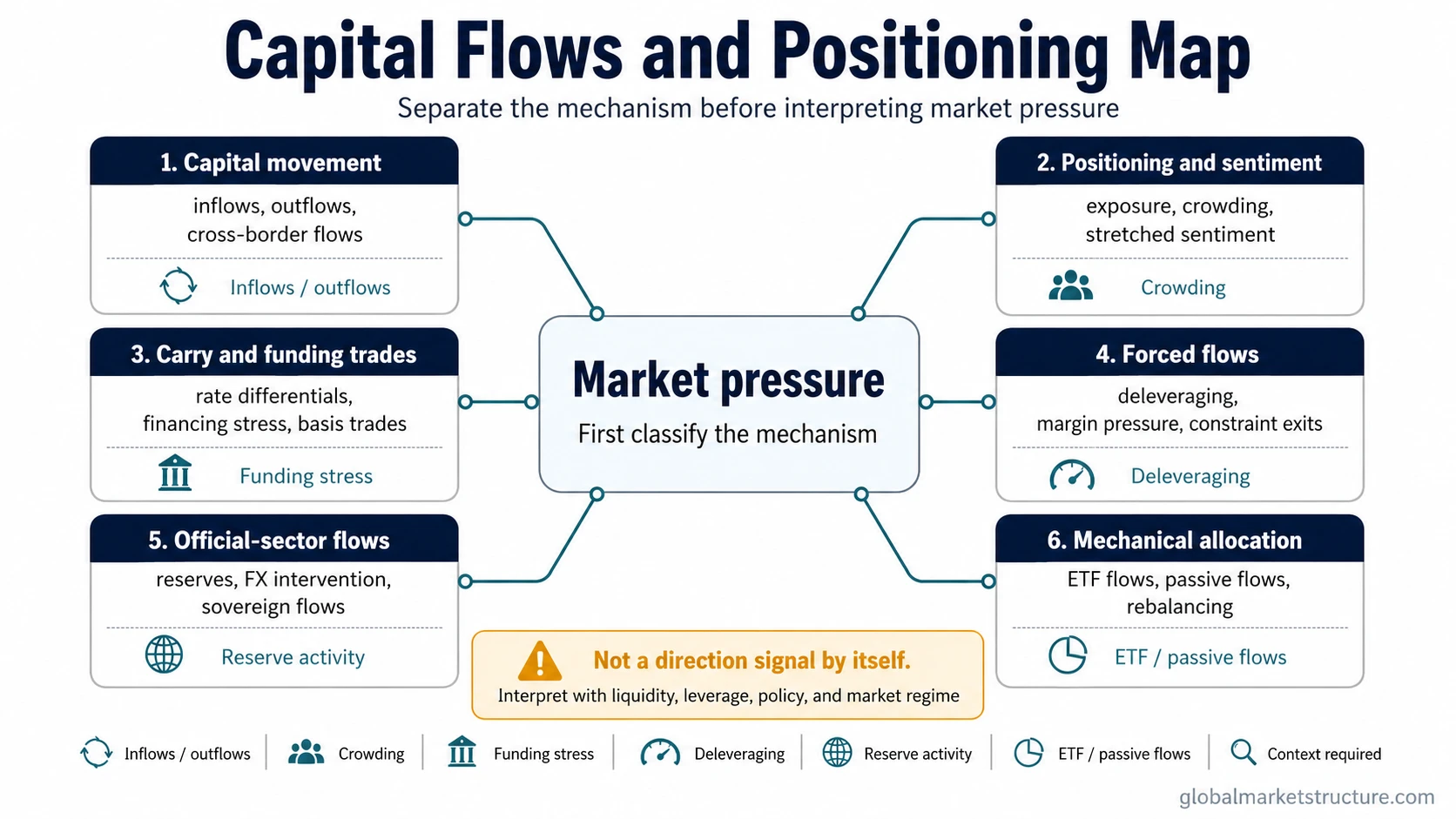
Capital Flow and Positioning Categories
Use the map below to separate the main question from the best market-structure lens.
| Reader question | Best lens | What it helps explain | Continue with |
|---|---|---|---|
| What counts as a capital flow? | Capital Flow Basics | Inflows, outflows, cross-border flows, fund flows, safe-haven flows, and capital flight. | Capital Flow Basics |
| Are investors already crowded? | Positioning and Sentiment | Exposure, sentiment, crowding, contrarian pressure, and positioning indicators. | Positioning and Sentiment |
| Are rate differentials or funding trades involved? | Carry, Basis, and Funding Trades | Carry trades, basis trades, funding stress, and financing-linked flows. | Carry, Basis, and Funding Trades |
| Is the flow voluntary or forced? | Leverage, Deleveraging, and Forced Flows | Forced selling, deleveraging, margin pressure, and constraint-driven exits. | Leverage, Deleveraging, and Forced Flows |
| Are official institutions driving the movement? | Reserve and Sovereign Flows | Reserve recycling, FX intervention, sovereign wealth flows, and official-sector flows. | Reserve and Sovereign Flows |
| Is the move mechanical or index-driven? | Passive, ETF, and Rebalancing Flows | ETF flows, passive flows, index rebalancing, pension rebalancing, and mechanical allocation. | Passive, ETF, and Rebalancing Flows |
How to Classify the Pressure
Start with capital movement. When the main question is whether money is entering, leaving, crossing borders, moving into safer assets, or leaving a region under stress, use Capital Flow Basics.
Use exposure and crowding for positioning questions. When the issue is how investors are already positioned, how sentiment is stretched, or whether a trade may be crowded, use Positioning and Sentiment.
Separate funding-linked trades from ordinary allocation. When the pressure comes from rate differentials, financing, carry, basis behavior, or funding stress, use Carry, Basis, and Funding Trades.
Check whether constraints are forcing the move. Forced selling, deleveraging, margin pressure, and balance-sheet stress belong in Leverage, Deleveraging, and Forced Flows.
Keep official-sector flows separate. Reserve accumulation, reserve drawdowns, FX intervention, sovereign wealth allocation, and official-sector activity belong in Reserve and Sovereign Flows.
Classify mechanical allocation separately from discretionary conviction. ETF creation and redemption, passive flows, index changes, and scheduled rebalancing belong in Passive, ETF, and Rebalancing Flows.
A Simple Interpretation Boundary
A market discussion may mention ETF inflows, crowded speculative positioning, and reserve accumulation in the same paragraph. Those are not interchangeable signals. ETF flows can reflect passive or product-level allocation. Crowding describes exposure and sentiment. Reserve activity belongs to official-sector flow analysis. Treating them as one single flow signal can make the interpretation weaker rather than stronger.
What Flows and Positioning Do Not Prove
Capital flows and positioning can help interpret pressure, but they are not automatic direction signals. Their meaning depends on liquidity, time horizon, leverage, crowding, policy context, and the specific type of flow involved.
Crowded positioning does not automatically mean reversal. ETF inflows do not automatically prove durable demand. Forced flows may reflect constraint rather than investor preference. Official flows may affect liquidity conditions without creating a simple asset-price conclusion. The interpretation becomes more useful only when the flow type is matched with the surrounding market structure.
What This Does Not Replace
Capital-flow analysis often depends on direct source categories: official statistics, balance-of-payments releases, central-bank data, fund-flow tools, ETF-flow databases, futures positioning reports, and institutional research. This hub provides a concept map for interpreting the different mechanisms. It does not replace raw data providers, official macro datasets, academic research, or current market-positioning commentary.
How to Continue the Analysis
Begin with the category that matches the type of pressure being analyzed: money movement, investor exposure, funding trades, forced flows, official flows, or mechanical rebalancing.