
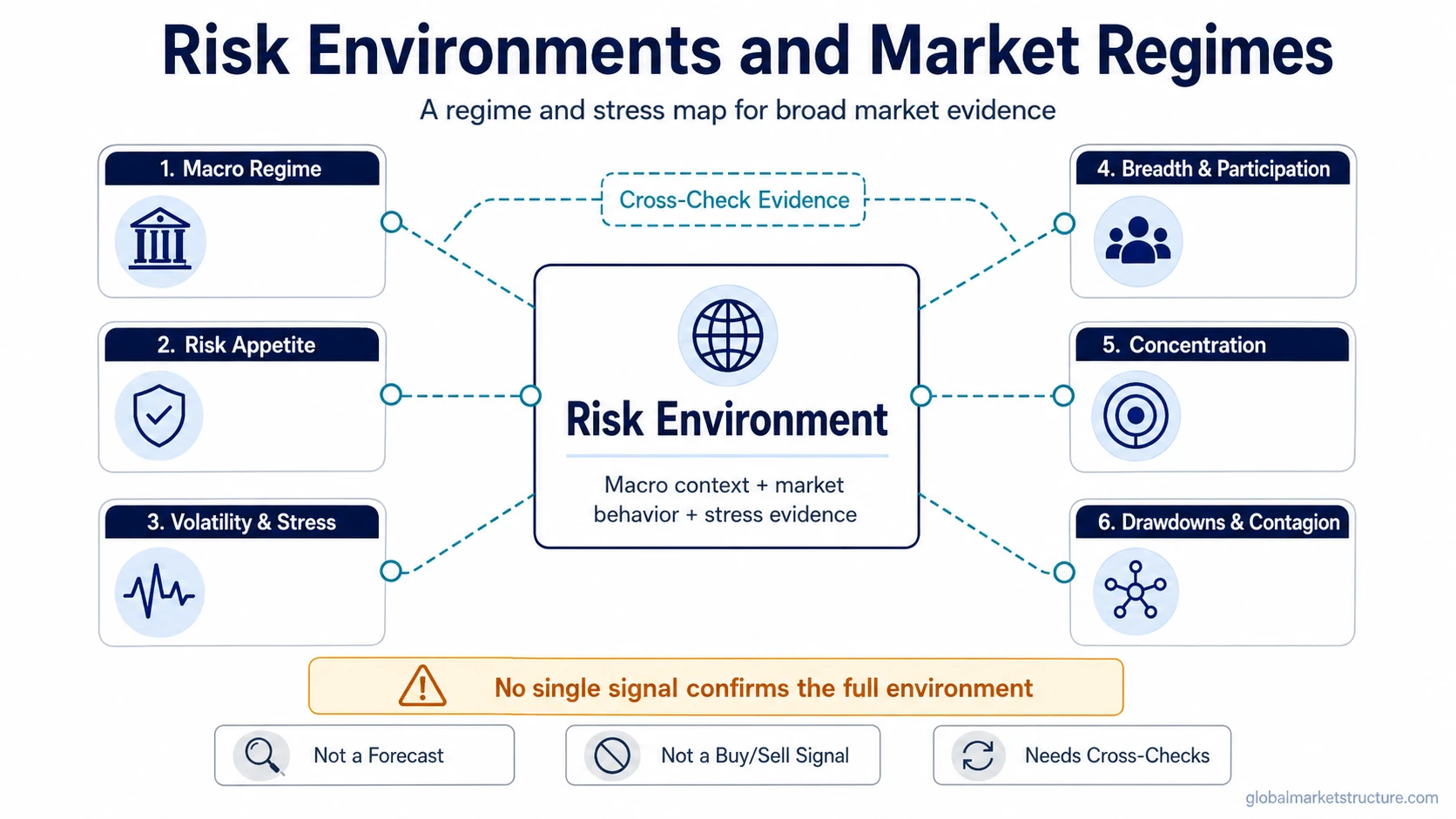
Risk environments and market regimes organize broad market-structure questions by regime backdrop, risk appetite, volatility, breadth, concentration, drawdowns, contagion, and systemic stress. The point is not to reduce the market to one label. A volatility spike, risk-on move, or breadth divergence can be useful, but each needs confirmation from surrounding macro, liquidity, credit, and participation evidence.
Key Points
- Regime questions start with the broader macro backdrop, not one market move.
- Risk appetite is only one lens; stress, breadth, concentration, and contagion can change the reading.
- Volatility needs context from credit, liquidity, participation, and drawdown behavior.
- The strongest next step is the narrower topic that matches the question being asked.
What This Area Organizes
Risk environments describe the conditions around market behavior: whether participants are adding risk, reducing risk, concentrating leadership, reacting to stress, or transmitting pressure across assets. Market regimes describe the broader backdrop that gives those signals meaning.
Broad labels are useful for orientation, but the specific evidence should decide which concept deserves more attention. A broad risk label should not replace the deeper concept that actually explains the behavior.
Start With the Right Question
| Question | Best starting path | Use it for |
|---|---|---|
| What kind of regime is being described? | regime foundations | Market regime, macro regime, inflation regime, and classification frameworks. |
| Which macro backdrop is shaping the environment? | macro regime archetypes | Goldilocks, stagflation, reflation, disinflationary growth, and deflationary bust conditions. |
| Are participants adding or reducing risk? | risk-on and risk-off behavior | Risk appetite, safe-haven behavior, flight to quality, and broad risk preference. |
| Is volatility showing ordinary movement or stress? | volatility and stress | Volatility regimes, implied volatility, realized volatility, market stress, and spike interpretation. |
| Is participation broad or narrow? | concentration, breadth and participation | Market breadth, concentration, breadth divergence, narrow leadership, and participation quality. |
| Is pressure contained, spreading, or systemic? | drawdowns, contagion and crisis dynamics | Drawdowns, financial contagion, systemic risk, fire-sale pressure, and crisis transmission. |
Core Areas in the Map
- Regime foundations: the base language for classifying market regimes, macro regimes, inflation regimes, and regime frameworks.
- Macro regime archetypes: named backdrop patterns where growth, inflation, policy, and asset behavior interact.
- Risk-on and risk-off behavior: the risk appetite layer that shows whether participants are generally reaching for risk or moving toward safety.
- Volatility and stress: the layer that separates normal movement, volatility clustering, implied and realized volatility, and market stress.
- Concentration, breadth and participation: the layer that checks whether market strength or weakness is broadly supported or narrowly led.
- Drawdowns, contagion and crisis dynamics: the layer for deeper pressure, transmission risk, systemic stress, and forced-flow behavior.
A Common False Reading
A single stress signal can make the environment look clearer than it is. Rising volatility may reflect event risk, liquidity pressure, positioning, or uncertainty about growth and policy. The reading becomes more useful only when it is checked against credit conditions, liquidity, participation, concentration, drawdown behavior, and the broader macro regime.
How Risk-On/Risk-Off Fits
Risk-on and risk-off behavior describes whether market participants are generally adding or reducing risk. It is a behavior lens, not the whole regime map. A risk-off move can occur inside different macro regimes, and a risk-on move can still be narrow if breadth is weak or leadership is concentrated.
What Belongs Elsewhere
Current outlooks, product screens, one-ticker cases, and buy/sell framing belong outside this topic area. A regime label should help organize evidence, not become a forecast, trade instruction, or shortcut for market direction.
When Evidence Remains Mixed
Start with the most specific question: regime definition, macro archetype, risk appetite, volatility, breadth, concentration, or crisis transmission. If the signal remains ambiguous, compare at least one macro or liquidity lens with one market-behavior lens before treating the environment as confirmed.