
Volatility and stress describe different parts of market-risk behavior. Volatility tracks how much prices move, while stress asks whether those moves are accompanied by broader pressure in liquidity, credit, positioning, risk appetite, or other markets.
Describes the size and pattern of price movement, including expected movement, observed movement, persistence, and the broader volatility state.
Describes broader strain when volatility appears alongside pressure in areas such as liquidity, credit, positioning, risk appetite, or cross-asset behavior.
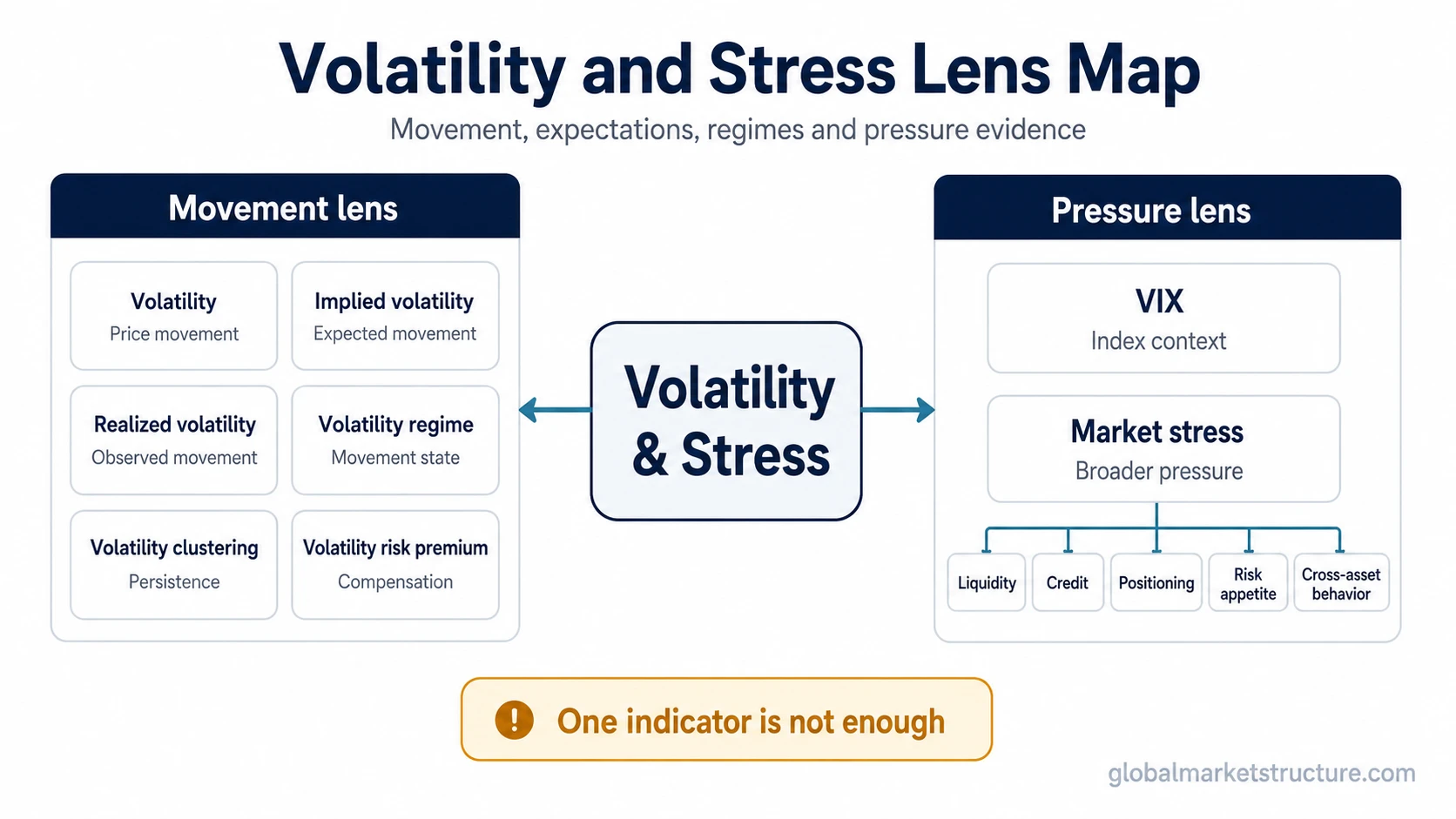
Choose the Right Volatility or Stress Concept
The correct route depends on what is being measured or interpreted. Movement, expected movement, observed movement, persistence, compensation, and broader market pressure belong to different concepts.
| Market question | Concept to use | What it focuses on |
|---|---|---|
| How much are markets moving? | Volatility | The size and pattern of price movement across markets. |
| What movement is priced into options? | Implied volatility | Market-priced expectations for future movement. |
| What movement already happened? | Realized volatility | Observed price movement over a past measurement window. |
| What volatility state is the market in? | Volatility regime | The broader volatility environment rather than one isolated move. |
| Why does volatility persist after shocks? | Volatility clustering | The tendency for high-volatility and low-volatility periods to cluster. |
| How is volatility risk compensated? | Volatility risk premium | The compensation associated with bearing volatility risk. |
| Is pressure broader than movement alone? | Market stress | Pressure across volatility, liquidity, credit, positioning and risk appetite. |
| What does the common equity volatility index represent? | VIX | An index-based measure of expected S&P 500 volatility derived from options. |
When Volatility Carries More Stress Information
A volatility spike can accompany ordinary repricing, event uncertainty, changing option demand, or a broader deterioration in market conditions. The stress interpretation becomes stronger when pressure appears across additional channels rather than remaining confined to price movement.
| Pressure lens | What to examine | Why it changes the reading |
|---|---|---|
| Risk appetite | Whether markets continue to reward risk exposure or defensive behavior becomes more widespread. | A broad change in risk preference gives the volatility move more context than price movement alone. |
| Liquidity pressure | Whether depth, spreads, market impact, or trading conditions deteriorate. | Larger movement has a different meaning when markets become less able to absorb trading activity. |
| Credit pressure | Whether credit risk and financing conditions are deteriorating alongside the volatility move. | Credit confirmation shows that repricing is extending beyond one market or one volatility measure. |
| Positioning pressure | Whether crowded exposure, leverage, or forced adjustment is amplifying the move. | Positioning can turn an initial price adjustment into a broader transmission mechanism. |
| Cross-asset behavior | Whether several markets show compatible signs of pressure. | Cross-market confirmation reduces the chance that the reading is specific to one asset or one isolated event. |
A stronger stress reading requires evidence that pressure extends beyond the volatility measure itself. Liquidity, credit, positioning, risk appetite, and cross-asset behavior can strengthen or weaken that interpretation.
Related Analysis Paths
Some questions need a narrower comparison or interaction framework before a broader stress interpretation is useful.
Implied vs realized volatility compares what was priced before a measurement window with the movement that actually occurred.
Volatility spikes focuses on what a sharp change in volatility may signal and what evidence changes the interpretation.
Volatility and liquidity examines how larger price movement interacts with depth, spreads, market impact, and trading conditions.