
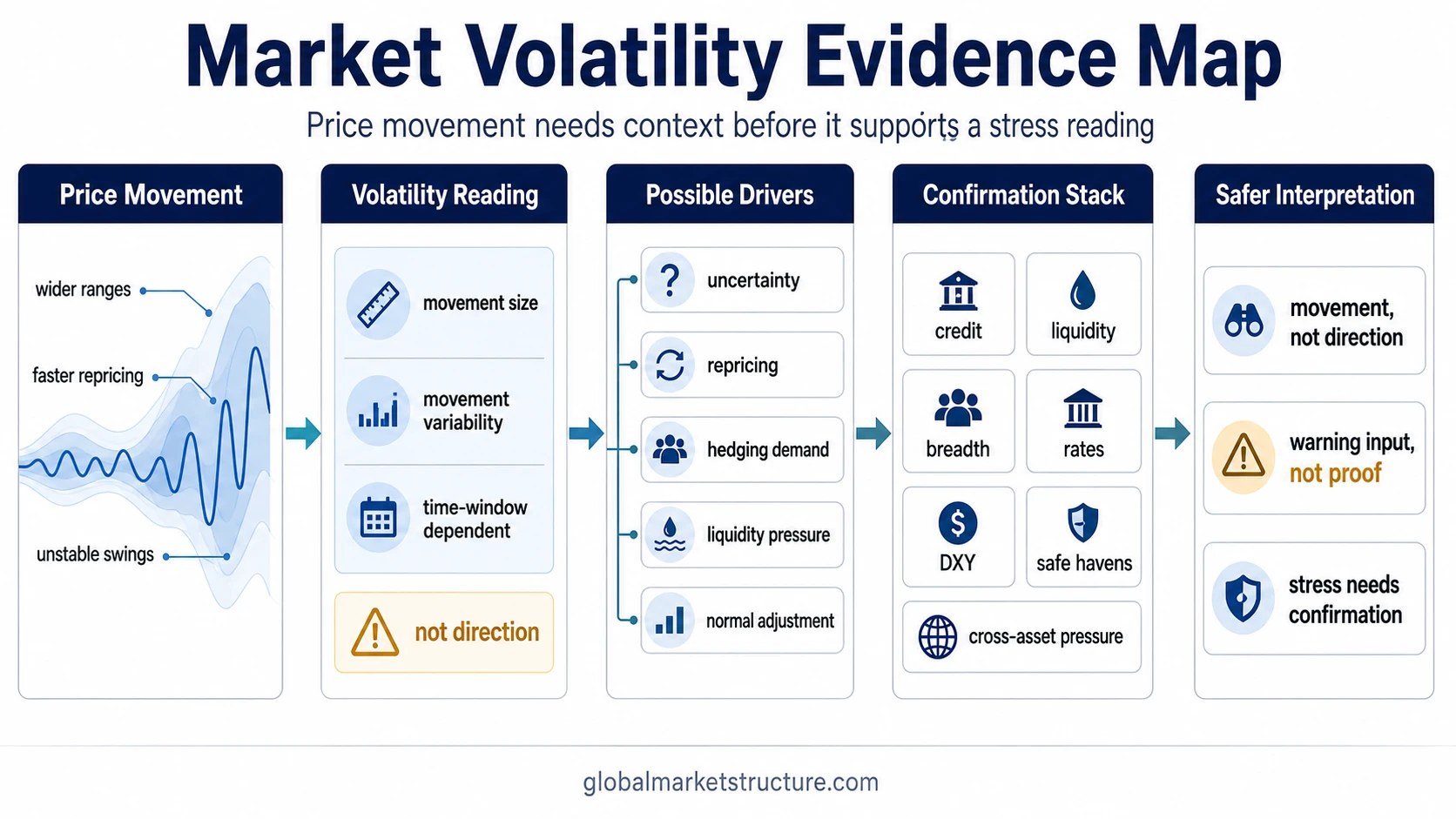
Market volatility describes the size and variability of price movement over a given period. Higher volatility means prices are moving more widely or less steadily. The reading shows how movement has changed, while direction, cause, persistence, and broader market stress require separate evidence.
What Market Volatility Measures
A market with wider price swings, faster repricing, or less stable movement is more volatile than one with smaller and more orderly movement. The same level of volatility can appear while prices are rising, falling, or moving through a broad range.
One describes the magnitude and variability of movement. The other describes the path prices are taking.
How large or unstable price movement has become over the period being observed.
Whether the market is moving higher, lower, or through a range.
How Volatility Appears in Markets
Volatility often first appears as wider ranges, faster repricing, or less stable intraday movement. Those observations establish that price behavior has changed, but they do not identify the driver.
The same pattern can appear around a macro release, earnings uncertainty, policy repricing, positioning adjustments, or thin liquidity. It can also be a normal adjustment after a quiet period. The cause therefore has to be inferred from the surrounding market evidence rather than from the volatility reading alone.
Market Volatility and Related Measures
| Concept | Main measurement | Analytical job | Boundary |
|---|---|---|---|
| Market volatility | The size and variability of market price movement. | Describe how active, wide, or unstable market movement has become. | Does not establish direction or a broader stress condition by itself. |
| Realized volatility | Movement already observed over a completed measurement window. | Measure how much price actually moved. | Does not determine what future volatility will be. |
| Implied volatility | Volatility inferred from option prices for a future horizon. | Show how option markets are pricing expected movement. | Does not specify the direction of the underlying move. |
| VIX | An equity volatility benchmark derived from S&P 500 option prices. | Summarize part of the equity-index volatility environment. | Does not represent the entire global volatility landscape. |
| Volatility spike | A sudden short-term increase in volatility. | Identify an abrupt expansion in movement or repricing. | Does not establish panic, crash risk, or a broad risk-off regime. |
| Market stress | A broader condition involving several market channels. | Assess whether pressure is spreading beyond one volatility reading. | Requires evidence from other parts of the market. |
Common Misreads of Market Volatility
| Common reading | Analytical boundary |
|---|---|
| High volatility means fear. | Fear can contribute to larger movement, but event risk, repricing, hedging activity, positioning, and liquidity changes can produce a similar result. |
| High volatility means prices will fall. | The size of price movement does not determine its direction. |
| Low volatility means the market is safe. | Quiet movement does not establish the condition of liquidity, credit, positioning, or future risk. |
| A volatility spike confirms risk-off conditions. | Its meaning depends on duration, source, persistence, and confirmation from other market channels. |
| Volatility is a complete trading signal. | A volatility reading does not supply direction, entry, exit, or regime confirmation on its own. |
When Volatility Supports a Broader Stress Reading
A rise in volatility becomes more informative when other parts of the market begin to deteriorate at the same time. Credit can show whether risk pricing is spreading. Liquidity can show whether the market is becoming harder to transact in without larger price impact. Breadth indicates whether weakness is narrow or broadly shared. Rates, DXY, and cross-asset behavior can show whether the pressure extends beyond the market that moved first.
Price movement expands and volatility rises relative to the recent environment.
Credit, liquidity, breadth, rates, DXY, or other markets remain stable or send mixed signals.
The move may still reflect localized repricing rather than a broad deterioration in market conditions.
If several channels deteriorate together, the evidence for a broader stress environment becomes stronger. That conclusion comes from the combination of observations rather than from a higher volatility reading alone.
Related Volatility Concepts
Use Implied volatility when the question concerns volatility being priced through options before the outcome is known.
Use VIX when the question concerns expected S&P 500 volatility derived from index option prices.
Use volatility-spike interpretation when the speed, duration, and broader meaning of a sharp increase in movement are the main question.
Use volatility and liquidity when the question concerns whether larger movement is occurring alongside changing market depth and trading conditions.