
Macro drivers are broad economic and policy forces used to interpret market conditions. They organize questions about growth, inflation, labor demand, policy reaction, earnings pressure, housing sensitivity, liquidity, rates, credit, and risk appetite. Their useful role is category selection: context for market interpretation, not forecasts, trading signals, or live dashboard outputs.
Macro drivers describe the forces that shape the broad market environment rather than one company, one trade setup, or one asset in isolation. A driver can affect market pricing through growth expectations, inflation pressure, policy response, credit conditions, liquidity, earnings assumptions, or risk appetite.
The practical distinction is simple: a driver identifies the type of question being asked. It does not determine the market outcome by itself. The same market move can mean different things when inflation pressure, growth weakness, liquidity stress, or policy repricing is the main force underneath it.
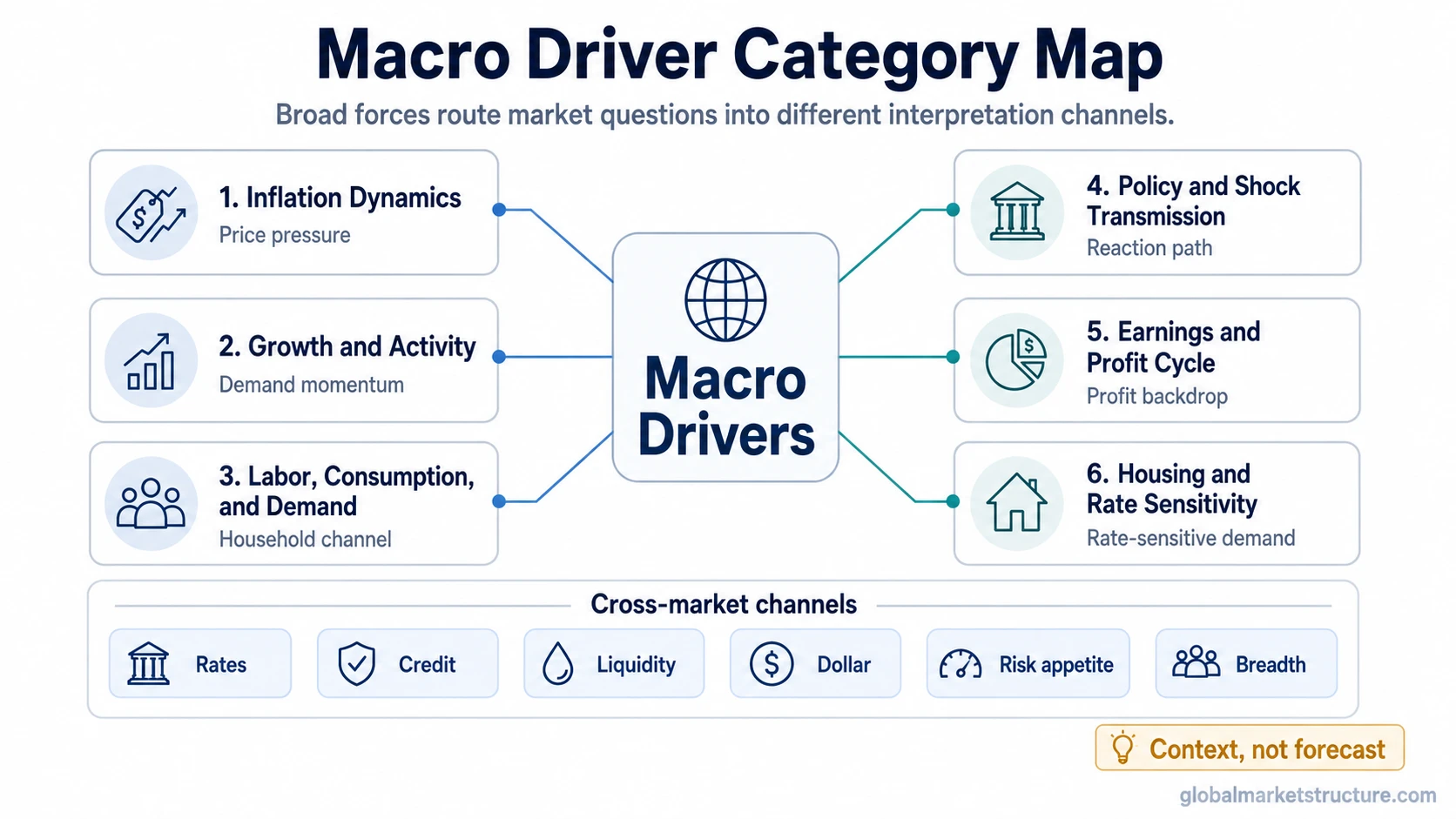
Macro Driver Categories
Macro driver categories make the market question easier to separate. Inflation pressure points toward price dynamics. Growth weakness points toward activity and demand. Policy shifts point toward transmission channels. Earnings pressure, housing sensitivity, liquidity, rates, credit, and risk appetite each add a different interpretation layer.
| Driver question | Market interpretation channel | Go deeper |
|---|---|---|
| Are price pressures changing the discount-rate and purchasing-power backdrop? | Inflation expectations, real-rate pressure, policy sensitivity, and margin pressure | Inflation Dynamics |
| Is economic activity accelerating, slowing, or becoming uneven? | Growth expectations, cyclical demand, risk appetite, and earnings assumptions | Growth and Activity |
| Are labor income, consumption, and demand conditions strengthening or weakening? | Household demand, wage pressure, service activity, and recession sensitivity | Labor, Consumption, and Demand |
| Is policy reaction or an external shock changing the transmission path? | Central-bank reaction, fiscal impulse, geopolitical shock, supply shock, and confidence channel | Policy and Shock Transmission |
| Are profits, margins, or earnings expectations changing the equity backdrop? | Revenue growth, margin pressure, earnings revisions, and profit-cycle sensitivity | Earnings and Profit Cycle |
| Are housing, credit costs, or rate sensitivity affecting demand? | Mortgage rates, construction activity, household balance sheets, and rate-sensitive sectors | Housing and Rate Sensitivity |
How Macro Drivers Reach Markets
Markets often translate broad conditions through pricing channels. Inflation can affect real yields and policy expectations. Growth can affect earnings assumptions and credit risk. Labor and consumption can affect demand durability. Housing can reveal rate sensitivity. Liquidity and credit conditions can change how easily risk is financed.
| Market channel | What it can change | Main interpretation risk |
|---|---|---|
| Rates and discount rates | Valuation pressure, duration sensitivity, and policy expectations | A yield move may reflect growth repricing, inflation concern, supply pressure, policy expectations, or changes in estimated term premium. |
| Credit and funding | Risk compensation, financing conditions, and stress sensitivity | Calm equity prices may coexist with tighter credit conditions, especially when risk appetite has not yet adjusted. |
| Earnings and margins | Profit expectations, sector leadership, and cyclical sensitivity | Strong nominal growth can still pressure margins if costs rise faster than revenue. |
| Liquidity and risk appetite | Cross-asset behavior, breadth, volatility, and positioning | Liquidity conditions can support risk-taking until policy, credit, or funding conditions shift. |
| Currency and global flows | Dollar pressure, imported inflation, capital movement, and emerging-market sensitivity | A stronger dollar can reflect safety demand, rate differentials, or global liquidity pressure. |
Macro Drivers Are Not Forecasts
Macro drivers create context, not certainty. Growth, inflation, policy, liquidity, and credit signals can point in different directions at the same time. A strong interpretation usually needs interaction across categories rather than one isolated data point.
A driver also differs from a dashboard output. A live data value can describe the latest reading, while the driver category explains which market question the reading belongs to. A single data release, yield move, or currency move does not become a full market view without surrounding context.
| Do not treat macro drivers as | Better interpretation |
|---|---|
| Forecasts | They organize the forces that can influence market pricing, but they do not predict a single path. |
| Trading signals | They frame the environment. They do not provide buy, sell, entry, exit, or timing instructions. |
| Live dashboard outputs | They classify the question behind a reading rather than replace current data sources. |
| Company-specific thesis drivers | They describe broad market conditions, not one firm’s valuation, product cycle, or balance-sheet story. |
Choosing the Right Macro Driver Category
Start with the pressure point. If the question is about prices, purchasing power, real yields, or central-bank reaction, begin with inflation. If the question is about demand, production, services, or recession sensitivity, begin with growth and activity. If the question is about household income, wages, or spending durability, begin with labor and consumption.
Policy and shock transmission become central when the market is reacting to central-bank decisions, fiscal impulses, supply disruptions, or geopolitical stress. Earnings and profit-cycle conditions become central when the macro question reaches margins, revenue expectations, or equity leadership. Housing and rate sensitivity become central when borrowing costs, mortgage activity, construction, or household balance sheets are the pressure point.
Use inflation when: the main issue is price pressure, real yields, purchasing power, or the policy reaction function.
Use growth when: the main issue is demand strength, activity momentum, cyclical slowdown, or expansion risk.
Use labor and consumption when: the main issue is household income, spending resilience, wage pressure, or demand durability.
Use policy and shock transmission when: the main issue is how a policy decision, fiscal impulse, supply shock, or geopolitical event moves through markets.
Use earnings and profits when: the main issue is margin pressure, earnings revisions, sector leadership, or the profit cycle.
Use housing and rate sensitivity when: the main issue is mortgage costs, construction, household leverage, or rate-sensitive demand.
Macro Drivers Work Best in Combination
One category rarely carries the whole interpretation. Inflation can be cooling while growth is also weakening. Earnings can hold up while credit conditions begin to tighten. Housing can weaken before broader employment data deteriorates. Policy can ease financial conditions in one channel while liquidity remains tight in another.
A stronger macro reading separates the visible market move from the possible driver mix. A falling yield can reflect lower inflation expectations, weaker growth, safety demand, or policy repricing. A stronger equity market can reflect earnings strength, easier liquidity, falling discount rates, or narrow positioning pressure. The driver category helps identify what needs confirmation next.
Next category paths: inflation pressure, growth momentum, labor demand, policy transmission, profit-cycle pressure, and housing sensitivity each belong to a different interpretation path. The useful starting point is the driver that best matches the market question being asked.