
Earnings and profit cycle connects earnings revisions, profit margins, margin compression, operating leverage, earnings recession, and earnings season within macro-driver interpretation. The useful starting point is not a market forecast. It is choosing which earnings or profitability lens answers the question: estimates, margins, margin pressure, earnings sensitivity, aggregate contraction, or reporting-season information flow.
Definition: The earnings and profit cycle describes how expected earnings, realized profitability, margin pressure, operating leverage, and reporting events move through the broader market environment. It helps organize earnings-related signals without treating any single signal as automatic proof of recession, asset direction, or market timing.
Key Points
- The topic separates estimate changes, profitability levels, margin pressure, earnings sensitivity, aggregate contraction, and reporting-season effects.
- Each concept answers a different macro-driver question, so the correct next step depends on the question being asked.
- Earnings-cycle interpretation is conditional. It can support regime analysis, but it does not produce a direct market signal.
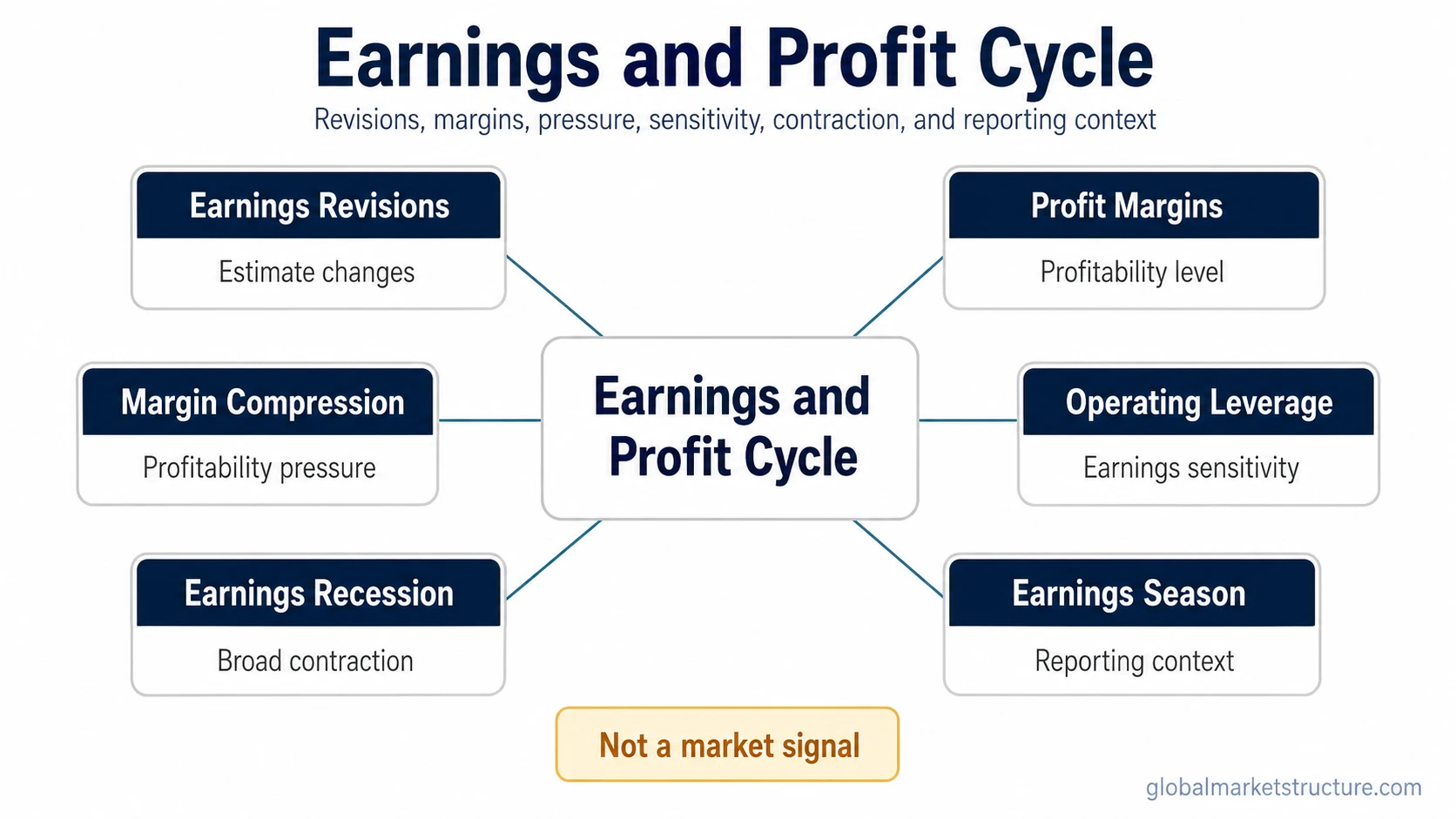
Choose the Right Earnings and Profit Concept
Different earnings questions need different destinations. Analyst estimate changes, profitability pressure, operating leverage, and aggregate earnings contraction are related, but they do not measure the same part of the cycle.
| User question | Best concept | Why it fits |
|---|---|---|
| Are analyst expectations moving higher or lower? | earnings revisions | Revisions focus on changes in forward earnings expectations, not only reported results. |
| How much profit is being produced from revenue? | profit margins | Margins show the profitability layer behind sales, costs, pricing power, and operating pressure. |
| Are costs, pricing, or demand reducing profitability? | margin compression | Compression focuses on the narrowing of margins and the conditions that can pressure earnings quality. |
| How sensitive are earnings to a change in revenue? | operating leverage | Operating leverage explains why earnings can change faster than revenue when fixed costs matter. |
| Has the aggregate earnings backdrop moved into contraction? | earnings recession | Earnings recession focuses on broad earnings contraction, not official economic recession dating. |
| Is the question about the reporting window itself? | earnings season | Earnings season is the reporting-event layer where results, guidance, and revisions can reset expectations. |
How Earnings and Profit Cycle Concepts Fit Together
The earnings and profit cycle works best as a set of connected lenses. Earnings revisions describe how expectations are changing. Profit margins describe the profitability level. Margin compression describes pressure on that profitability. Operating leverage explains why small changes in revenue can create larger earnings effects when cost structures are fixed.
Earnings recession sits at the aggregate contraction layer. It becomes relevant when the question is no longer only about one company, one sector, or one reporting season, but about whether broad earnings momentum has weakened across the market. Earnings season is different because it is the event window where results and guidance can change the information set.
Boundary: The earnings and profit cycle is not the same as the full business cycle. Earnings can weaken before, during, or after broader economic deterioration, and official recession dating belongs to a different analytical layer.
Common False Readings
One common mistake is treating weaker earnings expectations as a direct market forecast. Earnings deterioration can matter for valuation, risk appetite, and regime interpretation, but the market response also depends on liquidity, rates, positioning, credit conditions, and how much weakness was already priced in.
Limitation: A weak profit cycle does not automatically prove that asset prices must fall. It can raise pressure on risk assets, but the interpretation remains conditional unless other macro, liquidity, credit, and market-breadth evidence supports the same direction.
Another false reading is treating earnings season as the whole earnings cycle. Reporting season is an information event. The broader cycle also includes estimate revisions before results, margin trends inside the results, operating leverage effects, and the way guidance changes forward expectations.
A third false reading is collapsing profit margins, margin compression, and operating leverage into one idea. Margins describe profitability. Compression describes deterioration in that profitability. Operating leverage describes sensitivity. Keeping those concepts separate makes the cycle easier to interpret without overloading one signal.
Next Earnings and Profit Questions
Start with earnings revisions when the question is about changing expectations. Start with profit margins when the question is about profitability level. Use margin compression when the focus is pressure from costs, pricing, or demand. Use operating leverage when revenue changes may create amplified earnings effects.
Use earnings recession when the concern is aggregate contraction rather than one reporting period. Use earnings season when the question is about the reporting calendar, guidance resets, and the information flow that can change forward expectations.
Route logic: Estimate change points to earnings revisions. Profitability level points to profit margins. Profitability pressure points to margin compression. Revenue sensitivity points to operating leverage. Broad contraction points to earnings recession. Reporting-event context points to earnings season.