
Operating leverage describes how fixed operating costs can make operating income respond more strongly than revenue. For profit-cycle analysis, the useful question is not only whether a business has fixed costs, but how the current sales and margin base changes the sensitivity of profits as revenue strengthens or weakens.
Operating leverage in simple terms: fixed costs create the possibility that operating income will move faster than revenue. The strength of that effect is not constant. It depends on the current revenue level, contribution margin, operating-income base, cost flexibility, pricing, and where the business sits relative to break-even.
Operating leverage is a profit-sensitivity mechanism. It is not a stock-market signal, a recession label, or proof that margins will expand or contract.
Operating Leverage in the Profit Cycle
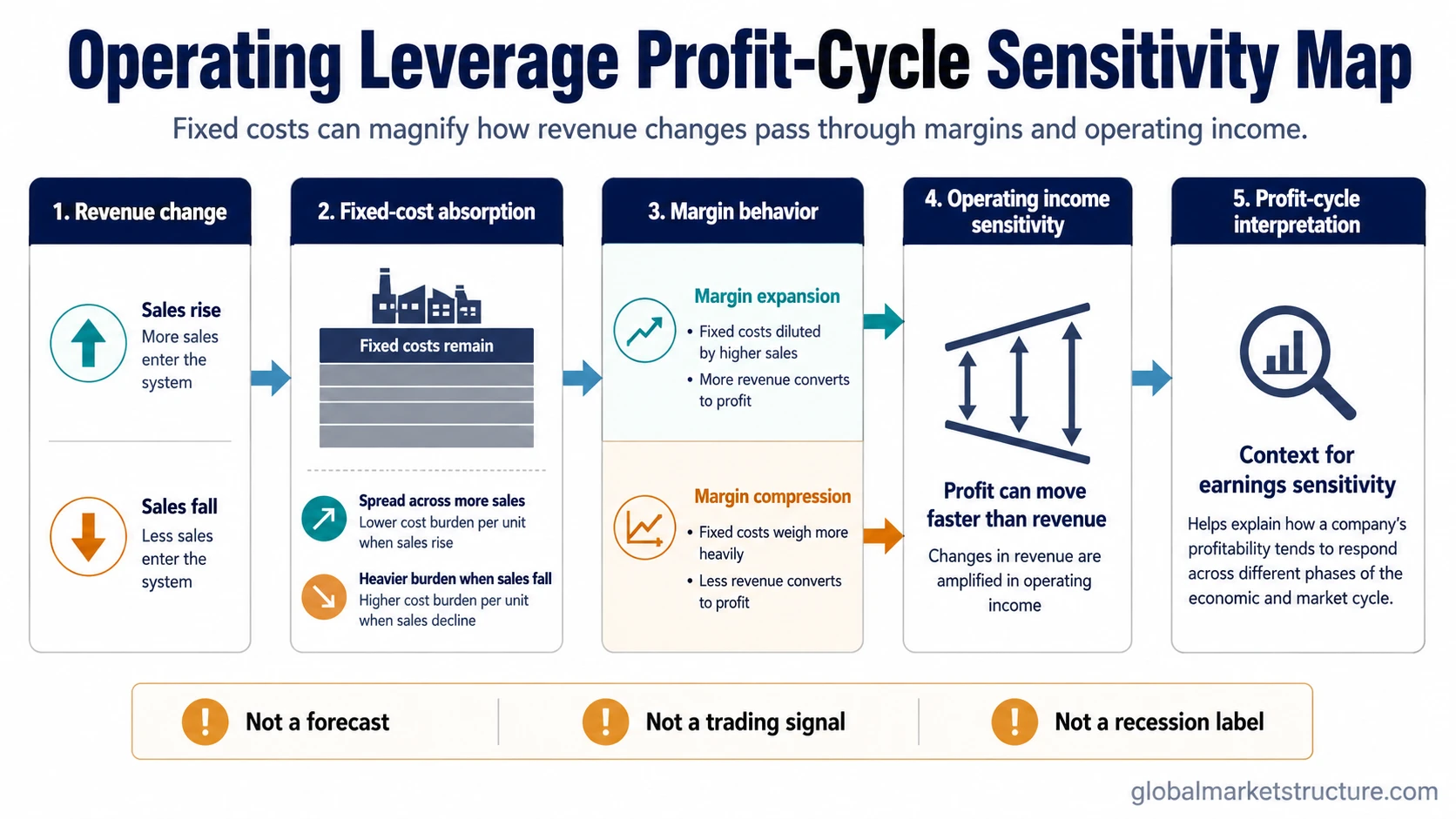
The operating-leverage mechanism starts with revenue and the cost base. Fixed operating costs do not move immediately with every change in sales. When revenue rises, those costs can be spread across a larger sales base. When revenue falls, the same fixed-cost burden can weigh more heavily on operating margins.
| Profit-cycle layer | What changes | Operating-leverage effect |
|---|---|---|
| Revenue | Demand, volume, pricing, or sales mix strengthens or weakens. | Revenue supplies the change that moves through the cost structure. |
| Fixed-cost absorption | The same fixed-cost base is spread across more or fewer sales. | Higher utilization can reduce the fixed-cost burden per unit of revenue. Lower utilization can increase it. |
| Operating margin | Margins expand or compress as revenue and costs move at different rates. | Fixed costs can cause the margin response to become larger than the revenue change alone suggests. |
| Operating income | Profit can rise or fall faster than revenue. | This is the earnings sensitivity that operating leverage is intended to describe. |
| Profit-cycle interpretation | Similar revenue changes can produce different profit outcomes across companies, sectors, or phases of the cycle. | The current margin base and cost structure determine how strongly revenue changes pass through to profits. |
This sequence is why operating leverage matters in an earnings and profit-cycle framework. Revenue weakness does not need to be equally severe across every business to produce large differences in profit pressure. The effect depends on the cost structure and the operating-income base that revenue is moving through.
Fixed-Cost Exposure and DOL Are Not the Same Thing
A high fixed-cost share creates the potential for stronger operating leverage, but the fixed-cost share and the measured degree of operating leverage are not identical concepts.
Fixed-cost exposure describes part of the structure of the business. The degree of operating leverage, or DOL, measures profit sensitivity at a particular operating state or across a particular observed period.
| Measure | Main question | Why it can change |
|---|---|---|
| Fixed-cost share | How much of the operating cost base does not move directly with sales? | Changes when the cost structure itself changes. |
| Degree of operating leverage | How sensitive is operating income to revenue at the current operating state? | Can change even when fixed costs stay the same because revenue, contribution margin, and operating income change. |
This distinction prevents a common false reading. A company does not have one permanent DOL simply because its fixed-cost structure looks stable.
Degree of Operating Leverage Is State-Dependent
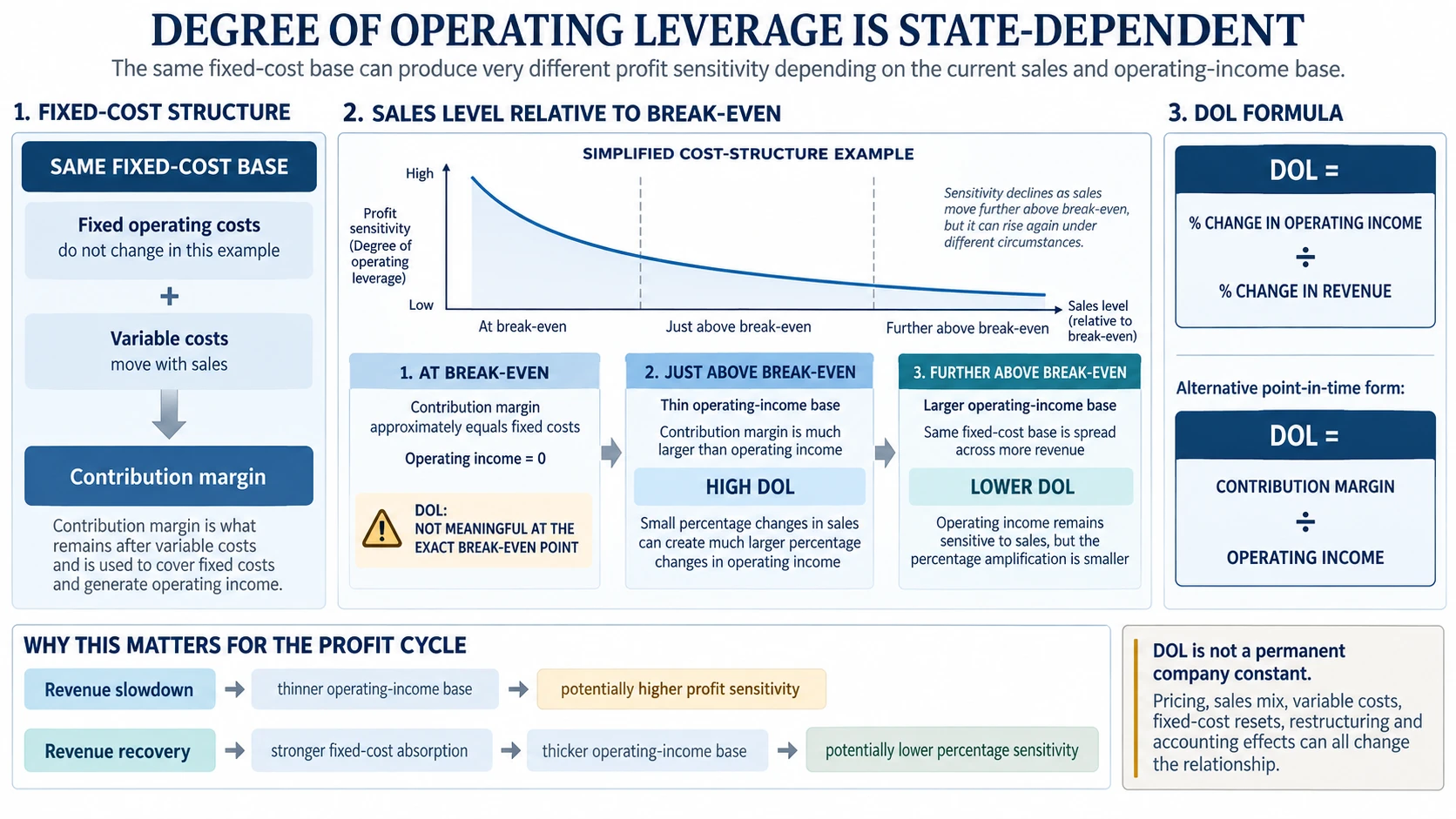
A common way to estimate the degree of operating leverage is:
Degree of operating leverage = percentage change in operating income ÷ percentage change in revenue
In a simplified cost-volume-profit framework, DOL can also be expressed at a given sales level as:
Degree of operating leverage = contribution margin ÷ operating income
The second expression makes an important point visible. DOL depends on the operating-income base. When operating income is thin relative to contribution margin, DOL can be high. When operating income becomes larger, the percentage sensitivity can fall even if fixed costs have not changed.
Illustrative example: assume variable costs remain 60% of sales and fixed operating costs remain 30. The cost structure is unchanged across all three states.
| Sales | Variable costs | Contribution margin | Fixed costs | Operating income | DOL |
|---|---|---|---|---|---|
| 80 | 48 | 32 | 30 | 2 | 16.0 |
| 100 | 60 | 40 | 30 | 10 | 4.0 |
| 120 | 72 | 48 | 30 | 18 | 2.67 |
In this simplified example, break-even sales are 75. At that point contribution margin equals fixed costs and operating income is zero, so the contribution-margin divided by operating-income form of DOL is not meaningful at the exact break-even point.
The important result is that the fixed-cost base remained 30 in every state, while DOL moved from 16.0 to 4.0 to 2.67. Profit sensitivity changed because the business moved through different sales and operating-income levels.
This state dependence is particularly useful in profit-cycle analysis. A thinner operating-income base can make subsequent percentage changes in profit much larger even when the fixed-cost structure itself has not materially changed.
For the standard contribution-margin formulation and operating-leverage treatment at a given sales level, see OpenStax Managerial Accounting.
What Can Change Operating Leverage Through the Cycle?
The sales level is only one input. Real businesses do not keep every assumption constant. Pricing, product mix, variable costs, capacity, staffing, restructuring, and accounting treatment can all change the observed relationship between revenue and operating income.
| Input | Possible change | Why it matters |
|---|---|---|
| Revenue level | Sales move closer to or farther from break-even. | The operating-income base changes, which can materially change DOL. |
| Pricing and mix | Revenue composition or unit economics change. | A stronger or weaker contribution margin changes fixed-cost absorption. |
| Variable costs | Materials, commissions, fulfillment, or usage-sensitive costs move. | The contribution available to cover fixed costs changes. |
| Fixed-cost reset | Hiring, layoffs, facilities, infrastructure, or capacity investment changes the fixed base. | The underlying operating-leverage structure itself changes. |
| One-time items | Restructuring charges, temporary savings, or accounting effects alter reported operating income. | Observed DOL can look stronger or weaker without representing a durable operating relationship. |
High Operating Leverage vs Low Operating Leverage
High operating leverage is not automatically positive or negative. It describes a stronger potential profit response to changes in revenue. The direction of that response depends on what revenue and margins are doing.
| Environment | Higher operating leverage | Lower operating leverage |
|---|---|---|
| Revenue expansion | Fixed-cost absorption can produce faster operating-income growth and margin expansion. | Costs may rise more closely with revenue, limiting profit amplification. |
| Revenue slowdown | Profit growth can slow faster than sales as fixed costs become harder to absorb. | Greater variable-cost flexibility can soften the profit response. |
| Revenue contraction | Operating income can fall sharply if fixed costs remain while the sales base shrinks. | Profit may still weaken, but a more flexible cost base can reduce fixed-cost pressure. |
| Early recovery | Improved utilization of an existing fixed-cost base can produce strong profit recovery. | Profit recovery may track revenue more closely. |
The current state matters as much as the structural label. A business near break-even and a highly profitable business can have the same broad fixed-cost characteristics but very different measured profit sensitivity.
Operating Leverage, Margin Compression, and Earnings Recession
Operating leverage belongs inside the profit-cycle chain, but it should not absorb the jobs of nearby concepts.
| Concept | Main job | Boundary |
|---|---|---|
| Operating leverage | Explains how revenue changes can be amplified into larger operating-income changes through the cost structure. | It describes sensitivity, not the direction of the whole earnings cycle. |
| margin compression | Describes narrowing profitability margins. | Margins can compress for reasons beyond operating leverage, including pricing pressure, input costs, wages, financing effects, or mix. |
| earnings recession | Describes sustained aggregate earnings contraction under a defined measurement basis. | One company or one high-DOL sector is not enough to establish an aggregate earnings recession. |
The sequence can therefore run from revenue weakness to weaker fixed-cost absorption, then to margin pressure and operating-income deterioration. Whether that becomes a broader earnings-cycle contraction depends on how widespread and persistent the weakness is.
Operating Leverage vs Financial Leverage
Both concepts describe amplification, but they operate at different layers.
| Concept | Source of leverage | Main sensitivity |
|---|---|---|
| Operating leverage | Fixed operating costs | Operating income sensitivity to revenue. |
| Financial leverage | Debt and financing obligations | Earnings or equity sensitivity after financing effects. |
A business can have high operating leverage without carrying heavy debt, and a highly indebted business can have a relatively flexible operating cost structure. Mixing the two makes it harder to identify where the amplification is actually coming from.
Can Operating Leverage Be Estimated From Public Financial Statements?
The revenue and operating-income version of DOL can be estimated from reported financial statements when the periods are reasonably comparable. The result should still be treated carefully because the percentage relationship can be distorted by a low starting profit base, restructuring, acquisitions, accounting changes, business-mix shifts, or temporary expense timing.
The contribution-margin version is often harder to calculate from public filings because companies do not always disclose a clean fixed-versus-variable cost split. That limitation matters when the analysis is trying to interpret the mechanism rather than only the observed revenue-to-operating-income relationship.
Common Misreads
Treating DOL as a permanent company constant. DOL changes with the sales level, operating-income base, pricing, mix, costs, and measurement period.
Assuming more fixed costs always mean a higher measured DOL. Fixed-cost intensity matters, but the current operating-income base also affects the ratio.
Reading strong operating leverage as automatic business strength. Profit amplification can work in both directions and says nothing by itself about demand durability, balance-sheet quality, or valuation.
Turning operating leverage into an earnings-recession signal. It is one transmission channel inside the profit cycle. Aggregate contraction requires broader evidence.
Ignoring cost resets. Companies can add capacity, cut staff, renegotiate contracts, restructure operations, or change business mix. The cost structure itself is not permanently fixed.
How to Use Operating Leverage in Profit-Cycle Interpretation
Operating leverage is most useful as a bridge between revenue conditions and profit outcomes. It helps explain why a modest change in sales can produce a much larger change in operating income, especially when the margin base is thin or fixed costs are difficult to adjust.
At the broader profit-cycle level, the interpretation should also ask how widespread the sensitivity is. Pressure concentrated in one company or one sector has a different meaning from simultaneous revenue weakness, margin pressure, and negative earnings sensitivity across many parts of the market.
Core limitation: operating leverage explains sensitivity. It does not forecast stock returns, determine market direction, prove an economic recession, or establish an earnings recession by itself.
FAQ
What is operating leverage?
Operating leverage is the sensitivity of operating income to revenue changes created by fixed operating costs. Fixed costs can cause operating income to rise or fall faster than revenue as the sales base changes.
Is high operating leverage good or bad?
Neither by itself. Higher operating leverage can amplify profit growth when revenue rises and amplify profit pressure when revenue falls. The result depends on demand, margins, cost flexibility, and the current operating state.
What is the degree of operating leverage?
The degree of operating leverage estimates operating-income sensitivity to revenue. It can be measured as percentage change in operating income divided by percentage change in revenue, or in a simplified cost-volume-profit framework as contribution margin divided by operating income at a given sales level.
Why can DOL change even when fixed costs do not?
DOL depends on the current sales and operating-income base. As a business moves closer to or farther from break-even, contribution margin and operating income change, so the measured sensitivity can change even when the fixed-cost base remains the same.
How is operating leverage different from financial leverage?
Operating leverage comes from fixed operating costs and affects operating-income sensitivity to revenue. Financial leverage comes from debt and financing obligations and affects results after financing costs.
Does operating leverage predict stock returns?
No. Operating leverage helps explain profit sensitivity, but it does not predict stock returns, provide a trading signal, or determine market direction by itself.