
Credit spreads are the extra yield investors require to hold debt with credit risk rather than a lower-risk benchmark. They are usually expressed in basis points and help show how markets are pricing borrower risk, liquidity, uncertainty, and willingness to bear credit exposure.
Definition: A credit spread is the yield premium on a credit instrument relative to an appropriate benchmark. A simple spread can be expressed as the risky bond yield minus a comparable benchmark yield.
Boundary: A credit spread is not a pure measure of expected default losses. It can also contain compensation for liquidity, uncertainty, risk aversion, bond characteristics, and market technicals. It is also different from the total yield a borrower pays.
Terminology: On this page, credit spreads refer to debt-market yield spreads. Options strategies that are also called credit spreads are a different concept.
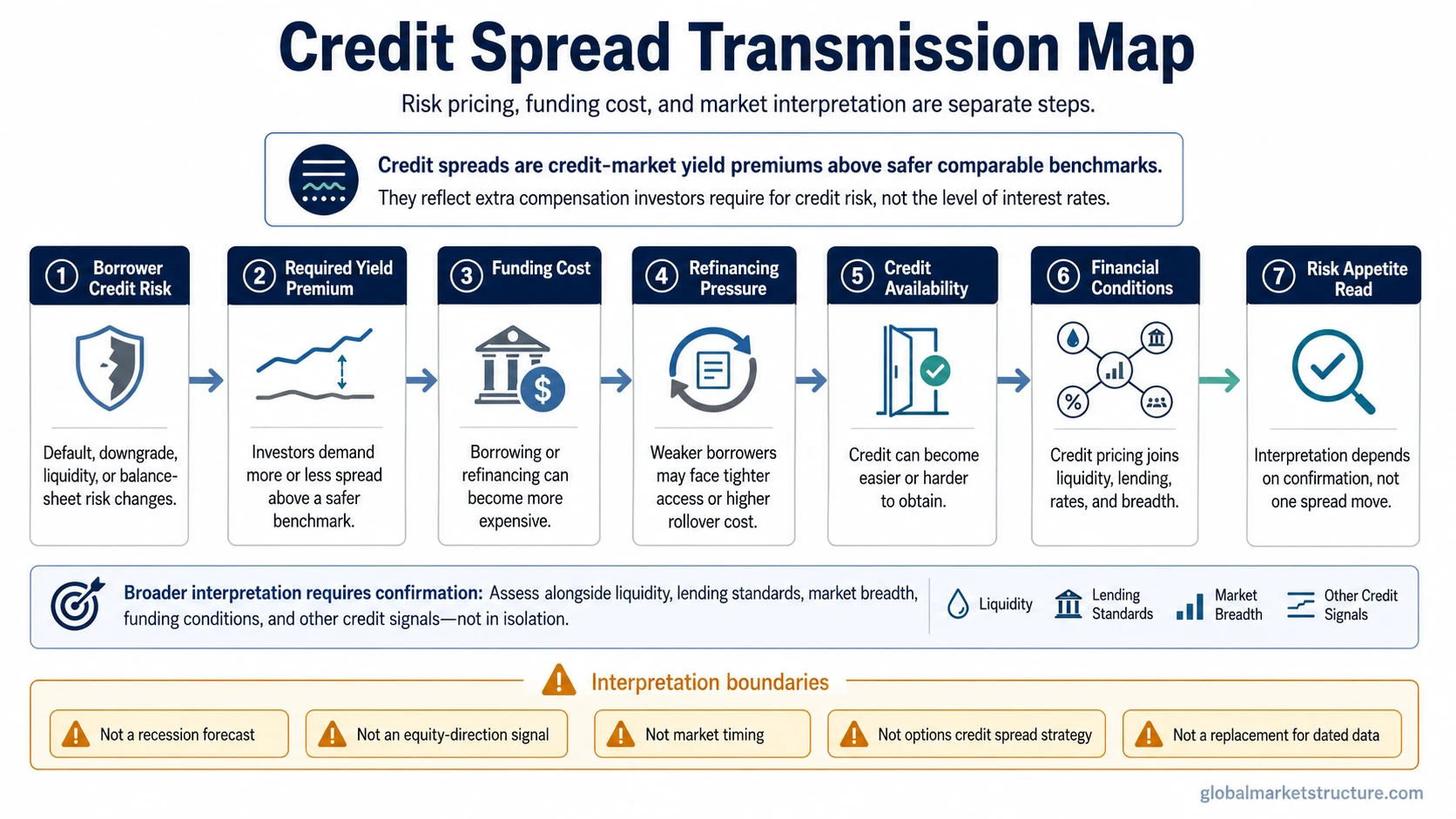
How a Credit Spread Is Calculated
The simplest version compares the yield on a credit-risky bond with the yield on a lower-risk benchmark:
Credit spread = Risky bond yield − Benchmark yield
If a corporate bond yields 6% and the relevant benchmark yields 4%, the simple spread is 2 percentage points, or 200 basis points.
One basis point equals 0.01 percentage point.
| Yield difference | Basis points |
|---|---|
| 0.25 percentage point | 25 bps |
| 0.50 percentage point | 50 bps |
| 1.00 percentage point | 100 bps |
| 2.00 percentage points | 200 bps |
The arithmetic is simple. The measurement depends on the benchmark, maturity, cash-flow structure, embedded options, liquidity, and the methodology behind the spread series.
Why the Benchmark Matters
A yield difference is meaningful only when the comparison is economically appropriate. Comparing bonds with very different maturity or cash-flow characteristics can mix credit information with interest-rate and duration effects.
Corporate spread measures commonly use government or other reference yield curves as benchmarks. More sophisticated measures can compare bond cash flows with a benchmark curve rather than subtracting one single benchmark yield.
Benchmark boundary: Before comparing spread levels, identify the benchmark, currency, maturity or cash-flow treatment, credit universe, and methodology used by the data series.
Simple Yield Spread vs Option-Adjusted Spread
Not every reported credit spread is constructed in the same way. A simple yield spread compares two yield levels directly. An option-adjusted spread, or OAS, measures a spread relative to a benchmark curve after adjusting for embedded optionality under the methodology used by the index or model.
| Spread type | Basic idea | Useful for | Main caution |
|---|---|---|---|
| Simple yield spread | Risky yield minus a selected benchmark yield | Direct, intuitive comparison | Can mix credit effects with differences in cash flows, maturity, or optionality. |
| Option-adjusted spread | Spread relative to a benchmark curve after model-based adjustment for embedded options | Comparing bonds or indexes where optionality matters | Depends on the methodology, curve, and model assumptions. |
A simple spread, an OAS series, and another proprietary spread measure should not be compared as if the numbers were constructed identically.
Credit Spread Is Not the Same as the Borrower’s Total Yield
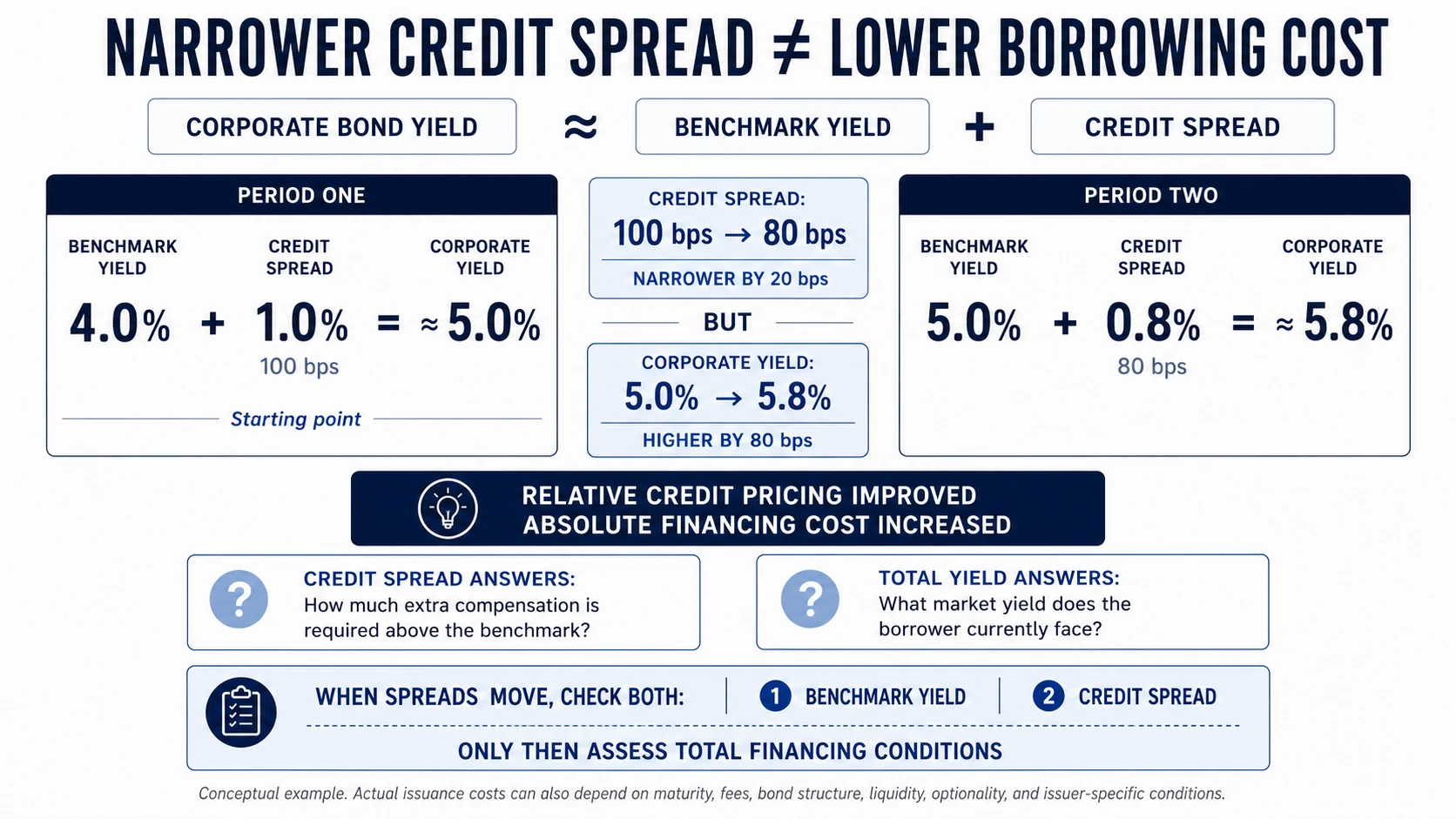
A credit spread measures the premium above the benchmark. The total market yield on corporate debt also depends on the benchmark yield itself.
Conceptually: Corporate yield ≈ Benchmark yield + Credit spread
Illustrative example:
Period one: benchmark yield 4.0% + credit spread 1.0% = corporate yield about 5.0%.
Period two: benchmark yield 5.0% + credit spread 0.8% = corporate yield about 5.8%.
The credit spread narrowed by 20 basis points, but the borrower’s market yield increased by about 80 basis points.
Tighter spreads describe relative credit pricing. They do not establish that absolute financing costs have fallen.
What Is Inside a Credit Spread?
The observed spread can contain several forms of compensation. Their relative importance changes across securities, markets, and economic conditions.
| Spread driver | What it represents | Possible effect |
|---|---|---|
| Expected credit losses | Compensation related to the probability and severity of borrower default | Higher perceived credit risk can widen spreads. |
| Downgrade and uncertainty risk | Compensation for deterioration that may occur before an actual default | Greater uncertainty can raise required compensation. |
| Liquidity premium | Compensation for holding a security that may be harder or more expensive to trade | Better liquidity can compress spreads without equivalent fundamental improvement. |
| Risk premium and risk aversion | Compensation investors require for bearing uncertain credit exposure beyond expected losses | Greater willingness to bear risk can narrow spreads. |
| Market supply and demand | Demand for corporate bonds relative to the amount of debt available to investors | Strong demand relative to supply can put downward pressure on spreads. |
| Market-making and balance-sheet capacity | The ability of intermediaries and investors to absorb or warehouse credit risk | Reduced risk-bearing capacity can contribute to wider spreads or weaker liquidity. |
| Bond-specific structure | Maturity, optionality, coupon structure, seniority, and other instrument characteristics | Can affect comparability across securities and spread measures. |
Because these components can move differently, a narrower spread does not necessarily imply an equivalent improvement in borrower fundamentals. Liquidity, demand, or risk appetite can compress the observed premium even when leverage or cash-flow conditions change little.
Interpretation boundary: This is a conceptual decomposition, not a universal accounting identity. The exact components depend on the model, security, market, and spread methodology.
What Widening and Narrowing Tell You
Direction answers a limited but useful question. Wider spreads mean investors are demanding more compensation above the benchmark. Narrower spreads mean the required premium has fallen.
| Direction | Immediate observation | What still needs diagnosis |
|---|---|---|
| Widening | The required credit premium is increasing. | Whether the move comes from borrower fundamentals, liquidity, risk appetite, refinancing pressure, market technicals, or several channels together. |
| Narrowing | The required credit premium is decreasing. | Whether the move reflects stronger fundamentals, better liquidity, stronger demand, greater risk willingness, or other technical conditions. |
The direction is the observation. The cause has to be diagnosed separately. For the narrower question of why a widening move matters, how starting level and speed change the reading, and what evidence can confirm stress, use the dedicated credit spreads widening framework.
Credit Spreads Inside Financial Conditions
Credit spreads affect the price at which market-based borrowers can raise or refinance debt. A higher required premium makes the credit component of financing more restrictive. A lower premium makes that component more supportive.
Transmission sequence:
- Risk assessment changes: investors reassess credit quality, liquidity, uncertainty, or willingness to bear risk.
- Required spread changes: the yield premium above the benchmark moves.
- Market financing terms change: issuance or refinancing can become more or less expensive.
- Borrower access changes: weaker issuers can become more sensitive to the new financing environment.
- Corporate behavior can respond: investment, hiring, cash retention, refinancing, and balance-sheet decisions can adjust.
Credit spreads are therefore an important component of broader financial conditions index frameworks, but they represent only one channel inside the financing environment.
Market Credit Spreads and Bank Lending Standards Measure Different Channels
Corporate bond spreads describe the compensation demanded by investors in traded debt markets. Bank lending standards describe how banks are changing underwriting criteria, loan availability, collateral requirements, pricing, or other lending terms.
The two can move together during broad credit tightening, but they do not have to. Large companies may retain bond-market access while banks become more restrictive. Bank lending can remain relatively stable while market spreads reprice sharply for lower-quality issuers.
| Signal | Primary market | Main information |
|---|---|---|
| Corporate credit spreads | Market-based debt | Investor-required yield compensation relative to a benchmark |
| Bank lending standards | Bank lending | Lender willingness and terms for extending loans |
Agreement between the channels can strengthen a broad tightening interpretation. Disagreement can show that financing pressure is concentrated in one part of the credit system.
Index Spreads Can Hide Credit-Market Dispersion
A broad credit index compresses many issuers into one aggregate measure. The headline can therefore hide large differences across credit quality, sectors, maturities, and individual borrowers.
Higher-quality borrowers can remain relatively stable while lower-quality issuers experience much larger repricing. The reverse can also occur: a move in one heavily weighted segment can affect an index without representing equivalent deterioration across every issuer.
Aggregation boundary: Before describing credit conditions as broadly tight or loose, check whether the move is widespread across rating and sector groups or concentrated in a narrower part of the market.
Spread Level, Direction, Speed, and Breadth Answer Different Questions
| Dimension | Main question | Why it matters |
|---|---|---|
| Level | How much compensation is currently required? | Shows where pricing sits relative to the chosen benchmark and relevant historical context. |
| Direction | Is the required premium rising or falling? | Shows whether the credit component of financing is becoming more or less restrictive. |
| Speed | How rapidly is repricing occurring? | Separates gradual adjustment from a faster change in liquidity or risk pricing. |
| Breadth | How many sectors or credit-quality groups are participating? | Separates broad credit deterioration from concentrated stress. |
| Fundamental confirmation | Are borrower conditions changing as well? | Helps separate credit-quality deterioration from predominantly technical repricing. |
Why Credit Spreads Can Diverge From Equities
Credit and equity investors have different payoff structures and sensitivities. Credit investors focus heavily on repayment capacity, downside protection, refinancing, and liquidity. Equity investors also price earnings growth, valuation, upside potential, and changing discount rates.
Credit spreads can therefore reprice while major equity indexes remain relatively firm. That divergence shows that different parts of the financial system are placing different prices on risk.
The divergence does not identify which market must eventually be correct. Its value is diagnostic: check whether credit deterioration is broad, whether borrower fundamentals and funding access are weakening, and whether bank lending, liquidity, earnings, and other risk markets confirm the same environment.
How to Read Credit Spreads
- Identify the measure: Determine whether the series is a simple spread, OAS, or another methodology.
- Check the benchmark: Identify the reference curve, maturity treatment, currency, and credit universe.
- Separate spread from total yield: Check whether benchmark rates are reinforcing or offsetting the spread move.
- Measure level, direction, speed, and breadth: Determine whether repricing is mild, rapid, broad, or concentrated.
- Check the driver: Compare the move with borrower fundamentals, liquidity, investor demand, issuance, and market technicals.
- Confirm across credit channels: Compare market spreads with bank lending standards, refinancing conditions, and broader financial conditions.
Current Credit Spread Data and Methodology
Any current spread level should be tied to a dated data series and its exact methodology. High-yield, investment-grade, rating-specific, sector-specific, and option-adjusted spread indexes represent different credit universes and should not be compared without checking their definitions.
Historical comparisons also require methodology discipline. Index composition, issuer weights, average duration, credit-quality mix, optionality, and benchmark construction can change the meaning of a headline spread level over time.
Data rule: Record the source, observation date, benchmark, credit universe, rating category, maturity treatment, and spread methodology before using a current value as evidence.