
Liquidity can describe trading conditions, access to financing, the risk that either channel weakens, or the way liquidity stress spreads through markets. The first step is to identify which liquidity problem is actually being observed.
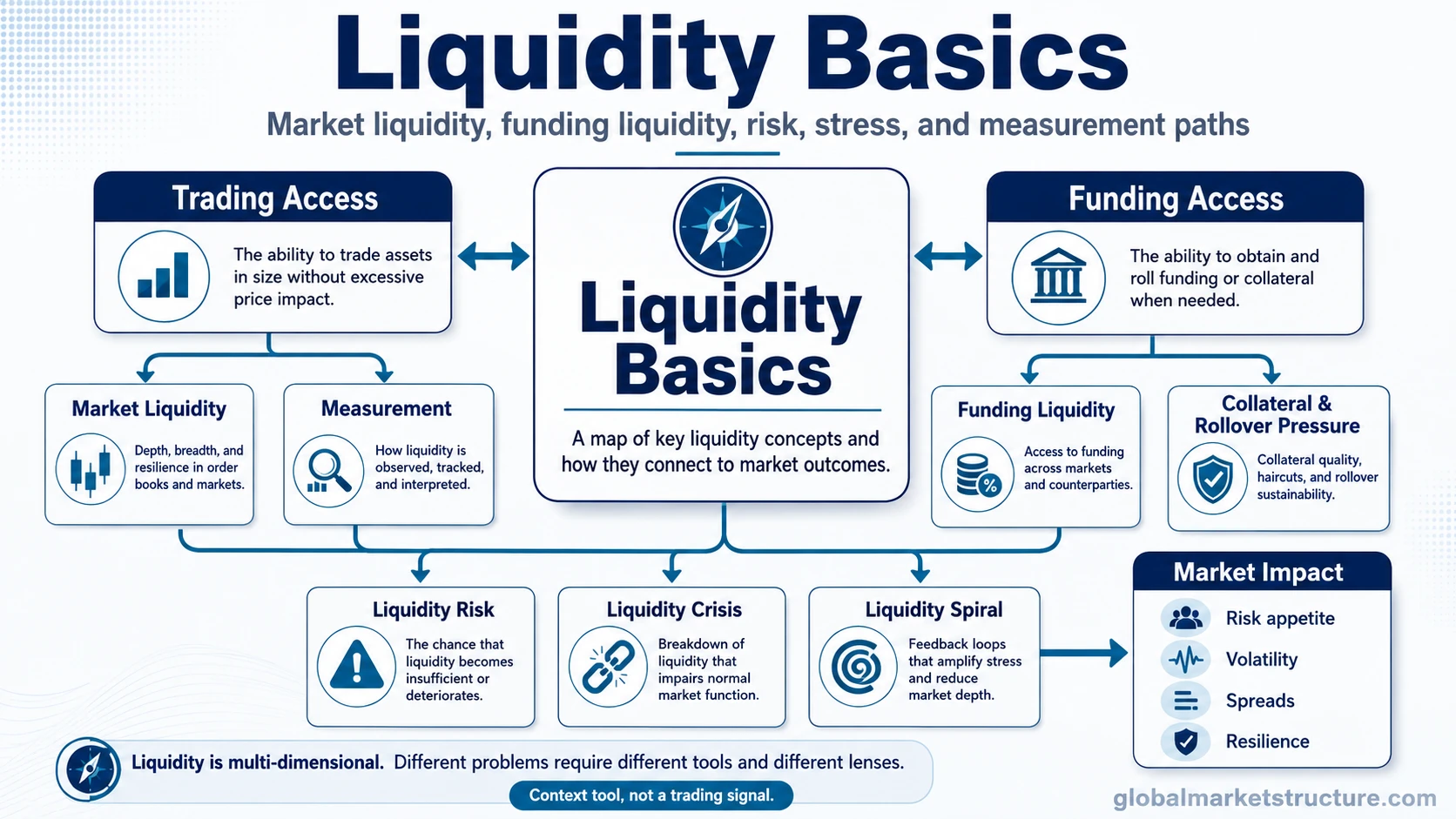
Choose the Liquidity Concept
| Concept | Start here when the question is… | What it clarifies | Destination |
|---|---|---|---|
| Liquidity | What does liquidity mean in market context? | The broad concept and how liquidity differs across trading, funding, and stress conditions. | Liquidity |
| Market Liquidity | Can an asset trade without large cost or price impact? | Spreads, depth, turnover, price impact, and trading conditions. | Market Liquidity |
| Funding Liquidity | Can participants obtain or maintain financing? | Funding access, collateral, leverage, margins, and rollover pressure. | Funding Liquidity |
| Liquidity Risk | What can happen when trading or funding liquidity is unavailable when needed? | The risk created by impaired transaction capacity or financing access. | Liquidity Risk |
| Liquidity Crisis | When has liquidity stress become a broader breakdown? | Severe market or funding dysfunction and wider stress transmission. | Liquidity Crisis |
| Liquidity Spiral | How can liquidity pressure reinforce itself? | Feedback between funding pressure, forced selling, market depth, and collateral conditions. | Liquidity Spiral |
| Market Liquidity vs Funding Liquidity | Which liquidity channel is under pressure? | The distinction between asset-trading conditions and participant-financing conditions. | Market Liquidity vs Funding Liquidity |
| How to Measure Market Liquidity | Which observations describe trading liquidity? | Bid-ask spreads, depth, volume or turnover, price impact, and resiliency. | How to Measure Market Liquidity |
| How Liquidity Affects Markets | How can liquidity conditions transmit into broader market behavior? | Connections between liquidity, volatility, financing capacity, risk-taking, and cross-asset stress. | How Liquidity Affects Markets |
The Federal Reserve Bank of New York distinguishes market liquidity through the cost and time required to trade an asset from funding liquidity through a participant’s ability to raise cash through borrowing. It also notes that weakness in one channel can reinforce weakness in the other. Source: Federal Reserve Bank of New York.
Beyond Liquidity Basics
Central bank liquidity covers the policy and balance-sheet channel, including reserves, liquidity facilities, quantitative easing, and quantitative tightening. Rates, financial conditions, and credit conditions then widen the analysis beyond the core liquidity definitions in this sub-hub.
Keeping those layers separate matters because trading conditions, private financing access, central-bank liquidity, rates, and credit can move differently even when they eventually interact inside the same market regime.
A liquidity reading becomes more useful after the relevant channel has been identified. Market liquidity, funding liquidity, policy liquidity, credit conditions, and broader financial conditions can reinforce one another or move in different directions.