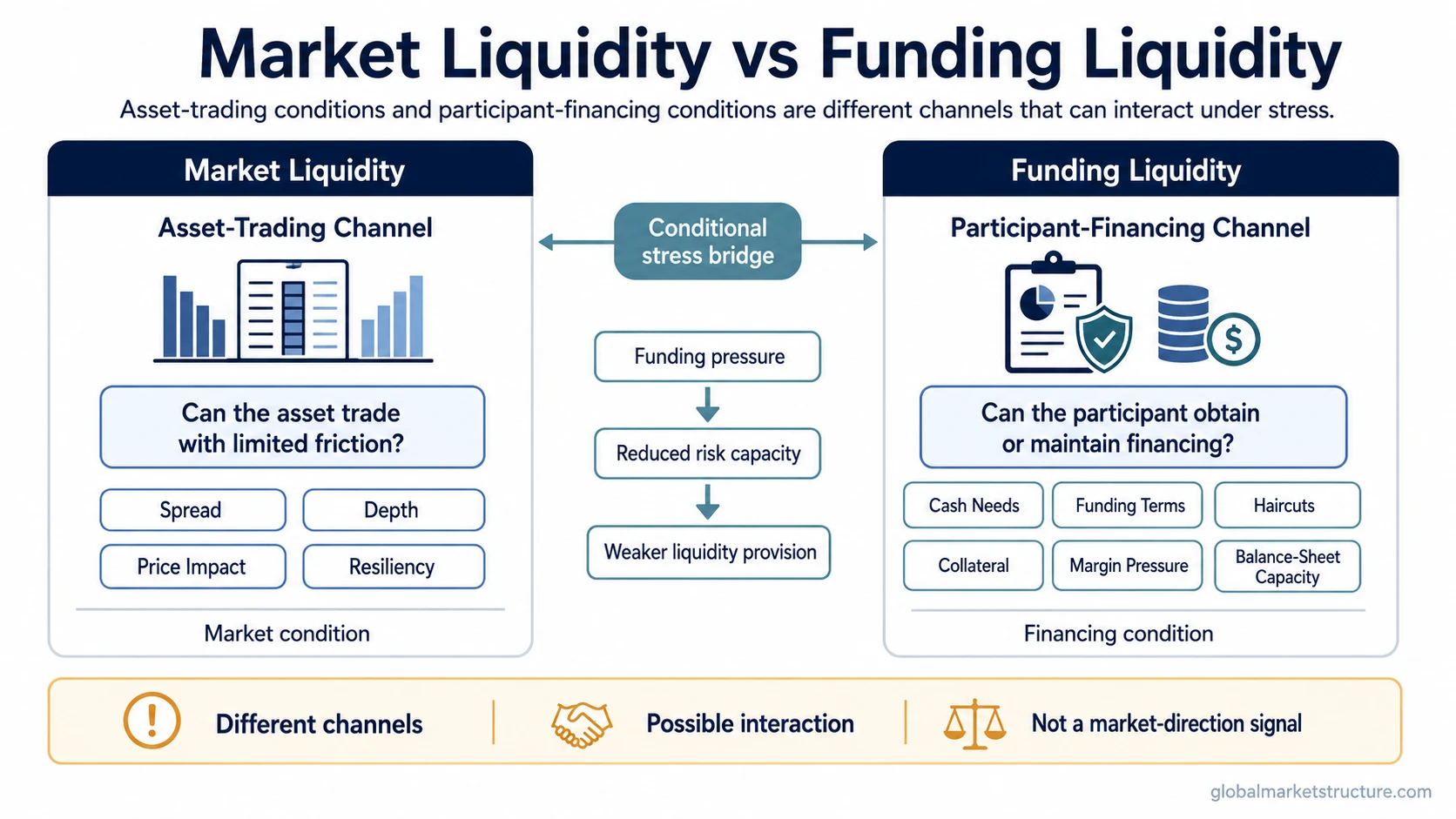
Market liquidity and funding liquidity are related but distinct. Market liquidity refers to how easily an asset can be bought or sold under current trading conditions, with the focus on bid-ask spreads, order book depth, and price impact. Funding liquidity refers to the ability of investors, banks, or other financial actors to obtain cash or financing to initiate, maintain, or refinance positions. One describes trading conditions in the market itself; the other describes access to balance sheet capacity behind those trades.
Key difference at a glance
- Market liquidity is about tradability: how easily positions can be executed without large price disruption.
- Funding liquidity is about financing capacity: whether participants can obtain and maintain the cash, credit, or collateral needed to hold positions.
- Market liquidity stress shows up in spreads, depth, slippage, and price impact.
- Funding liquidity stress shows up in tighter borrowing terms, higher haircuts, margin pressure, and weaker refinancing access.
What each type of liquidity represents
The difference starts with where each concept operates. Market liquidity belongs to the trading layer, where execution depends on how many buyers and sellers are present, how much depth exists at different price levels, and how easily orders can be absorbed without large price changes. It is about tradability.
Funding liquidity belongs to the financing layer, where the key question is whether market participants can access capital, roll borrowing, meet margin requirements, or post acceptable collateral. It is about financial capacity rather than direct execution quality.
This is why the two should not be treated as interchangeable. An asset can trade in a market that still looks reasonably liquid even while the institutions involved are facing tightening financing conditions. In the same way, funding can remain available even when trading conditions deteriorate temporarily in a specific market.
How market liquidity works differently from funding liquidity
Market liquidity is driven by participation inside the market. Tight spreads, visible depth, and continuous two-way quoting usually indicate that buyers and sellers can transact with limited disruption. When that structure weakens, execution becomes more expensive and price moves become more abrupt.
Funding liquidity is driven by access to financing channels. It depends on lender willingness, collateral quality, borrowing terms, leverage limits, and the broader availability of credit. The constraint is not mainly whether an asset can be traded, but whether the capital needed to hold that asset is available on workable terms.
Their constraints therefore look different. Market liquidity deteriorates through wider spreads, thinner depth, and greater slippage. Funding liquidity deteriorates through higher haircuts, tighter margin requirements, reduced leverage tolerance, or less reliable access to short-term financing.
They also differ in visibility. Market liquidity can often be observed directly through execution conditions and price behavior. Funding liquidity is less visible because it sits inside institutional balance sheets and funding arrangements, appearing indirectly through signs such as margin pressure, refinancing difficulty, or forced position reduction.
How market liquidity and funding liquidity overlap
They overlap when financing pressure changes positioning behavior. If funding becomes harder to obtain or maintain, leveraged participants may cut exposure, reduce balance sheet use, or sell assets, and those adjustments can weaken trading depth and execution quality.
They also overlap in the other direction. If trading conditions deteriorate sharply, collateral values become less stable and liquidation risk rises, which can make lenders more cautious and tighten financing terms. That is why the concepts often appear together in stress episodes even though they remain analytically separate.
Why they respond to different pressures
Market liquidity is highly sensitive to order imbalance, volatility, and changes in risk appetite. When uncertainty rises, dealers and other participants may quote more cautiously, reduce inventory, or step back from providing depth. That change appears quickly in spreads and execution quality.
Funding liquidity is more sensitive to financing costs, credit availability, and collateral conditions. Changes in interest rates, lender risk tolerance, or balance sheet constraints can tighten funding even before there is obvious disruption in day-to-day trading.
This difference matters because each type of liquidity can weaken through its own transmission channel. Market liquidity weakens through the mechanics of trading. Funding liquidity weakens through the mechanics of financing. They often interact, but they do not begin from the same source.
How they affect each other
The two concepts are connected because trading activity and financing capacity influence one another. When funding liquidity tightens, leveraged participants may need to reduce exposure, sell assets, or avoid adding risk. Those actions can weigh on trading conditions and reduce market depth, especially when many participants are adjusting at once.
The reverse can also happen. When market liquidity deteriorates, price moves become sharper and collateral values can become less stable. That can lead lenders to demand more collateral, raise haircuts, or reduce financing availability, which in turn makes funding liquidity tighter.
This feedback loop is one reason liquidity stress can intensify quickly. A funding problem can become a market problem, and a market problem can feed back into financing conditions. Even so, the comparison remains clear: the loop links two different layers of the system rather than collapsing them into one concept.
Where confusion usually comes from
Confusion arises because both concepts are described with the word liquidity, even though they answer different questions. Market liquidity asks whether an asset can be traded efficiently at prevailing prices. Funding liquidity asks whether the participant behind the trade can obtain and maintain the financing needed to hold the position.
They also tend to appear together in periods of stress, which makes them sound more similar than they are. During unstable periods, declining market depth, forced selling, tighter collateral terms, and margin pressure may happen at the same time. But co-movement does not mean the concepts are identical.
The distinction becomes clearer when you separate observed trading conditions from underlying balance sheet capacity. Market liquidity is visible in execution. Funding liquidity is visible through financing constraints. That difference is the core of the comparison.
Why the distinction matters in market stress
The distinction matters most when interpreting stress in financial markets. A sharp move in prices does not automatically mean funding is unavailable, just as tighter financing conditions do not always mean markets have already become disorderly. Understanding which layer is under pressure helps explain whether the issue is mainly one of tradability, financing, or an emerging interaction between both.
Market liquidity and funding liquidity can influence each other strongly, but they remain separate concepts with different mechanisms, different constraints, and different ways of showing stress.
Limits and interpretation risks
Reading market liquidity in isolation can understate hidden balance-sheet strain. Execution may still look orderly for a time even while margin pressure, collateral deterioration, or refinancing risk is building underneath the surface.
Reading funding liquidity in isolation can also mislead. Financing conditions can tighten for a specific set of borrowers or intermediaries without immediately producing broad trading dislocation across the whole market.
Another risk is scale confusion. A localized loss of depth in one asset or venue does not automatically signal a systemwide funding problem, and tighter financing terms in one channel do not by themselves prove that overall market liquidity has already broken down.
FAQ
Can market liquidity be strong while funding liquidity is weak?
Yes. Trading conditions can still look orderly for a time even when balance sheet pressure is building in the background. In that case, spreads and depth may not yet fully reflect the financing strain affecting leveraged participants.
Can funding liquidity improve without immediately improving market liquidity?
Yes. Easier financing conditions may support participation, but market liquidity can still stay uneven if volatility remains high or if market makers are cautious about providing depth.
Why are both concepts often discussed during crises?
Because crises often expose the interaction between financing pressure and trading stress. Forced deleveraging, margin calls, and weaker execution conditions can reinforce one another, making both forms of liquidity relevant at the same time.
Is funding liquidity only relevant for banks?
No. It matters for any participant that relies on borrowing, collateral, leverage, or refinancing to hold positions. Banks are central to funding channels, but the concept also matters for hedge funds, dealers, and other leveraged investors.