
Market liquidity is the ability to buy or sell an asset with limited transaction cost and price impact. Stronger liquidity usually combines narrow bid-ask spreads, usable depth near the current price, timely execution, and the ability to absorb ordinary order flow without large disruption.
What Market Liquidity Measures
Market liquidity describes trading quality rather than trading activity alone. The relevant question is how much can trade, how quickly it can trade, and how much the execution itself changes the price.
| Component | What it indicates | Liquidity interpretation |
|---|---|---|
| Bid-ask spread | The gap between the best available buying and selling prices | Narrower spreads generally indicate lower transaction friction; wider spreads can indicate weaker trading conditions. |
| Market depth | The amount of size available near the current price | Deeper markets can usually absorb larger orders before price moves materially. |
| Trading volume | The amount traded over a period | Volume shows activity, but it does not establish how much additional order flow the market can absorb. |
| Execution speed | How quickly a trade can be completed | Fast execution supports a stronger liquidity reading when it does not require sharply worse prices. |
| Price impact | How much price changes as order flow is executed | Lower price impact for a given order size usually indicates stronger market liquidity. |
The Federal Reserve Bank of New York defines market liquidity through the cost in money and time of buying or selling an asset for cash. Federal Reserve research also uses bid-ask spreads, quoted depth, and price impact as measures of different liquidity dimensions. Source: Federal Reserve Bank of New York. Source: Federal Reserve Board.
How Market Liquidity Works
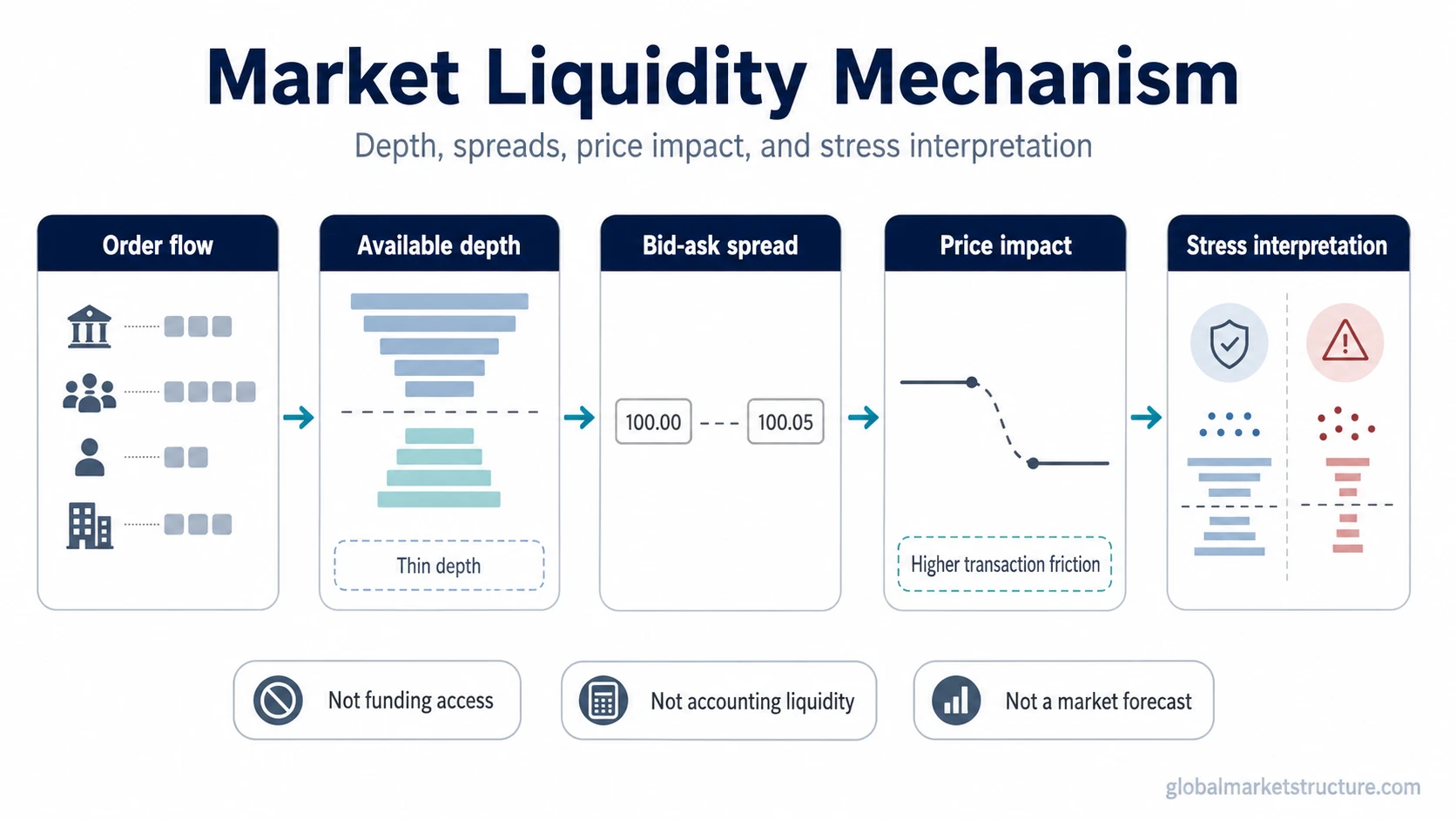
Liquidity changes as incoming orders meet the size available at nearby prices. When two-sided depth is strong, orders can be absorbed with less price movement. When depth thins or participation becomes one-sided, the same order flow can travel through more price levels.
Buyers and sellers provide the prices and size available for immediate execution.
The amount of size near the market determines how much can trade before execution moves to another price level.
Wider spreads or poorer execution increase the cost of completing the trade.
A larger share of the order must execute away from the starting price when nearby liquidity cannot absorb it.
Thin depth can amplify movement in either direction without determining that direction in advance.
Market Liquidity and Other Liquidity Concepts
Liquidity is the broader concept. Market liquidity is the part concerned with trading conditions inside a market.
| Concept | Core question | Main boundary |
|---|---|---|
| Market liquidity | Can an asset trade without large transaction cost or price impact? | Spreads, depth, execution conditions, trading activity, and price impact |
| Funding liquidity | Can a participant obtain financing, roll funding, or meet collateral needs? | Cash access, borrowing, repo, margin, collateral, and balance-sheet capacity |
| Accounting liquidity | Can a company or institution meet near-term obligations? | Current assets, liabilities, and balance-sheet resources |
The dedicated market liquidity vs funding liquidity comparison covers how the trading and financing channels can diverge or reinforce each other under stress.
Why High Volume Can Mislead
Trading volume rises and the market appears highly active.
Spreads widen, available depth falls, or the same order size creates larger price impact.
Activity is high, but the evidence does not support calling the market deeply liquid from volume alone.
Illustrative scenario: A market trades steadily with stable prices, but the order book near the current price is shallow. A larger seller then consumes the nearest bids and must execute through lower levels to find enough demand. The larger price move reflects limited depth relative to the order, while the earlier volume reading did not capture that capacity.
Where Measurement Belongs
Spreads, quoted depth, volume or turnover, execution quality, and price impact can all contribute to a liquidity assessment. The detailed measurement problem belongs in how to measure market liquidity, including the limits of individual proxies and the need to combine them.
Market Liquidity in Broader Market Structure
Market liquidity affects transaction costs and the way order flow is transmitted into prices. When depth weakens, market moves can become more sensitive to new information, position reduction, or forced transactions. That can matter during stress because execution conditions may amplify a move that began for another reason.
Weak liquidity can make price changes more sensitive to order flow in either direction. Direction still depends on the balance of buyers and sellers, new information, positioning, funding conditions, and the wider market environment.