
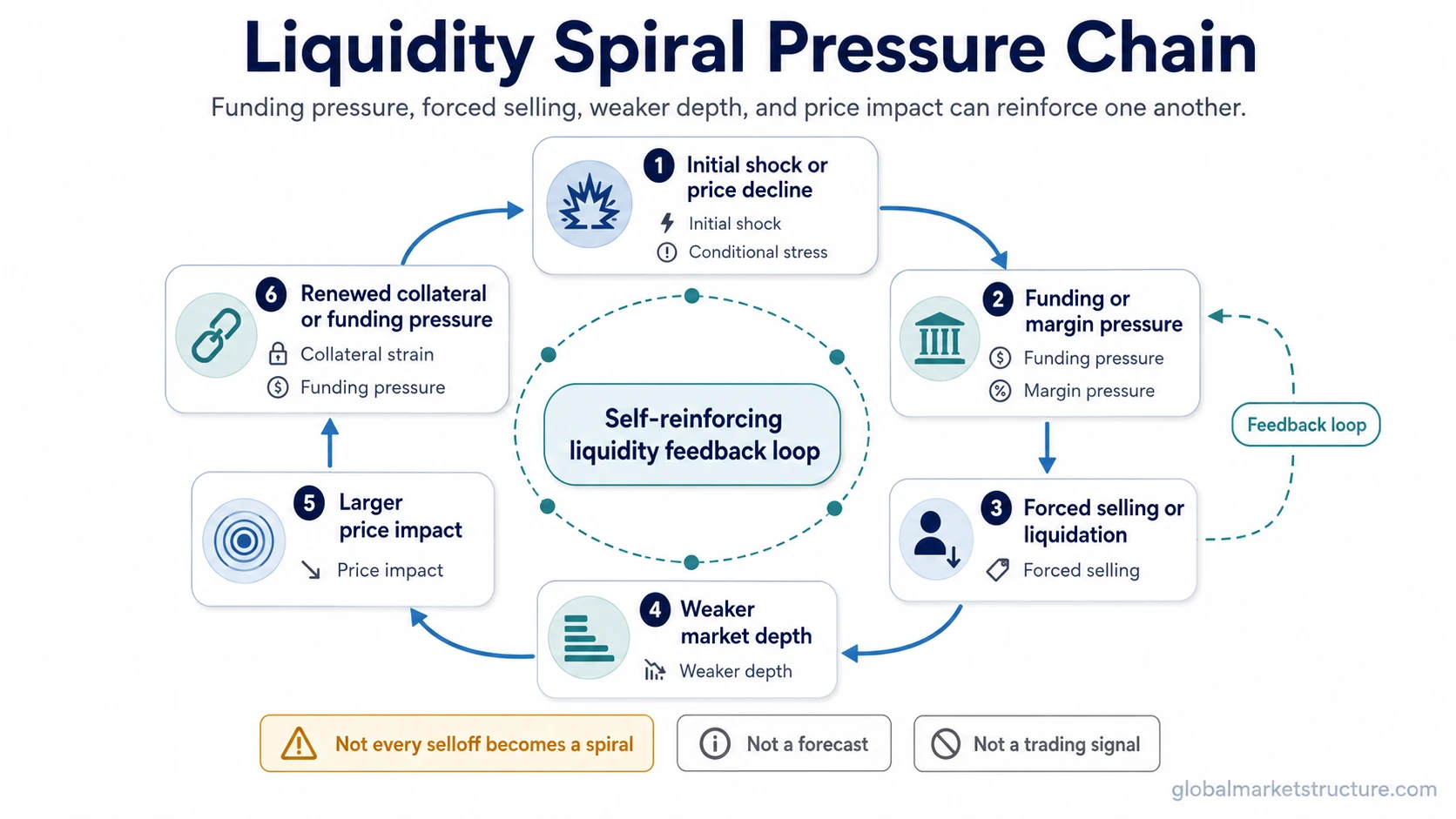
A liquidity spiral is a self-reinforcing feedback loop in which funding pressure and weaker market liquidity amplify each other. Falling prices or tighter financing can force participants to reduce positions; those sales can weaken market depth, push prices lower, and create another round of losses, margin demands, or collateral pressure.
How a Liquidity Spiral Works
An initial price decline or funding shock is not enough by itself. The spiral forms when the response to the first shock creates the next round of pressure.
Losses, tighter financing terms, margin demands, or lower collateral values reduce the capacity to keep positions unchanged.
Assets may be sold to raise cash, reduce leverage, or meet collateral requirements.
If buyers step back or liquidity providers reduce capacity, the same amount of selling can create larger price impact.
Further losses or lower collateral values can tighten funding constraints again.
The process can continue while funding pressure and market illiquidity keep feeding into one another.
Two Amplification Channels Inside the Spiral
- Market conditions deteriorate and financing terms tighten.
- Higher margins or haircuts reduce usable funding capacity.
- Participants cut positions, which can weaken liquidity further.
- Falling prices reduce wealth on existing positions.
- Lower balance-sheet capacity forces additional position reduction.
- More selling can deepen illiquidity and create further losses.
Brunnermeier and Pedersen distinguish a margin spiral from a loss spiral in their model of market and funding liquidity, and show how the mechanisms can reinforce the same liquidity feedback loop. BIS also describes how procyclical increases in margins and haircuts can force deleveraging and additional asset sales. Source: Brunnermeier and Pedersen. Source: BIS.
Market Liquidity and Funding Liquidity in the Loop
Market liquidity describes the ability to trade without creating large price impact. When depth deteriorates, forced transactions can move prices more sharply.
Funding liquidity describes the ability to obtain financing, roll funding, meet obligations, or post collateral. Tighter funding can reduce the capacity to maintain positions through stress.
The spiral connects those two conditions. Funding constraints can force asset sales, while weaker market liquidity can make those sales more disruptive. The resulting price changes can then feed back into collateral values, losses, and funding capacity.
Liquidity Spiral vs Liquidity Crisis
| Concept | Primary meaning | Boundary |
|---|---|---|
| Liquidity spiral | A feedback mechanism in which funding pressure and market illiquidity reinforce each other. | Requires a reinforcing loop, not just falling prices. |
| Liquidity crisis | A broader condition in which liquidity becomes insufficient relative to demand for cash, funding, or tradable depth. | A spiral can contribute to a crisis, but the two terms describe different things. |
| Liquidity pressure | Strain on cash, financing, collateral, or trading depth. | Pressure can remain contained without becoming self-reinforcing. |
| Solvency problem | A condition in which assets or income may be insufficient relative to obligations. | Liquidity stress can occur without proving insolvency. |
When a Selloff Is Not Enough to Call It a Liquidity Spiral
Asset prices decline or volatility rises.
Funding strain, collateral pressure, forced selling, or weaker market depth begins to reinforce the move.
Without that reinforcing channel, the evidence supports a selloff or liquidity pressure rather than a confirmed liquidity spiral.
Illustrative scenario: A leveraged participant suffers a decline in collateral value and faces additional margin demands. Assets are sold to raise cash. If market depth is thin, those sales create larger price impact, which can reduce collateral values again and place similar participants under more pressure. The example describes the mechanism; it is not a claim that every leveraged selloff develops this way.
Where Liquidity Spiral Fits in the Liquidity Framework
The broader concept of liquidity covers the availability of cash, funding, and tradable market depth. Liquidity risk focuses on the possibility that liquidity may become unavailable or more expensive when it is needed.
Liquidity spiral is narrower. It describes the feedback mechanism that can emerge when financing constraints and market illiquidity begin to amplify one another.
The framework does not by itself establish insolvency, recession, a market bottom, or a trading signal. The starting shock, leverage structure, funding terms, collateral, market depth, and possible policy or private-sector responses can all change how far the feedback loop develops.