Liquidity

Liquidity is the capacity of a market or financial system to absorb transactions, transfer risk, and maintain orderly trading without disproportionate price disruption. It is not simply the presence of money or cash in the system. Liquidity depends on whether buyers and sellers can meet directly or through intermediaries, whether orders can be executed near prevailing prices, and whether two-way trading can continue when flows become one-sided.

Seen this way, liquidity is a structural property of market organization rather than a vague synonym for easy conditions. It reflects the interaction between order flow, available counterparties, dealer balance sheets, financing access, collateral quality, and the rules that govern how trades are cleared and settled. A market can look active while still becoming less liquid if the capacity to warehouse risk, finance positions, or maintain continuous execution starts to weaken.

What liquidity includes

Liquidity is not one condition compressed into a single number. Its core dimensions are execution, absorption, price impact, and continuity. Execution refers to whether trades can be completed quickly and near the quoted price. Absorption refers to whether the market can take the other side of meaningful size without immediately exhausting available demand or supply. Price impact refers to how far prices must move to clear that flow. Continuity refers to whether trading remains orderly across time, including during stress, rather than breaking into gaps, pauses, or one-sided conditions.

These dimensions do not always move together. A market may show tight quoted spreads but remain shallow once trade size increases. It may also display visible depth but recover poorly after stress, or stay open while becoming harder to trade without noticeable slippage. That is why liquidity measures only capture parts of the concept rather than the whole of it.

Main forms of liquidity

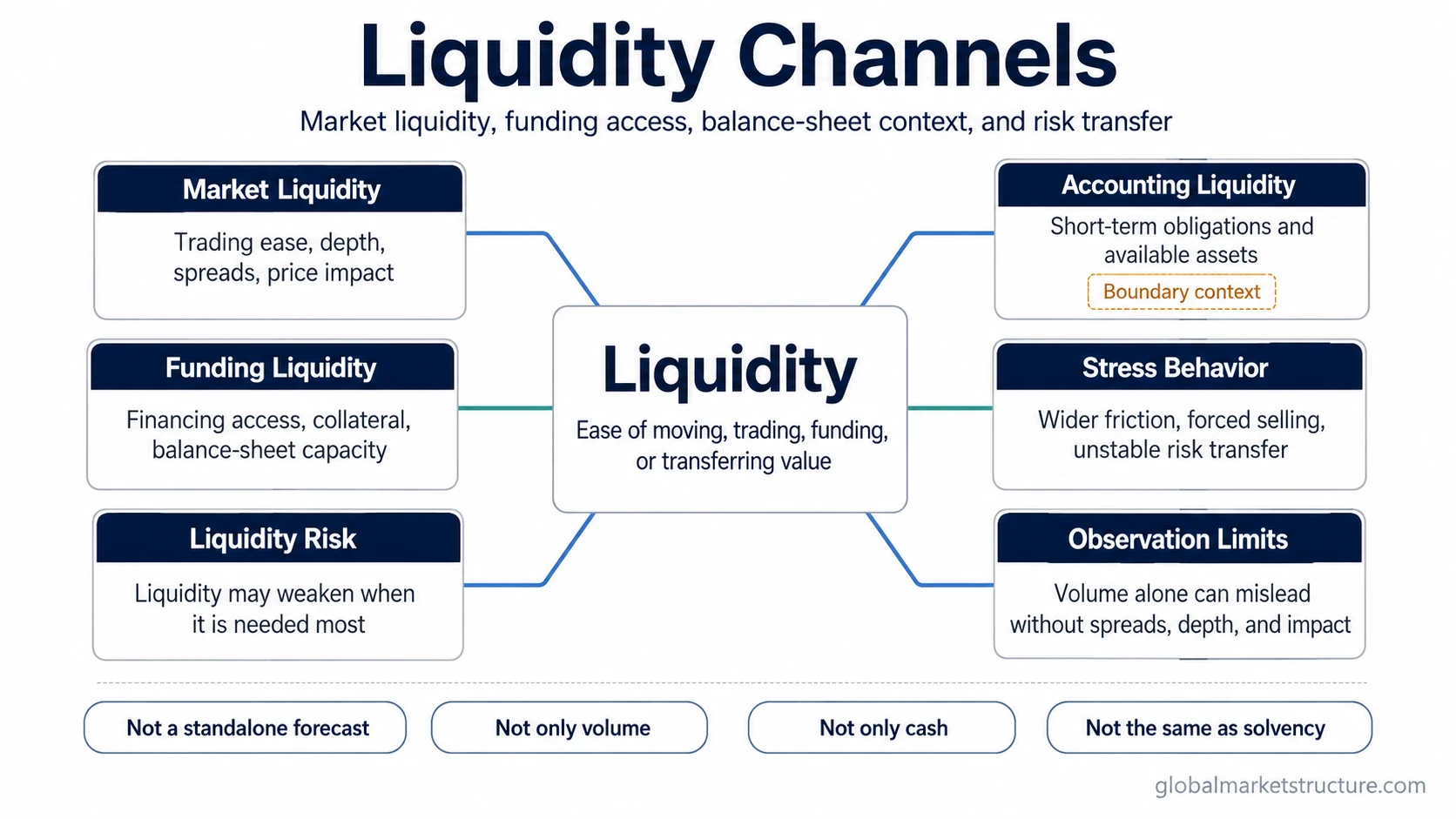
Liquidity appears in more than one functional form. Market liquidity refers to the tradability of assets: the ability to buy or sell with limited price disruption. Funding liquidity refers to the ability of institutions to obtain cash, borrow against collateral, roll short-term liabilities, and keep positions financed through time. A broader system-level layer describes the overall monetary and balance-sheet environment in which both trading and financing take place.

These forms interact but they are not interchangeable. An asset can continue trading while the institutions that normally intermediate it face tighter financing terms. Financing conditions can also remain open while trading depth in a specific instrument deteriorates. Keeping those distinctions clear prevents liquidity from becoming a catch-all term for every market strain.

How liquidity is structured

In practice, liquidity rests on a few core building blocks. The first is participation: a market needs enough buyers, sellers, and intermediaries to keep two-way trading possible. The second is balance-sheet capacity: dealers, market makers, and leveraged investors must be able to absorb temporary inventory without immediately pulling back. The third is funding and collateral: positions usually depend on financing arrangements, margin terms, and assets that can be posted or pledged with confidence.

A fourth structural layer is market design. Some markets rely on continuous order books, while others depend more heavily on dealer intermediation or bilateral negotiation. That difference matters because liquidity behaves differently when it is provided by standing orders than when it is provided by institutions willing to take the other side of flow. Settlement rules, haircut practices, and margin requirements also shape how durable liquidity really is once conditions tighten.

For that reason, liquidity can be classified in more than one way. It can be classified by function, such as trading liquidity versus financing liquidity. It can also be classified by durability, meaning whether liquidity is broad and stable or narrow and conditional on favorable funding, low volatility, and continued risk appetite. A market may therefore look liquid on the surface while relying on fragile underlying support.

How liquidity moves through markets

Liquidity does not sit in one place like a static pool. It moves through the system when counterparties are willing and able to transact, lend, borrow, and post acceptable collateral. Dealers and other intermediaries are central to this process because they bridge timing gaps between buyers and sellers, temporarily absorb inventory, and connect otherwise separate pools of demand.

That movement depends heavily on balance-sheet capacity. When dealers can carry inventory and fund positions efficiently, markets can absorb more flow with less price disruption. When financing tightens, collateral becomes less usable, or risk limits bind, the same market can remain open while becoming less accommodating. This is also why liquidity stress often spreads across instruments rather than staying isolated within one market.

Transmission matters because institutions do not manage assets in isolation. Pressure in one market can affect margin requirements, hedging demand, and financing conditions elsewhere. The result is a networked process in which liquidity conditions travel through collateral chains, funding markets, and shared intermediary balance sheets rather than through a single visible channel. That broader propagation becomes especially important once conditions move toward a liquidity crunch.

What liquidity changes in market behavior

Liquidity shapes how order flow becomes price action. In deeper conditions, markets can absorb new information and rebalancing flows through a larger buffer of counterparties and balance-sheet capacity. Prices still move, but adjustment tends to be more continuous. In thinner conditions, the same volume of buying or selling can create larger displacement because less capital is available to absorb it.

This changes more than transaction cost. It affects how easily positions can be transferred, how much size the market can handle without disruption, and how sensitive prices become to temporary imbalances. When liquidity is strong, execution remains smoother, absorption capacity is wider, price impact is lower, and market continuity is easier to preserve. When liquidity is weak, execution itself becomes part of the price move because the market has less ability to process inventory transfer smoothly.

Liquidity also influences shock absorption. Strong liquidity does not prevent repricing, but it allows more participants to distribute the shock across time and balance sheets. Weak liquidity produces the opposite pattern: fewer risk absorbers, larger price gaps, and greater sensitivity to urgency. That transition helps explain why stress can become self-reinforcing and, in more extreme cases, develop into a liquidity spiral.

When liquidity becomes fragile

Liquidity can appear stable for long periods because it is usually inferred from smooth execution rather than observed directly. Tight spreads and orderly trading do not guarantee durable support underneath. Apparent depth may rely on a narrow set of leveraged intermediaries, favorable funding conditions, or collateral that remains accepted only while confidence holds.

Fragility emerges when that support becomes conditional. Quote sizes may shrink before quoted prices disappear. Trading volume may remain high even as the number of committed counterparties falls. Financing terms may tighten even while markets still print transactions. In that environment, liquidity has not vanished, but it has become more selective, more one-sided, and less reliable under pressure.

Not every volatile market is illiquid, and not every price decline is a liquidity event. The more precise test is whether willingness or capacity to transact at scale has weakened enough to alter the mechanics of price formation. Once execution becomes meaningfully harder, gaps become more common, and risk-bearing retreats, liquidity stops being a background condition and starts shaping market behavior directly.

What liquidity is not

Liquidity should not be reduced to cash balances, monetary aggregates, or rising asset prices. Money availability can support participation, but it does not by itself ensure that assets can be traded efficiently or financed smoothly. High prices can coincide with strong liquidity, but they can also exist in markets where depth is uneven and intermediation capacity is fragile.

Liquidity is also broader than any one indicator and narrower than a full theory of market direction. It explains the conditions under which exchange, financing, and repricing occur. It does not explain every price move on its own, and it should not be used as a vague substitute for sentiment, optimism, or policy stance.

Within Liquidity Basics, liquidity works best as the umbrella concept for market tradability, funding access, measurement, and stress transmission. Narrower questions about trading conditions, financing access, measurement, and stress dynamics need to be separated, because markets can remain liquid in one sense while weakening in another.

FAQ

Is liquidity the same as cash in the financial system?

No. Cash or reserves may support participation, but liquidity is about whether assets can be traded and positions financed without disproportionate disruption to prices, execution, or settlement.

Can a market be active but still have weak liquidity?

Yes. High trading volume does not automatically mean strong liquidity. Activity can stay elevated even while quote sizes shrink, counterparties retreat, and price impact rises.

Why does liquidity matter for volatility?

Because liquidity affects how easily markets absorb order flow. When fewer participants are willing or able to intermediate risk, the same buying or selling pressure can produce larger and faster price moves.

What is the difference between market liquidity and funding liquidity?

Market liquidity concerns how easily an asset can be traded. Funding liquidity concerns whether institutions can obtain cash, borrow against collateral, roll short-term liabilities, and keep positions financed.

Does strong liquidity mean prices will rise?

No. Strong liquidity improves the mechanics of trading and shock absorption, but it does not determine valuation direction. Assets can still fall in highly liquid conditions if expectations or fundamentals deteriorate.