
Liquidity and monetary conditions describe the channels through which funding, central-bank policy, rates, yield curves, dollar pressure, financial conditions, and credit stress shape the market environment. Each channel answers a different question. Liquidity is not a forecast by itself; it becomes useful when the source of pressure, the market response, and the confirming signals are separated.
Liquidity and monetary conditions in one view
Liquidity conditions focus on the ease of funding and transacting. Monetary conditions focus on policy settings, rate expectations, guidance, and balance-sheet effects. Financial conditions show how markets are pricing that environment across rates, credit, currencies, equities, and volatility. Credit signals add a separate stress lens because risk compensation can change before broader narratives adjust.
The useful starting point is the channel, not the label. A change in yields, a firmer dollar, wider credit spreads, or easier policy expectations can point to different parts of the system. Interpretation improves when each signal is assigned to the route it actually belongs to.
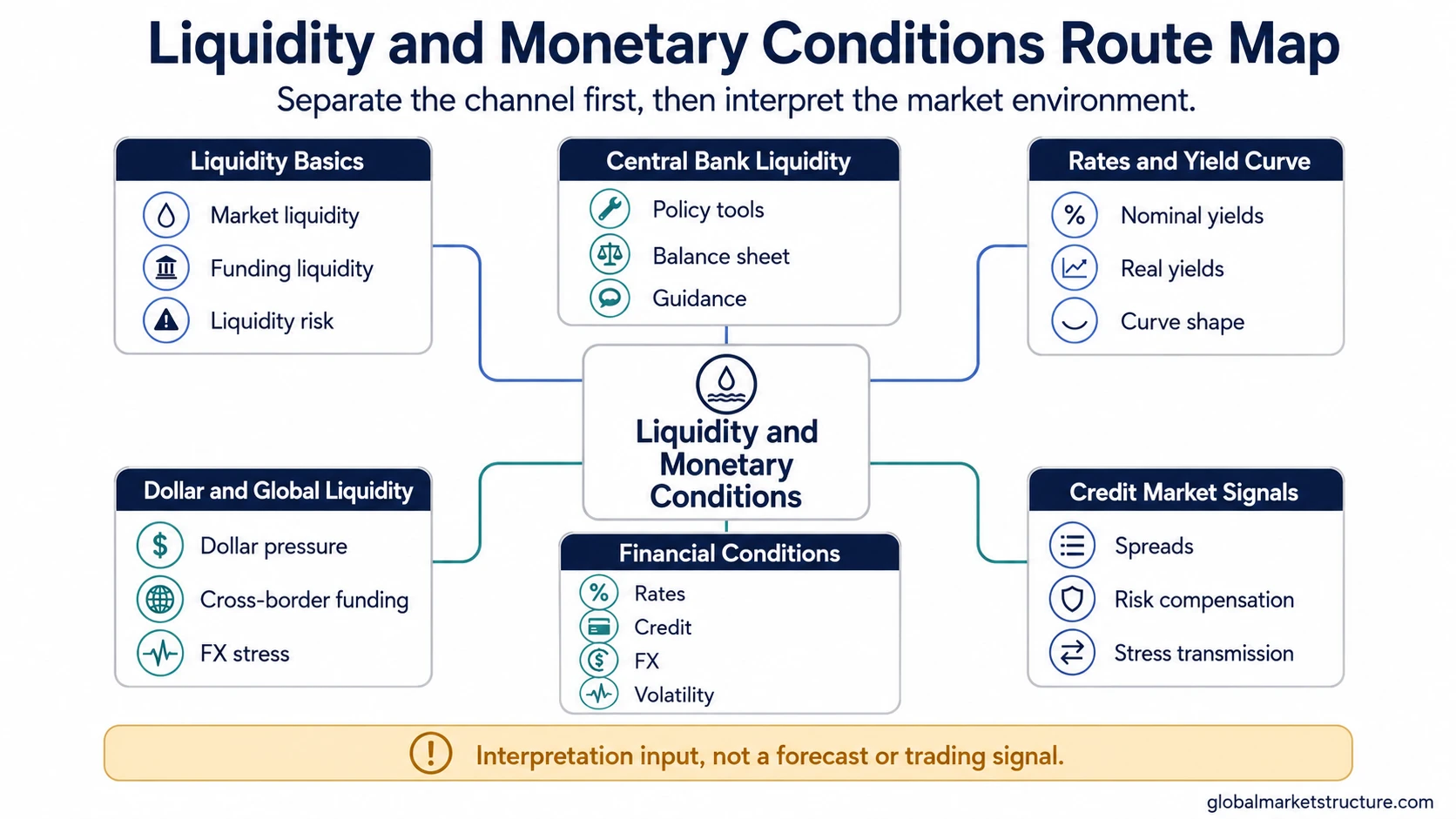
Choose the right liquidity route
The right starting point depends on whether the signal comes from funding, policy, rates, dollar pressure, market pricing, or credit stress.
| Question | Best route | Use this route when |
|---|---|---|
| What does liquidity mean in markets? | Liquidity basics | You need the foundation for market liquidity, funding liquidity, liquidity risk, and liquidity stress. |
| How do central banks add or drain liquidity? | Central bank liquidity | You are separating policy tools, balance-sheet actions, guidance, and operational liquidity channels. |
| How do rates and yield curves change interpretation? | Rates and yield curve | You are reading discount-rate pressure, curve shape, term structure, real yields, or nominal yields. |
| How does dollar pressure affect global funding? | Dollar and global liquidity | You are looking at cross-border funding pressure, dollar strength, global liquidity, or FX stress. |
| How do markets price easier or tighter conditions? | Financial conditions | You need the market-pricing layer across rates, credit, equities, currencies, and volatility. |
| How do credit markets reveal stress? | Credit market signals | You are checking risk compensation, spread behavior, funding stress, or stress transmission. |
How the transmission channels differ
Liquidity, policy, rates, dollar pressure, financial conditions, and credit stress often move together, but they are not interchangeable. A cleaner reading separates the source of pressure from the market symptom.
| Channel | What it describes | Common confusion to avoid |
|---|---|---|
| Liquidity | The ability to transact or obtain funding without severe friction. | Liquidity is not identical to all monetary policy. |
| Monetary policy | Central-bank tools, rate settings, guidance, and balance-sheet actions. | Policy changes do not always create immediate market impact. |
| Rates and yield curve | The price and term-structure channel for money, duration, and discount-rate pressure. | A yield move is not a standalone liquidity reading. |
| Dollar and global liquidity | Cross-border funding pressure, dollar demand, and international liquidity conditions. | Dollar pressure is not only a U.S. domestic liquidity issue. |
| Financial conditions | The market-pricing symptom layer across rates, credit, FX, equities, and volatility. | Financial conditions are related to liquidity, but they are not the whole liquidity system. |
| Credit signals | Risk compensation, spread behavior, and stress transmission through credit markets. | Credit stress can appear before broader risk narratives change. |
Liquidity conditions vs financial conditions
Liquidity conditions describe the ease or difficulty of funding, transacting, and absorbing flows. Financial conditions describe how markets are pricing that environment through rates, credit spreads, equity behavior, currency pressure, and volatility. The two can overlap, but they are not the same lens.
A market can price easier policy expectations while credit spreads widen and the dollar stays firm. That mix weakens a simple “liquidity is easy, risk is on” reading because policy expectations, funding pressure, and credit risk are not confirming the same environment.
What not to infer from liquidity alone
Liquidity and monetary conditions are interpretation inputs, not market calls. Easier liquidity does not automatically mean risk assets should rise, and tighter monetary conditions do not always create immediate market stress. The timing, source, and confirmation across rates, credit, currencies, and risk appetite matter.
The strongest reading usually comes from agreement across channels. If policy expectations ease while the dollar stays firm, credit spreads widen, and market breadth weakens, the environment is mixed rather than clearly supportive.
FAQ
Are liquidity conditions the same as financial conditions?
No. Liquidity conditions focus on funding and transaction ease. Financial conditions show how markets price the broader environment through rates, credit, equities, currencies, and volatility.
Does easier liquidity always support risk assets?
No. Easier liquidity can support risk appetite under some conditions, but the reading weakens when credit stress, dollar pressure, weak breadth, or higher risk compensation point in the opposite direction.