
Dollar and global liquidity connects the availability, pricing, and movement of dollar-based liquidity across offshore credit, funding markets, central-bank facilities, net liquidity measures, and DXY-sensitive risk regimes.
Definition: Dollar and global liquidity is a market-structure lens for separating dollar funding access, offshore dollar credit, cross-currency funding pressure, reserve-currency mechanics, net liquidity conditions, and dollar-cycle behavior.
The main distinction is that dollar liquidity is not one universal market signal. Offshore credit, funding stress, reserve-currency structure, net liquidity, and dollar-cycle conditions describe related but different mechanisms.
Key Distinctions
- Offshore dollar credit belongs mainly to the eurodollar system and cross-border dollar lending.
- Funding stress belongs mainly to dollar funding liquidity and cross-currency basis behavior.
- Liquidity impulse questions belong mainly to net liquidity and liquidity-cycle conditions.
- DXY-sensitive regime questions belong mainly to dollar smile theory and risk-environment interpretation.
- Reserve-currency questions belong mainly to the dollar’s role as a reserve currency, not to a short-term market signal.
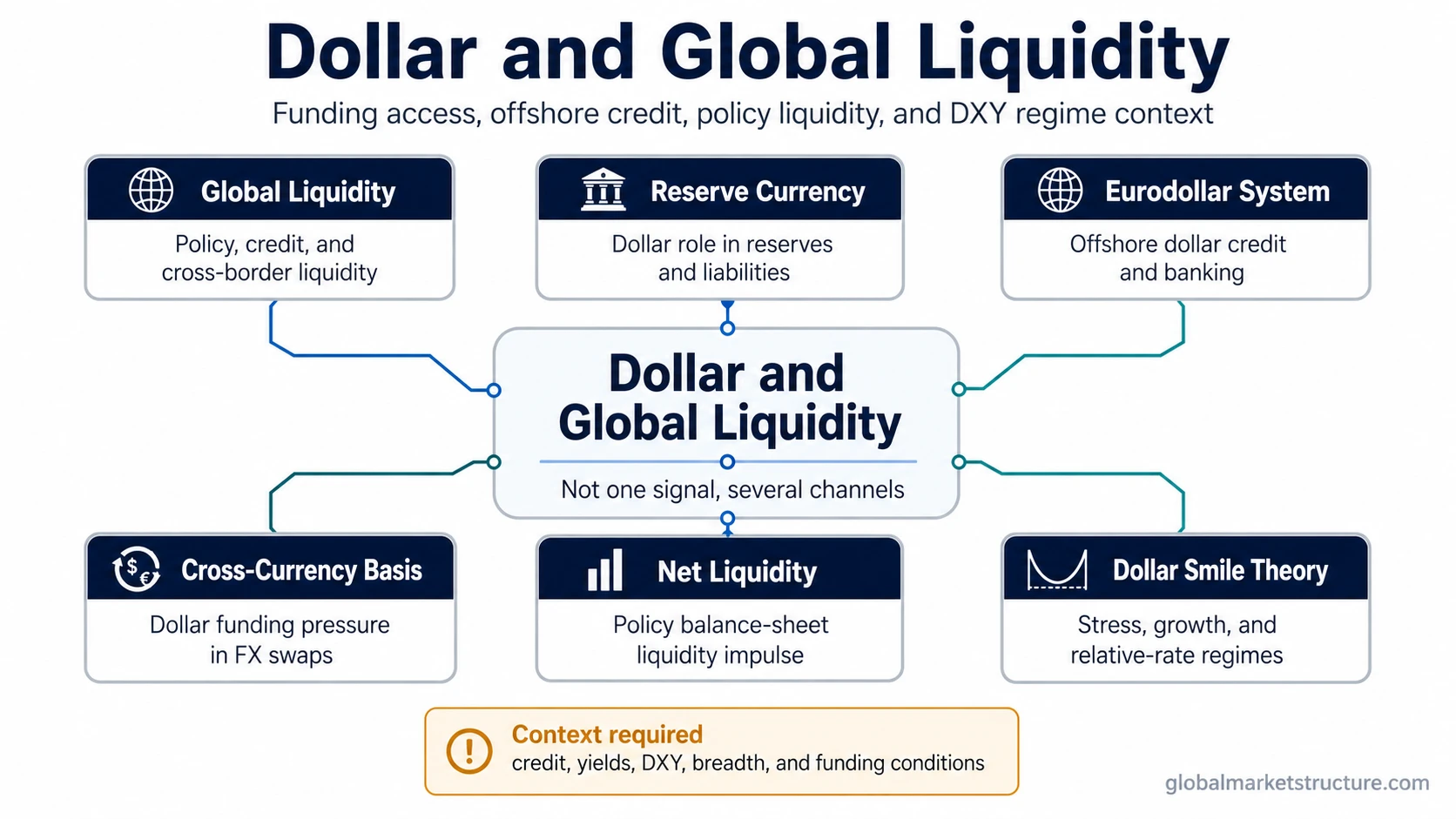
Dollar Liquidity Concept Paths
Funding access, offshore credit, policy liquidity, reserve demand, and DXY behavior can move together, but they do not describe the same channel. The cleaner starting point is the market-structure problem being analyzed.
| Question | Relevant concept | Why it matters |
|---|---|---|
| How does liquidity move through the global financial system? | Global liquidity | Global liquidity connects credit creation, policy liquidity, cross-border financing, and broader risk conditions. |
| Why does the dollar matter outside the United States? | Reserve currency | Reserve-currency status helps explain why dollar funding, dollar assets, and dollar liabilities matter across countries and balance sheets. |
| How can offshore dollar credit expand outside the domestic banking system? | Eurodollar system | The eurodollar system describes dollar-denominated banking and credit activity outside the direct domestic deposit base. |
| How can dollar funding stress appear in currency markets? | Cross-currency basis | Cross-currency basis can reflect pressure in swapping one currency into dollars when dollar funding demand becomes more difficult to meet. |
| How do balance-sheet and liquidity inputs affect the risk environment? | Net liquidity | Net liquidity frames selected policy-liquidity inputs as one condition to compare against risk appetite, credit, yields, and market breadth. |
| Why can the dollar strengthen in both stress and strong-growth regimes? | Dollar smile theory | Dollar smile theory separates different dollar-strength regimes instead of treating every DXY rise as the same macro message. |
Core Dollar and Global Liquidity Map
The useful split is between liquidity quantity, funding access, credit structure, and dollar-regime behavior. Each concept answers a different market-structure question.
| Concept group | Main focus | Best use |
|---|---|---|
| Global liquidity | System-wide liquidity conditions across policy, credit, and cross-border flows. | Broad regime interpretation when liquidity conditions are being compared with credit, yields, DXY, and breadth. |
| Reserve-currency structure | The dollar’s role in reserves, trade invoicing, liabilities, and safe-asset demand. | Understanding why dollar conditions can transmit beyond the United States. |
| Eurodollar credit | Dollar credit and banking activity outside the direct domestic dollar deposit system. | Separating offshore dollar credit creation from a simple domestic-money explanation. |
| Cross-currency funding pressure | The cost and availability of transforming non-dollar funding into dollar funding. | Identifying when funding demand, hedging needs, or balance-sheet constraints create pressure in currency funding channels. |
| Net liquidity | A selected liquidity-condition measure built from policy and balance-sheet inputs. | Comparing liquidity impulse with other macro and cross-asset evidence without treating it as a complete timing model. |
| Dollar-regime behavior | Different reasons the dollar can strengthen or weaken across growth, yield, and stress conditions. | Separating DXY behavior linked to risk stress from DXY behavior linked to relative growth or rate expectations. |
Data Sources and Interpretation Are Different Jobs
Official data, central-bank research, and liquidity dashboards are direct source endpoints. They are the better place for raw series, facility details, official methodology, and current data readings.
Market-structure interpretation asks a different question: which dollar-liquidity concept is relevant, what channel is being observed, and what other evidence is needed before the signal carries macro meaning.
Limitation: Dollar liquidity should not be treated as a single bullish or bearish switch. The same dollar move can reflect funding stress, relative growth, yield differentials, safe-haven demand, or reserve demand depending on the surrounding credit, rates, liquidity, and cross-asset context.
Interpreting Dollar Liquidity Without Overreach
A stronger interpretation usually requires more than one evidence layer. Funding stress carries more macro meaning when cross-currency pressure, credit spreads, short-term funding conditions, and risk-asset behavior point in the same direction.
A liquidity impulse becomes more useful when it is compared with yields, DXY, market breadth, and credit conditions. The weaker reading is to take one liquidity label and turn it into a forecast.
Dollar funding stress, net liquidity, and dollar-cycle behavior can affect the market environment, but they do not remove the need for confirmation across related macro and cross-asset signals.
Related Dollar Liquidity Concepts
The broad system view starts with global liquidity. Offshore dollar credit is usually closer to the eurodollar system, while funding-pressure questions often require cross-currency basis behavior.
Liquidity-impulse framing belongs closer to net liquidity, DXY regime interpretation belongs closer to dollar smile theory, and the dollar’s structural role belongs closer to reserve-currency analysis.