
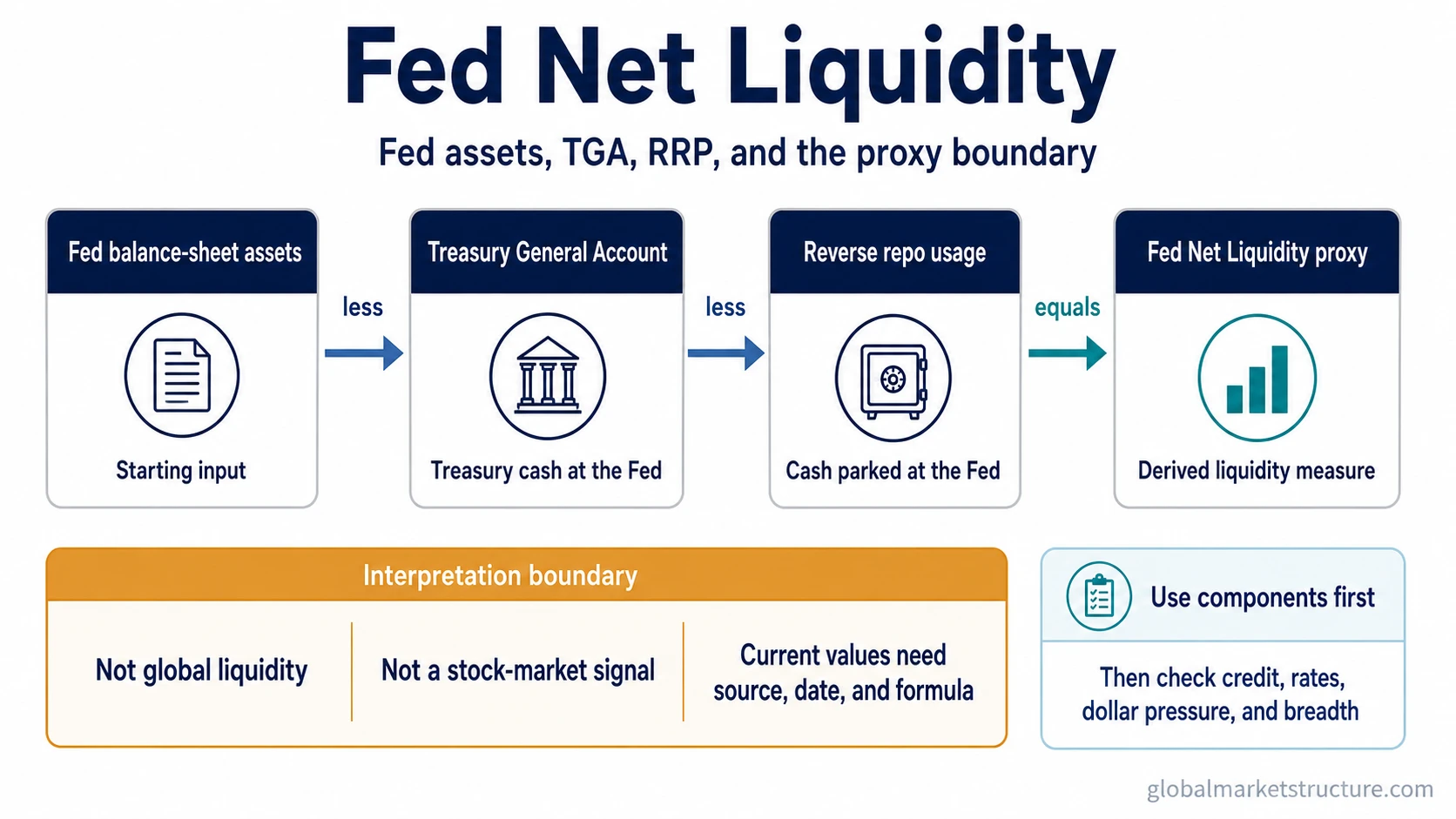
Fed Net Liquidity is a derived Fed-focused liquidity proxy that commonly starts with the Federal Reserve balance sheet and adjusts for liquidity-absorbing channels such as the Treasury General Account and reverse repo. It can help frame Fed-related liquidity conditions, but it is not a complete measure of global liquidity and not a mechanical equity-market signal.
Compact formula logic: Fed Net Liquidity is commonly interpreted as Fed balance-sheet assets minus the Treasury General Account and reverse repo usage. The result is a proxy for how much Fed-related liquidity may be moving toward or away from the private financial system, not a direct measure of cash available for stocks.
Key Points
- Fed Net Liquidity is a derived liquidity proxy, not an official all-purpose market indicator.
- The common formula starts with Fed balance-sheet assets and subtracts TGA and reverse repo usage.
- TGA and RRP matter because they can absorb cash away from private-sector balance sheets.
- The metric is different from global liquidity, market liquidity, funding liquidity, and dollar funding stress.
- It can support macro interpretation, but it should not be used as a standalone risk-asset signal.
How Fed Net Liquidity Is Commonly Framed
Fed Net Liquidity is not a single official line item. It is a derived proxy built from several balance-sheet-related components. The usual logic begins with the size of the central bank balance sheet, then adjusts for channels that can pull liquidity away from private markets.
The formula is usually summarized in plain language as:
Fed Net Liquidity = Fed assets minus Treasury General Account minus reverse repo usage.
That formula is useful as a framework, but the interpretation depends on the component mix. A rise in Fed assets does not have the same meaning if the TGA is rising at the same time. A fall in reverse repo usage can also change liquidity context even without a new quantitative easing program.
Fed Net Liquidity Component Table
| Component | Direction in common formula | What it represents | Why it matters | Interpretation boundary |
|---|---|---|---|---|
| Fed balance-sheet assets | Added | Assets held by the Federal Reserve, including securities and other balance-sheet items. | A larger balance sheet can represent a more accommodative Fed-related liquidity backdrop. | Asset size alone does not show where liquidity is flowing or how markets will respond. |
| Treasury General Account | Subtracted | The Treasury’s operating account at the Federal Reserve. | A rising TGA can absorb reserves from the private banking system as cash moves into the Treasury account. | The impact depends on fiscal flows, debt issuance, and banking-system context. |
| Reverse repo usage | Subtracted | Cash placed at the Fed through reverse repurchase operations. | High reverse repo usage can represent cash parked at the Fed instead of circulating through private money markets. | RRP movement should not be read as a direct equity signal without checking the broader liquidity regime. |
| Reserve balances | Related, not identical | Balances held by banks at the Federal Reserve. | Reserve balances help show banking-system liquidity conditions. | Reserve balances are connected to the same plumbing, but they are not the same concept as Fed Net Liquidity. |
Why TGA and Reverse Repo Are Subtracted
The Treasury General Account and reverse repo facility are subtracted because both can absorb liquidity from private-sector use. When money moves into the Treasury’s account at the Fed, it is not sitting in private bank deposits in the same way. When money-market funds or other eligible counterparties use reverse repo, cash is effectively parked at the Fed against collateral.
This is why Fed Net Liquidity can move differently from the headline Fed balance sheet. A stable or expanding Fed balance sheet can still produce a weaker net-liquidity reading if TGA or RRP usage rises enough to offset it. The reverse can also happen when a falling RRP balance releases cash back toward private money-market channels.
Interpretation limit: subtracting TGA and RRP improves the proxy, but it does not make Fed Net Liquidity a full map of financial conditions. Credit spreads, bank lending, dollar funding pressure, market depth, risk appetite, and cross-asset confirmation can all change the interpretation.
Fed Net Liquidity and Reserve Balances
Reserve balances are closely related to Fed liquidity analysis because they show balances held by depository institutions at the Federal Reserve. Fed Net Liquidity, however, is a broader derived proxy that tries to adjust Fed balance-sheet size for major liquidity-absorbing channels.
The distinction matters because reserve balances can help describe the banking-system side of liquidity, while Fed Net Liquidity is often used as a market-facing proxy. They can point in similar directions, but they should not be treated as interchangeable. A cleaner reading comes from checking the component path rather than relying on the final proxy alone.
What Fed Net Liquidity Is Not
Fed Net Liquidity is not the same as market liquidity. Market liquidity is about the ability to trade assets without large price impact. Fed Net Liquidity is also not the same as funding liquidity, which refers to the ability of market participants to obtain financing.
It is also different from dollar funding liquidity, which focuses more directly on access to dollar funding, funding stress, offshore dollar pressure, and related channels. Fed Net Liquidity is narrower because it is built around Fed balance-sheet plumbing rather than the entire dollar funding system.
Useful distinction: Fed Net Liquidity is best treated as a Fed balance-sheet proxy. Global liquidity is broader. Funding liquidity is about access to financing. Market liquidity is about trading conditions. Dollar funding liquidity is about the availability and stress level of dollar funding across the system.
How to Interpret Changes in Fed Net Liquidity
A rising Fed Net Liquidity reading can suggest that Fed-related liquidity pressure is easing, especially if Fed assets are expanding or liquidity-absorbing channels are falling. A falling reading can suggest that liquidity conditions are becoming less supportive from this specific Fed-balance-sheet angle.
The word “suggest” matters. Fed Net Liquidity is a proxy, not a forecast. Risk assets can rise during a falling liquidity proxy if earnings, positioning, policy expectations, or risk appetite dominate. They can also struggle during a rising proxy if credit stress, recession risk, valuation pressure, or dollar funding stress is strong enough.
Fed Net Liquidity is most useful when it is read with other regime indicators rather than in isolation. The surrounding context can include credit spreads, Treasury yields, the dollar, market breadth, volatility, and whether the Fed is expanding or reducing its balance sheet through quantitative easing or quantitative tightening.
Illustrative Scenario
Consider a general scenario where Fed assets are rising, but the Treasury General Account is also rising. The headline balance sheet may look more supportive, yet part of that liquidity effect can be offset because cash is moving into the Treasury’s account at the Fed.
Now consider the opposite type of component mix. Fed assets may be flat, but reverse repo usage may decline as cash moves away from the Fed’s RRP facility and back toward private money-market channels. In that case, the net-liquidity proxy can improve even without a new QE program.
No specific historical outcome is implied. Equity markets do not have to rise or fall only because the proxy changes.
Source Hierarchy and Data Caution
Fed Net Liquidity is safer to interpret from its components before relying on a final chart. Official and primary data sources are best for the underlying balance-sheet and facility components. Dashboard providers can be useful for visualization, but they may use their own update timing, formula choices, labels, or presentation layers.
Tool pages, scripts, social posts, and forum explanations can help reveal how traders talk about the metric, but they should not be treated as factual authority. If a page or chart shows a current Fed Net Liquidity value, the value needs a source, date, and formula definition before it can be used responsibly.
Common Mistakes With Fed Net Liquidity
| Mistake | Why it is a problem | Better interpretation |
|---|---|---|
| Treating the proxy as global liquidity | Fed Net Liquidity is built around Fed balance-sheet plumbing, not every global liquidity channel. | Use it as one Fed-specific input inside a broader liquidity framework. |
| Reading correlation as causation | Asset prices can move with the proxy for periods without the proxy being the direct cause. | Check whether credit, rates, dollar pressure, and breadth confirm the same regime. |
| Using it as a buy or sell signal | The metric does not define entries, exits, timing, or risk. | Treat it as macro context, not as trade instruction. |
| Ignoring component offsets | The final proxy can hide whether the move came from Fed assets, TGA, or RRP. | Read the component path before interpreting the headline proxy. |
| Quoting current values without a date | Liquidity components update over time and can be revised or displayed differently across providers. | Attach source, formula, and date whenever current data is used. |
Related Concepts
Fed Net Liquidity sits inside the broader dollar and liquidity framework, but it should not absorb every nearby concept. Global liquidity covers the wider system-wide context. Dollar funding liquidity covers funding access, offshore dollar pressure, and stress conditions more directly. The central bank balance sheet covers the official asset side of Fed liquidity analysis.
When the component path matters, reverse repo, Treasury cash balances, reserve balances, quantitative easing, and quantitative tightening become the natural next concepts. The strongest interpretation comes from understanding how those pieces interact rather than treating the final proxy as a standalone market answer.
FAQ
What is Fed Net Liquidity?
Fed Net Liquidity is a derived liquidity proxy that commonly starts with Fed balance-sheet assets and subtracts liquidity-absorbing channels such as the Treasury General Account and reverse repo usage. It is used to frame Fed-related liquidity conditions, not to forecast markets mechanically.
Why are TGA and reverse repo subtracted?
TGA and reverse repo are subtracted because they can absorb cash away from private-sector use. A rising TGA or high reverse repo usage can offset some of the liquidity effect that might otherwise be inferred from the Fed balance sheet alone.
Is Fed Net Liquidity a stock market signal?
No. Fed Net Liquidity can provide macro context, but it is not a buy signal, sell signal, or complete risk-asset model. Market interpretation still depends on rates, credit, earnings, positioning, the dollar, market breadth, and broader liquidity conditions.