
Dollar Smile Theory is a macro framework for understanding why the US dollar can strengthen at both extremes of the global cycle: during global stress, when demand for dollar safety and funding can rise, and during US outperformance, when capital can favor stronger relative US growth or returns.
The middle zone can be less supportive for the dollar when global conditions improve, safe-haven demand fades, and non-US markets become more attractive. The framework is a regime lens, not a mechanical DXY forecast, trading signal, or complete liquidity model.
What Dollar Smile Theory Means
Definition: Dollar Smile Theory describes a U-shaped relationship between the US dollar and the global macro environment.
The left side of the smile represents dollar strength during stress. The middle represents a softer dollar environment when global conditions are improving. The right side represents dollar strength during US outperformance.
The same dollar move can have different meanings. A rising dollar can reflect stress demand, funding pressure, reserve demand, or relative US strength. Without context from credit, rates, liquidity, capital flows, and risk appetite, the dollar move alone does not identify the regime.
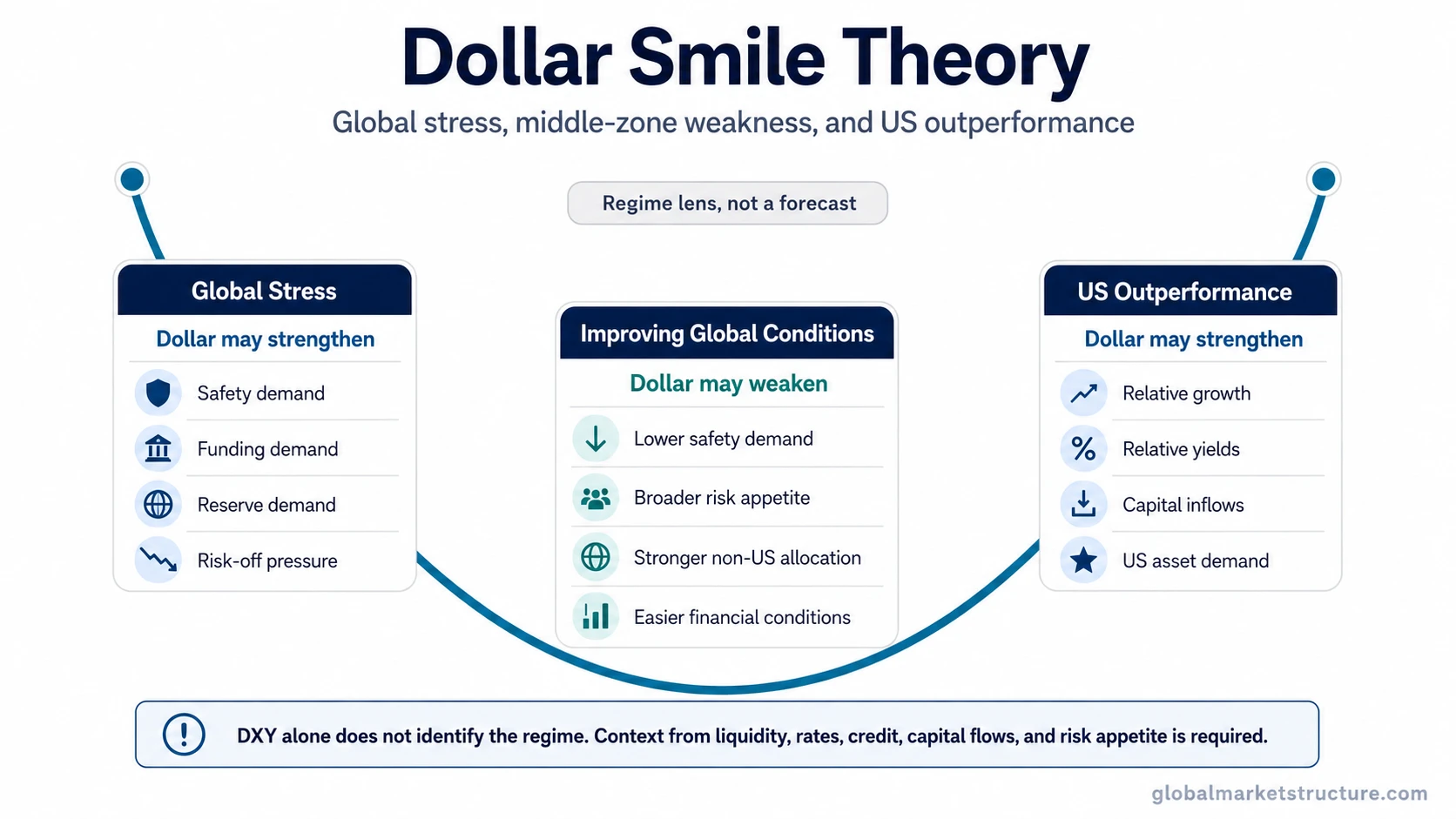
Dollar Smile Reading Map
The Dollar Smile framework is easiest to read as three zones rather than as one simple bullish or bearish dollar view.
| Zone | Dollar behavior | Macro backdrop | Main drivers | Misread risk |
|---|---|---|---|---|
| Left side: global stress | The dollar may strengthen | Risk appetite weakens, liquidity preference rises, and investors may seek dollar safety or funding access. | Safe-haven demand, funding demand, reserve demand, defensive positioning, and pressure in global risk assets. | Reading every dollar rise as US strength instead of checking whether stress, credit pressure, or funding demand is driving the move. |
| Middle zone: improving global conditions | The dollar may weaken | Global growth and risk appetite improve, reducing the need to hold dollars for safety. | Lower safe-haven demand, stronger non-US appetite, broader capital allocation, and easier financial conditions. | Assuming a weaker dollar always means the US is weak, when it may reflect better global risk appetite. |
| Right side: US outperformance | The dollar may strengthen | The US economy, US returns, or US asset demand appear stronger than the rest of the world. | Relative growth, relative yields, capital inflows, stronger US asset demand, and higher perceived return opportunity. | Confusing outperformance-driven dollar strength with stress-driven dollar strength. |
Why Dollar Strength Can Mean Two Different Things
A stronger dollar is not one signal. In the Dollar Smile framework, dollar strength can come from the left side or the right side of the smile, and those two regimes can carry very different market implications.
On the stress side, the dollar can rise because investors, institutions, and borrowers want access to dollar liquidity, safe assets, or balance-sheet protection. That kind of move may appear alongside weaker risk appetite, wider credit stress, tighter funding conditions, or defensive cross-asset behavior.
On the US-outperformance side, the dollar can rise because the US looks relatively stronger. Capital may favor US assets when relative growth, yields, earnings expectations, or perceived return opportunities compare well against other regions. In that case, dollar strength is not automatically a stress warning.
This distinction is why Dollar Smile Theory should be read with related market context, including net liquidity, rates, credit conditions, capital flows, and risk appetite.
The Middle Zone of the Dollar Smile
The middle of the Dollar Smile is the environment where the dollar can lose support. This can happen when global conditions improve enough that investors no longer need the dollar mainly for safety, but the US is not outperforming strongly enough to pull capital toward dollar assets on relative-return grounds.
In that zone, capital can become more willing to move into non-US markets, cyclical assets, higher-beta regions, commodities, or other risk-sensitive exposures. The weaker dollar is not guaranteed, but the pressure can shift away from defensive dollar demand.
The important point is conditional interpretation. A softer dollar can reflect better global appetite, not only a negative view of the US. A stronger dollar can reflect either stress or relative US strength. The surrounding regime determines the reading.
What Dollar Smile Theory Is Not
Dollar Smile Theory is not a forecast model for DXY. It does not say the dollar must rise in every stress phase, must weaken in every recovery, or must strengthen whenever the US performs better than other regions.
It is also not a complete liquidity cycle model. Dollar behavior can be influenced by central-bank policy, real yields, credit conditions, hedging flows, fiscal expectations, commodity dynamics, and positioning. The theory helps classify possible regimes, but it does not replace cross-asset confirmation.
DXY alone does not confirm which part of the smile is active. A dollar move needs context from liquidity, rates, credit, global growth, capital flows, and risk-on/risk-off behavior before it can be interpreted with confidence.
Illustrative Scenario: Two Different Dollar Rallies
A rising dollar can appear in two very different market settings.
In one scenario, credit conditions are deteriorating, risk assets are under pressure, and market participants prefer dollar cash or dollar funding access. The dollar rise may fit the left side of the smile because stress demand is the main interpretation.
In another scenario, credit conditions are stable, risk appetite is not breaking down, and US assets look more attractive than non-US alternatives. The dollar rise may fit the right side of the smile because relative US strength is the main interpretation.
The dollar chart may look similar in both cases, but the macro message is different. The practical mistake is reading dollar strength in isolation instead of checking whether stress demand or US outperformance is more consistent with the wider market structure.
Dollar Smile Theory vs Related Dollar and Liquidity Concepts
Dollar Smile Theory overlaps with several dollar and liquidity concepts, but it does not replace them. Each concept answers a different question.
| Related concept | How it relates | Boundary |
|---|---|---|
| Dollar funding liquidity | Can help explain stress-side dollar demand when borrowers or institutions need dollar financing. | Funding liquidity is about access to dollar financing. Dollar Smile Theory is a broader regime framework for interpreting why the dollar may strengthen or weaken. |
| Reserve currency | Helps explain why the dollar can attract demand during stress or global balance-sheet caution. | Reserve-currency status is a structural feature. Dollar Smile Theory describes a conditional pattern of dollar behavior across regimes. |
| Global liquidity | Provides broader context for whether financial conditions are expanding or tightening across markets. | Global liquidity is a broad condition. Dollar Smile Theory is a dollar-specific interpretation lens. |
| Net liquidity | Can provide context for the liquidity backdrop around risk appetite and dollar behavior. | Net liquidity is a liquidity measure or framework. Dollar Smile Theory does not measure liquidity directly. |
| Liquidity cycle | Can help place dollar behavior within a broader expansion or tightening phase. | The liquidity cycle is broader than dollar behavior. Dollar Smile Theory is one lens inside that broader environment. |
| Cross-currency basis | Can reflect stress or imbalance in dollar funding markets under certain conditions. | Cross-currency basis is a funding-market indicator. Dollar Smile Theory should not be treated as a technical basis model. |
| Risk-on/risk-off | Helps distinguish stress-driven dollar demand from broader risk appetite conditions. | Risk-on/risk-off describes allocation behavior. Dollar Smile Theory focuses on how the dollar may behave across different macro extremes and the middle zone. |
Key Points
- Dollar Smile Theory says the US dollar can strengthen in two different regimes: global stress and US outperformance.
- The middle of the smile can be less supportive for the dollar when global conditions improve and safe-haven demand fades.
- A rising dollar does not automatically mean the same thing in every environment.
- DXY alone does not confirm whether the market is pricing stress, US strength, or another driver.
- The theory is a regime lens, not a forecast, trading signal, or complete liquidity model.
- Dollar interpretation becomes stronger when liquidity, rates, credit, capital flows, and risk appetite point in the same direction.
FAQ
What is Dollar Smile Theory?
Dollar Smile Theory is a framework that describes why the US dollar may strengthen during global stress, weaken when global conditions improve, and strengthen again when the US outperforms other regions.
Why is it called a smile?
It is called a smile because the framework is often shown as a U-shaped curve. The dollar can be stronger on the left side during stress, weaker in the middle during improving global conditions, and stronger on the right side during US outperformance.
Does Dollar Smile Theory predict DXY?
No. It is not a mechanical DXY prediction model. It is a regime framework that helps interpret why the dollar may be rising or falling under different macro conditions.
Can dollar strength be bullish and bearish at the same time?
Dollar strength can have different meanings depending on the driver. Stress-driven dollar strength may point to defensive demand, while US-outperformance-driven dollar strength may reflect relative capital attraction toward US assets.
How is Dollar Smile Theory different from dollar funding liquidity?
Dollar funding liquidity is about access to dollar financing. Dollar Smile Theory is broader. It uses dollar behavior as one lens for reading stress, recovery, and relative US outperformance regimes.