
A credit crunch is a tightening in credit availability or lending conditions. Borrowers that previously could obtain financing may face stricter standards, smaller credit lines, higher costs, or harder refinancing. In market-structure terms, a credit crunch is a credit-market signal, not automatically a recession forecast, market crash signal, or trading instruction.
What Is a Credit Crunch?
A credit crunch occurs when the supply of available credit becomes meaningfully tighter. The pressure can come from lenders becoming more cautious, borrowers looking riskier, funding costs rising, collateral values weakening, or financial institutions reducing loan supply.
The central feature is not simply that interest rates are higher. The defining feature is that credit becomes harder to access. A borrower may still be willing to pay, but the loan may be smaller, more restrictive, more expensive, or unavailable.
In macro-credit analysis, the concept connects lending behavior, refinancing pressure, risk pricing, and broader economic conditions. It helps interpret credit stress, but it does not produce a standalone market conclusion.
Key Points
- A credit crunch means credit becomes harder or more expensive to obtain.
- It is mainly about credit availability and lending standards, not only the level of interest rates.
- It can make debt rollover harder and push investors to demand more compensation for credit risk.
- It may raise recession risk under certain conditions, but it is not the same as recession.
- It is a condition signal inside credit markets, not a standalone market conclusion.
What Changes During a Credit Crunch?
The first change is usually lender behavior. Banks, credit funds, or other lenders may demand stronger borrower quality, higher collateral coverage, wider margins of safety, or shorter maturities. That shift can reduce credit supply even before the broader economy visibly weakens.
Bank lending standards matter because they describe how strict lenders become when they decide whether to extend credit. When those standards tighten, weaker borrowers may lose access first, but stronger borrowers can also face tougher terms if risk appetite declines across the system.
The second change is borrower access. Companies, households, or financial entities that rely on rolling debt may find refinancing less reliable. Credit lines may be reduced, new issuance may become harder, and lenders may prefer liquidity preservation over balance-sheet expansion.
The third change is market pricing. If investors demand more compensation for credit risk, spreads can widen. That does not prove that defaults will surge, but it can show that the market is assigning a higher price to borrower stress.
Credit Crunch as a Credit-Market Signal
A credit crunch is best read as a condition signal rather than a forecast. It says that credit availability, credit standards, or refinancing access are tightening. The next step is interpretation: whether that tightening is narrow, temporary, policy-driven, sector-specific, or broad enough to affect economic activity.
Credit signals become more serious when several conditions align. Tight lending standards, weaker borrower access, wider spreads, rising refinancing pressure, and increasing concern about default risk create a stronger stress pattern than any single observation alone.
The main analytical mistake is treating the label as a conclusion. The same credit-pressure pattern can have different implications depending on depth, duration, borrower quality, policy response, and whether stress remains narrow or spreads across the system.
Credit-Transmission Mechanism
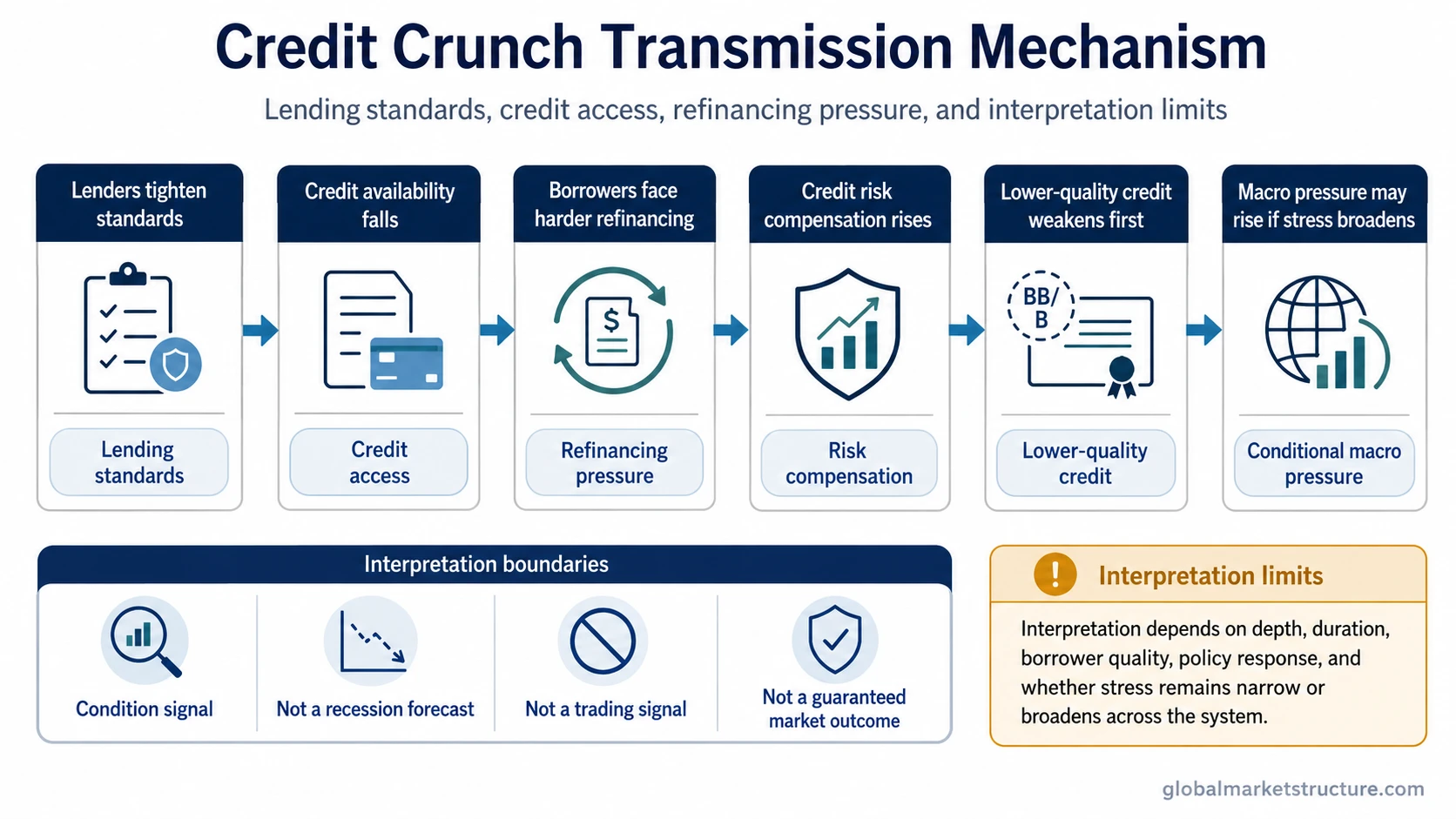
The useful way to interpret a credit crunch is as a transmission sequence. Lending behavior changes first, then borrower access changes, then refinancing and risk pricing can change, and only later may broader growth pressure become visible.
| Condition | What Changes | What It Can Imply | What It Does Not Prove |
|---|---|---|---|
| Lending standards tighten | Lenders demand stronger balance sheets, collateral, covenants, or risk compensation. | Credit supply may become more selective. | It does not prove that all borrowers are losing access. |
| Credit availability falls | Some borrowers receive smaller credit lines, fewer approvals, or less favorable terms. | Financing becomes less reliable for weaker borrowers. | It does not prove an economy-wide crisis. |
| Refinancing pressure rises | Debt rollover becomes harder or more expensive. | Borrowers with near-term maturities may face stress. | It does not prove immediate default. |
| Credit spreads widen | Investors demand more yield above safer benchmarks. | Credit spreads may reflect higher perceived risk compensation. | It does not prove that credit losses will follow mechanically. |
| Lower-quality credit weakens | Riskier borrowers may face sharper repricing than stronger borrowers. | High-yield spreads can become a useful stress gauge. | It does not prove that all risk assets must fall. |
| Growth pressure may build | Investment, hiring, inventory, or spending plans may become more constrained. | Macro slowdown risk can increase if credit tightening spreads widely. | It does not prove recession by itself. |
Credit Crunch vs Recession, Credit Crisis, Credit Tightening, and Rate Hikes
A credit crunch is not the same as a recession. A recession describes a broad contraction in economic activity. A credit crunch describes a tightening in credit availability or lending conditions. The two can interact, but they are not interchangeable.
A credit crunch is also not identical to a credit crisis. A credit crisis usually implies more severe instability, funding stress, market dysfunction, or institutional pressure. A credit crunch can be an earlier or narrower phase of credit stress without becoming a full crisis.
Credit tightening is a broader phrase. It can refer to tighter lending standards, tighter policy, reduced credit supply, weaker borrower access, or a more cautious financial system. A credit crunch is a more acute form of tightening where access to credit becomes materially constrained.
Higher rate hikes can contribute to tighter credit conditions, but rate hikes alone do not define a credit crunch. Credit can become more expensive while still widely available. A credit crunch requires pressure on availability, standards, refinancing, or lender willingness to extend credit.
Common False Readings
- False reading 1: A credit crunch automatically means recession. It can raise recession risk, but the outcome depends on depth, duration, policy response, borrower quality, and whether credit stress spreads.
- False reading 2: A credit crunch is just higher rates. Higher rates affect credit cost, while a credit crunch is centered on availability and lending behavior.
- False reading 3: One chart proves a credit crunch. A stronger reading usually needs several signals, such as standards, spreads, refinancing stress, defaults, and liquidity conditions.
- False reading 4: A credit crunch is a direct sell signal. It is an input into market-structure analysis, not an instruction to buy, sell, short, or exit.
- False reading 5: The term only belongs to one historical episode. Credit crunch dynamics can appear whenever credit availability tightens meaningfully, even if the cause and severity differ.
Credit Crunch Example Scenario
A group of lenders becomes more cautious after credit losses or rising perceived risk. Borrowers that previously refinanced easily now face smaller loan amounts, stricter terms, or higher costs. If that behavior spreads, refinancing pressure can rise and credit-risk pricing may become more demanding.
The scenario becomes more important when it affects several borrower groups at the same time. If the pressure remains isolated, it may describe a narrow credit event. If it spreads through funding access, credit pricing, and borrower behavior, it can become part of a broader macro-credit stress pattern.
How Related Credit Signals Fit Together
Default risk explains the borrower failure side of the credit channel. High-yield spreads focus on how riskier credit is priced in public markets. Credit spreads provide a broader risk-compensation lens across borrowers and instruments. Bank lending standards describe the lender-behavior side of credit tightening.
Together, these concepts help separate the parts of a credit crunch: lender willingness, borrower access, refinancing stress, credit-risk pricing, and broader macro interpretation.
FAQ
What does credit crunch mean?
A credit crunch means credit becomes harder to obtain because lending standards tighten, credit supply falls, borrowing terms become stricter, or refinancing becomes more difficult.
Is a credit crunch the same as a recession?
No. A recession is a broad contraction in economic activity. A credit crunch is a tightening in credit availability or lending conditions. A credit crunch can contribute to recession risk, but it is not the same thing.
Is a credit crunch only about higher interest rates?
No. Higher interest rates can make credit more expensive, but a credit crunch is mainly about access to credit. The defining issue is whether lenders are less willing or able to provide financing on workable terms.
Can a credit crunch happen before a recession?
Yes. Credit availability can tighten before broad economic weakness is fully visible. That timing makes credit conditions useful for market-structure interpretation, but it does not make recession automatic.
Is a credit crunch a trading signal?
No. A credit crunch is a condition signal inside credit markets. It can affect risk appetite and macro interpretation, but it does not provide a direct buy, sell, short, or exit instruction.