
High yield spreads are the extra yield investors demand to hold below-investment-grade corporate bonds instead of safer benchmark bonds or Treasury-equivalent curves. They are a credit-market signal because they reflect compensation for default risk, liquidity risk, and uncertainty around the macro environment. Wider spreads can indicate more defensive credit pricing, while tighter spreads can indicate easier risk pricing or stronger risk appetite. They do not, by themselves, prove that a recession, default wave, equity decline, or trading opportunity is coming.
Key Points
- High-yield spreads measure an extra yield premium, not the full yield on high-yield bonds.
- Widening spreads can reflect higher demanded compensation for credit risk, liquidity risk, or macro uncertainty.
- Tightening spreads can reflect easier credit-risk pricing, but not the absence of credit risk.
- Total high-yield bond yields can change because Treasury yields move, credit spreads move, or both move together.
- High-yield spreads are credit-condition signals, not standalone recession forecasts or buy/sell signals.
What Are High Yield Spreads?
High yield spreads measure the yield premium on below-investment-grade corporate debt above a safer benchmark. The benchmark is usually a Treasury or Treasury-equivalent curve, depending on the index or data provider. The spread is normally quoted in basis points, where 100 basis points equals one percentage point.
Investors demand extra compensation to hold riskier corporate credit instead of safer bonds. That extra compensation can rise when default risk, liquidity pressure, or uncertainty increases. It can fall when credit risk is priced more easily and investors are more willing to hold lower-rated debt.
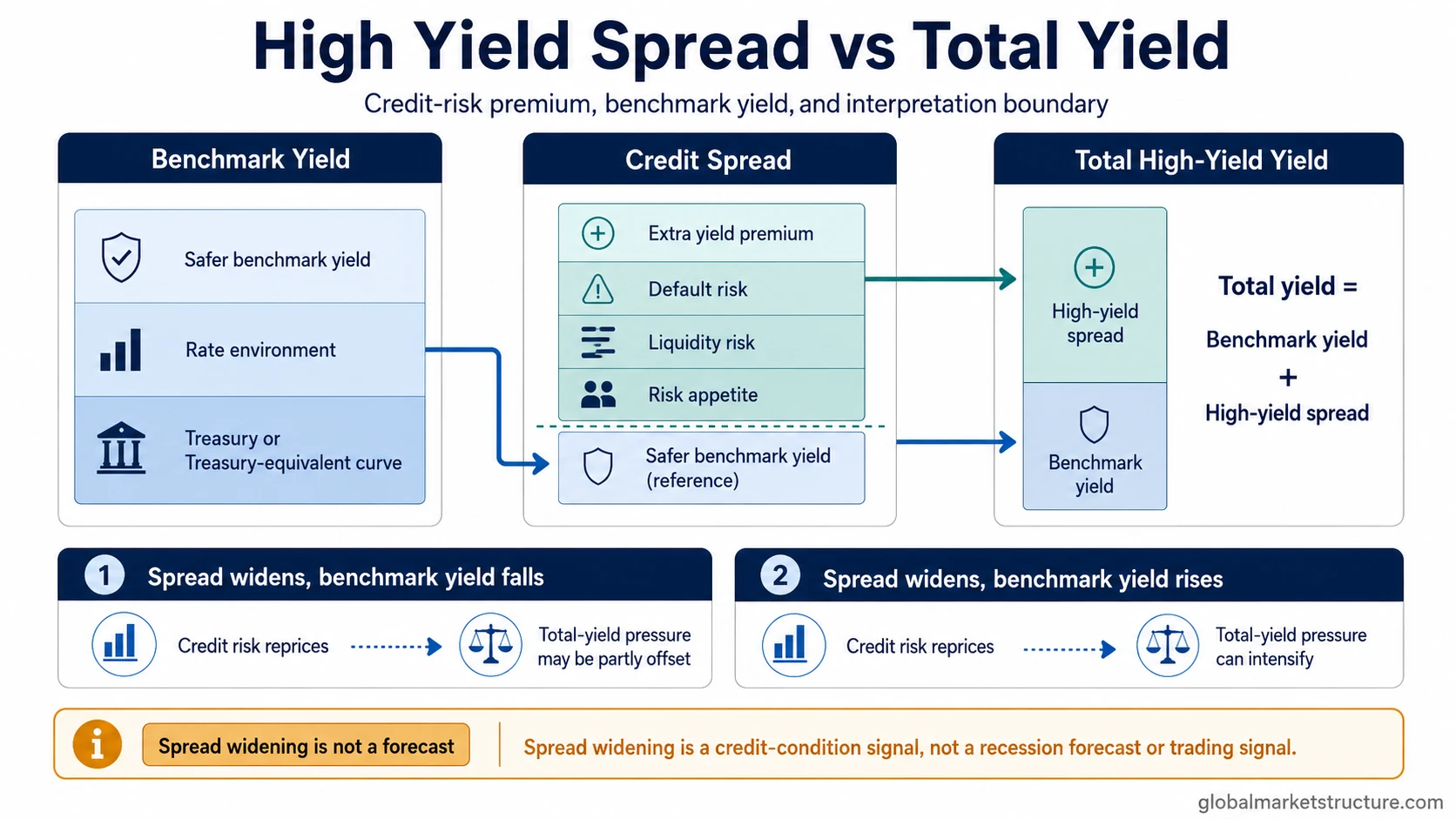
The spread is not the same thing as the total yield on a high-yield bond. A total yield includes both the safer benchmark yield and the credit spread. The spread isolates the credit-risk premium more clearly than the headline yield alone.
What High Yield Spreads Are and Are Not
| High-yield spreads are | High-yield spreads are not |
|---|---|
| An extra yield premium above safer benchmark yields. | The full yield on high-yield bonds. |
| A credit-market signal tied to lower-rated corporate debt. | A complete bond-market or portfolio-allocation framework. |
| A measure of demanded compensation for default risk, liquidity risk, and uncertainty. | A mechanical recession forecast. |
| A useful lens for credit stress, risk appetite, and financial conditions. | A trading signal or guaranteed asset-price outcome. |
| A narrower part of the broader credit spreads universe. | Proof that defaults, equity weakness, or a credit event must follow immediately. |
How High Yield Spreads Are Measured
High-yield spread series usually compare the yield on below-investment-grade corporate bonds with a safer benchmark curve. Commonly watched datasets may use option-adjusted spread, or OAS, to compare a bond index spread with a Treasury curve after accounting for embedded option effects in the bond universe.
The exact construction depends on the index provider. Some series use broad high-yield corporate bond indexes, while others use a specific benchmark universe. Spread values from different sources may therefore differ even when they describe the same broad credit-market condition.
The interpretation depends on the components. The safer benchmark yield reflects the rate environment. The high-yield spread reflects the extra compensation required for lower-quality credit. Total high-yield yield pressure comes from both pieces.
What Widening High Yield Spreads Can Indicate
Widening high-yield spreads can indicate that investors are demanding more compensation to hold below-investment-grade corporate debt. That can happen when default concerns rise, market liquidity becomes less reliable, refinancing conditions deteriorate, or investors become less willing to hold risky credit.
The signal is often watched as part of broader credit-market stress because high-yield issuers are more sensitive to funding conditions than stronger corporate borrowers. A widening spread can show that the market is repricing risk before the stress is fully visible in reported defaults or earnings data.
That interpretation becomes stronger when widening spreads appear alongside other credit and liquidity pressure, such as weaker market breadth, tighter funding conditions, falling risk appetite, or signs of a credit crunch. It becomes weaker when the move is isolated, technical, or not confirmed by adjacent risk signals.
What Tightening High Yield Spreads Can Indicate
Tightening high-yield spreads can indicate that investors require less extra compensation for holding lower-rated corporate debt. That can reflect stronger risk appetite, easier liquidity conditions, lower perceived default risk, or demand for yield in a calmer credit environment.
Tight spreads should not be read as proof that credit risk has disappeared. They can also reflect strong demand, easier financing, or investor willingness to accept less compensation for risk. In that situation, the credit market can look calm even though lower-quality borrowers still remain sensitive to refinancing costs, earnings pressure, and liquidity changes.
The cleaner reading is not “safe credit.” The cleaner reading is that risk compensation is being priced more easily at that moment. Whether that is justified depends on funding conditions, default expectations, earnings quality, policy context, and the direction of benchmark yields.
High Yield Spread vs High Yield Bond Yield
High-yield spread: the extra yield premium above a safer benchmark.
High-yield bond yield: the total yield on the high-yield bond or index, which includes both the benchmark yield and the spread.
This distinction matters because total high-yield yields can rise or fall for more than one reason. If Treasury yields rise while credit spreads stay stable, total high-yield yields may still rise. If credit spreads widen while Treasury yields fall, total yield pressure may be partly offset. If both Treasury yields and credit spreads rise together, total yield pressure can intensify.
The spread is therefore cleaner for credit-risk interpretation than the headline yield alone. It helps separate the compensation demanded for lower-quality credit from the broader level of interest rates.
Why High Yield Spreads Are Not a Standalone Recession Signal
High-yield spread widening can appear before credit stress becomes obvious, but it does not mechanically forecast recession timing, default timing, or equity-market direction. Defaults can lag spread widening, policy conditions can change, Treasury yields can offset part of the move, and equity markets can respond differently depending on earnings, liquidity, and risk appetite.
A common mistake is treating wider spreads as a complete macro forecast. They are better read as one part of a credit-condition stack. The signal becomes more useful when it is compared with funding liquidity, market breadth, refinancing pressure, default expectations, and the behavior of higher-quality corporate credit.
The same widening move can have different meanings. A modest widening from very tight levels may only show risk repricing. A sharp widening alongside weaker liquidity, deteriorating breadth, and refinancing stress can carry a stronger warning. The spread does not provide the whole answer by itself.
High Yield Spreads vs Investment-Grade Spreads
High-yield spreads focus on below-investment-grade corporate credit, where default risk and refinancing sensitivity are usually more important. Investment-grade spreads focus on higher-quality corporate debt, where the market is usually more sensitive to broad credit conditions, balance-sheet quality, duration, and risk-free-rate interaction.
The two signals can move together during broad credit stress, but they do not carry identical information. High-yield spreads usually react more strongly to concerns about default risk and lower-quality borrower access to capital. The distinction between investment-grade versus high-yield credit becomes especially important when the market is trying to separate normal risk repricing from deeper credit deterioration.
A Practical Spread-vs-Yield Scenario
Suppose high-yield spreads start widening after a period of calm credit pricing. The initial read is tempting: wider spreads look like a clear deterioration in credit conditions. That may be partly true, but the read is incomplete without the Treasury-yield side of the move.
If Treasury yields are falling at the same time, the total yield on high-yield bonds may not rise as much as the spread move suggests. Credit risk is being repriced, but lower benchmark yields can soften the total-yield pressure on borrowers and bond prices.
If Treasury yields are rising while high-yield spreads are also widening, the pressure is more severe. The borrower faces both a higher benchmark-rate environment and a higher credit-risk premium. In that case, refinancing pressure and market risk aversion can become more important to monitor.
The stronger case appears when spread widening, higher total yield pressure, weaker liquidity, and rising default risk point in the same direction. The weaker case appears when spreads widen modestly but broader liquidity and higher-quality credit signals remain stable.
Related Credit-Market Concepts
High-yield spreads sit inside a larger credit-market signal set. Broader credit-spread measures help frame the overall compensation demanded above safer benchmarks. Investment-grade spreads help compare lower-risk corporate credit against high-yield behavior. Credit-crunch conditions focus on lending standards and credit availability rather than market spread levels. Default-risk analysis focuses on the borrower-quality side of the spread premium.
FAQ
Are high-yield spreads the same as high-yield bond yields?
No. A high-yield spread is the extra yield premium above a safer benchmark. A high-yield bond yield is the total yield, which includes both the benchmark yield and the credit spread.
Do high-yield spreads predict recessions?
High-yield spread widening can be a warning sign of tighter credit conditions or higher risk aversion, but it is not a standalone recession forecast. Timing, policy conditions, liquidity, earnings, defaults, and benchmark yields can all change the interpretation.
What is the difference between high-yield and investment-grade spreads?
High-yield spreads track lower-rated corporate credit, where default risk and refinancing sensitivity are usually more important. Investment-grade spreads track higher-quality corporate debt, where balance-sheet strength and broader rate conditions often carry more weight.