Quantitative easing is a central-bank balance-sheet expansion tool that uses large-scale asset purchases to add reserves or settlement balances and influence longer-term yields and financial conditions. It is part of the central-bank liquidity toolkit, but it is not physical cash handed to the public, not quantitative tightening, not routine short-term open-market operations by default, and not a guaranteed market forecast.
Definition: Quantitative easing, often shortened to QE, is a monetary policy tool in which a central bank buys financial assets, commonly longer-term government bonds and sometimes other securities, in order to expand its balance sheet and ease financial conditions through the banking system and bond market.
For market-structure analysis, the useful starting point is not the slogan that QE is “money printing.” The useful starting point is the transmission path: central-bank asset purchases, reserve or settlement-balance creation, yield pressure, portfolio rebalancing, funding conditions, and then broader interpretation across macro and risk conditions.
What Quantitative Easing Is and Is Not
QE is easiest to interpret when it is separated from common shortcuts. It is a balance-sheet and liquidity mechanism, not a direct promise that lending, inflation, growth, or asset prices will follow one fixed path.
| QE is | QE is not |
|---|---|
| A central-bank asset-purchase program | Physical cash handed directly to the public |
| A balance-sheet expansion mechanism | A guaranteed inflation outcome |
| A reserve or settlement-balance creation process | A guaranteed stock-market rally |
| A tool used when conventional rate policy is constrained or judged insufficient | The same thing as quantitative tightening |
| A channel that can influence yields and financial conditions | Routine short-term open-market operations by default |
| One form of central-bank liquidity | The whole central-bank liquidity category |
How Quantitative Easing Works
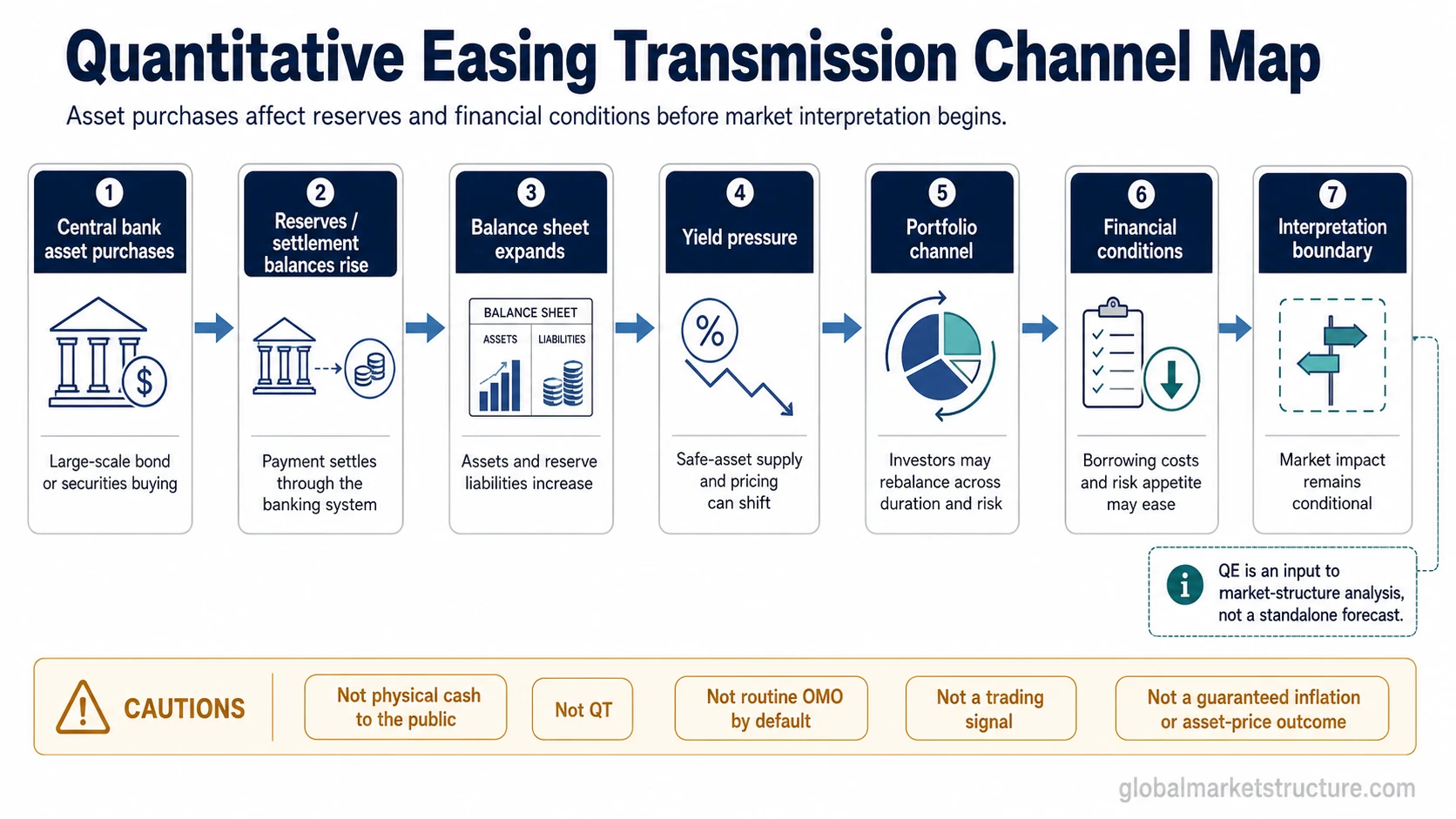
The mechanics of QE begin with the central bank buying assets. The market impact comes later, through the balance sheet, banking-system settlement, bond pricing, and investor behavior.
- The central bank announces or conducts a large-scale asset-purchase program.
- The purchased assets are usually government bonds and, in some programs, other securities.
- The central bank pays through the banking system rather than by handing cash directly to households.
- Bank reserves or settlement balances increase.
- The central-bank balance sheet expands.
- The supply and pricing of safe assets can change.
- Longer-term yields and term premia may face downward pressure.
- Investors may rebalance toward other duration, credit, or risk exposures.
- Funding conditions and broader financial conditions may ease.
- Market interpretation still depends on inflation, growth, credit stress, positioning, and risk appetite.
The sequence matters because the first observable effect is not the same as the final market interpretation. Reserves can rise quickly, while lending behavior, investor allocation, credit creation, and risk appetite may respond differently depending on the regime.
Where Liquidity Enters the System
QE usually enters the financial system through central-bank purchases and banking-system settlement. The central bank receives securities. The seller receives payment through the banking system. Reserves or settlement balances increase on the liability side of the central bank’s balance sheet.
Those reserves are not the same as household income, consumer cash, or guaranteed bank lending. They can support easier financial conditions, but the broader effect depends on how banks, investors, borrowers, and markets respond.
| Layer | What changes | Why it matters |
|---|---|---|
| Central-bank balance sheet | Assets and liabilities expand | QE becomes visible as balance-sheet growth |
| Banking system | Reserves or settlement balances increase | The liquidity effect enters through settlement plumbing |
| Bond market | Asset supply and price pressure can change | Longer-term yields may move |
| Portfolio channel | Investors may seek other duration, credit, or risk exposure | Financial conditions can ease |
| Market interpretation | Cross-asset confirmation still matters | QE alone is not a trading signal |
Why Central Banks Use Quantitative Easing
Central banks commonly use QE when conventional short-term rate policy is constrained, judged insufficient, or unable to deliver the desired effect through policy rates alone. The goal is usually to influence longer-term rates, market functioning, borrowing conditions, or broader financial conditions.
That purpose should not be confused with a guaranteed outcome. QE can make financial conditions easier, but it does not guarantee that banks will lend aggressively, households will spend, inflation will rise, or risk assets will move in one direction. The policy tool changes the environment; it does not remove the need to interpret the surrounding macro structure.
QE, Yields, and Financial Conditions
QE can affect yields because central-bank purchases change demand for the assets being bought. If the central bank buys longer-term bonds, bond prices may face upward pressure and yields may face downward pressure. Lower yields can influence discount rates, borrowing costs, credit spreads, and portfolio allocation incentives.
The portfolio channel matters because investors who sell bonds or hold assets with lower yields may look for other exposures. Some may move into longer-duration bonds, credit, equities, real assets, or other risk assets. That rebalancing can ease financial conditions, but the strength of the channel depends on scale, credibility, inflation context, rate expectations, credit stress, and risk appetite.
Important boundary: QE can support easier financial conditions, but it is not a standalone explanation for asset prices. A stronger market-structure reading also checks real yields, credit conditions, growth expectations, inflation pressure, fiscal backdrop, investor positioning, and cross-asset confirmation. The deeper asset-price channel belongs with how QE affects asset prices.
Quantitative Easing vs Quantitative Tightening
Quantitative easing expands the central-bank balance sheet through asset purchases. Quantitative tightening reduces the balance sheet or allows assets to run off over time. QE and QT are opposite balance-sheet directions, but they should not be treated as simple mirror-image market signals.
QE may ease liquidity conditions and downward pressure on yields, while QT may reduce excess reserves or withdraw balance-sheet support. Market reactions still depend on the level of reserves, banking-system demand for liquidity, Treasury issuance, risk appetite, inflation expectations, and whether other policy tools are moving in the same or opposite direction.
Quantitative Easing vs Open-Market Operations
Open-market operations can refer to central-bank operations used to implement monetary policy, manage short-term rates, or adjust liquidity conditions. Quantitative easing usually refers to larger and more persistent asset-purchase programs designed to expand the balance sheet and influence longer-term financial conditions.
The difference is partly about scale, purpose, duration, and market segment. Routine operations may help keep short-term rates aligned with the policy framework. QE is normally associated with balance-sheet expansion aimed at broader financial-condition transmission.
Common Mistakes and Limitations
QE is often misread because a balance-sheet tool gets compressed into simple market slogans. The most common mistake is treating QE as a direct market forecast rather than as a liquidity and financial-conditions input.
- Money-printing shortcut: QE creates reserves or settlement balances through asset purchases, but it is not the same as physical cash handed directly to the public.
- Direct-lending assumption: More reserves do not guarantee that banks will expand credit to households or businesses.
- Inflation certainty: QE can affect financial conditions, but inflation outcomes also depend on demand, supply, wages, fiscal policy, expectations, and velocity of money.
- Stock-market certainty: Easier financial conditions can support risk appetite, but QE does not guarantee a stock-market rally.
- Policy-tool confusion: QE is not identical to ordinary open-market operations and should not be merged with the entire central-bank liquidity category.
- Signal-service framing: QE is not a buy signal, sell signal, or standalone forecast.
Limitation: QE can change liquidity conditions, yields, and portfolio incentives, but market outcomes depend on the surrounding regime. Inflation expectations, real yields, credit stress, growth expectations, fiscal policy, investor positioning, and risk appetite can all change how QE is interpreted.
A Practical QE Scenario
A central bank is buying longer-term bonds while short-term rates are already low. Reserves rise, the central-bank balance sheet expands, and longer-term yields may decline. Some investors rebalance toward other assets because the yield on safe assets has fallen.
The interpretation still depends on context. If inflation expectations are contained, credit markets are stable, and risk appetite is improving, QE may be read as part of an easier financial-conditions backdrop. If inflation expectations are rising, credit stress is worsening, or growth confidence is weak, the market reaction can differ from the simple “QE equals risk-on” story.
Related Central-Bank Liquidity Concepts
QE sits inside a wider central-bank liquidity framework. The closest related concepts are central-bank balance sheets, quantitative tightening, open-market operations, central-bank liquidity, and the asset-price transmission channel.
- Central-bank balance sheet: Shows where QE appears in accounting terms.
- Quantitative tightening: Explains the opposite balance-sheet direction.
- Open-market operations: Separates routine implementation tools from larger balance-sheet programs.
- Central-bank liquidity: Places QE inside the broader liquidity toolkit.
- How QE affects asset prices: Extends the discussion into discount rates, risk appetite, and portfolio rebalancing.
Quantitative Easing FAQ
Is quantitative easing the same as printing money?
Quantitative easing is sometimes described that way, but the phrase can be misleading. QE usually works through central-bank asset purchases and the creation of reserves or settlement balances, not through physical cash being handed directly to the public.
Does QE always make stocks rise?
No. QE can ease financial conditions and influence portfolio behavior, but stock-market outcomes also depend on earnings expectations, inflation, real yields, credit stress, positioning, and risk appetite.
What is the difference between QE and QT?
QE expands the central-bank balance sheet through asset purchases. QT reduces the balance sheet or allows assets to run off. They are opposite balance-sheet directions, but they are not guaranteed mirror-image market signals.
Is QE the same as open-market operations?
No. Open-market operations can include routine policy implementation operations, while QE usually refers to larger and more persistent asset-purchase programs intended to expand the balance sheet and influence broader financial conditions.
Does QE always cause inflation?
No. QE can affect liquidity conditions and financial prices, but inflation also depends on demand, supply constraints, wages, fiscal policy, expectations, credit creation, and the broader economic environment.