
Quantitative tightening is a central-bank balance-sheet reduction process. It usually occurs when a central bank allows securities to mature without fully replacing them, and it can also involve active asset sales. QT can reduce reserves or liquidity support and influence financial conditions, but it is not the same as rate hikes, not the same as tapering, and not a trading signal or guaranteed market outcome.
Definition: Quantitative tightening, often shortened to QT, is the process of reducing or normalizing a central bank’s balance sheet after a period of asset purchases or large-scale liquidity support. The core mechanism is balance-sheet contraction, not a direct instruction for asset prices.
Key Points About Quantitative Tightening
- QT reduces or normalizes the size of a central bank balance sheet, usually through runoff and sometimes through asset sales.
- Runoff means maturing securities are not fully reinvested. Active sales mean the central bank sells securities before maturity.
- The liquidity effect depends on the liability side of the balance sheet, including reserves, reverse repo balances, Treasury cash balances, and related funding-market channels.
- QT can contribute to tighter financial conditions, but the effect depends on reserve abundance, private-sector demand for securities, credit conditions, growth expectations, inflation, and risk appetite.
- QT is not a forecast, recession signal, or market-timing rule by itself.
Quantitative Tightening in One Mechanism Sequence
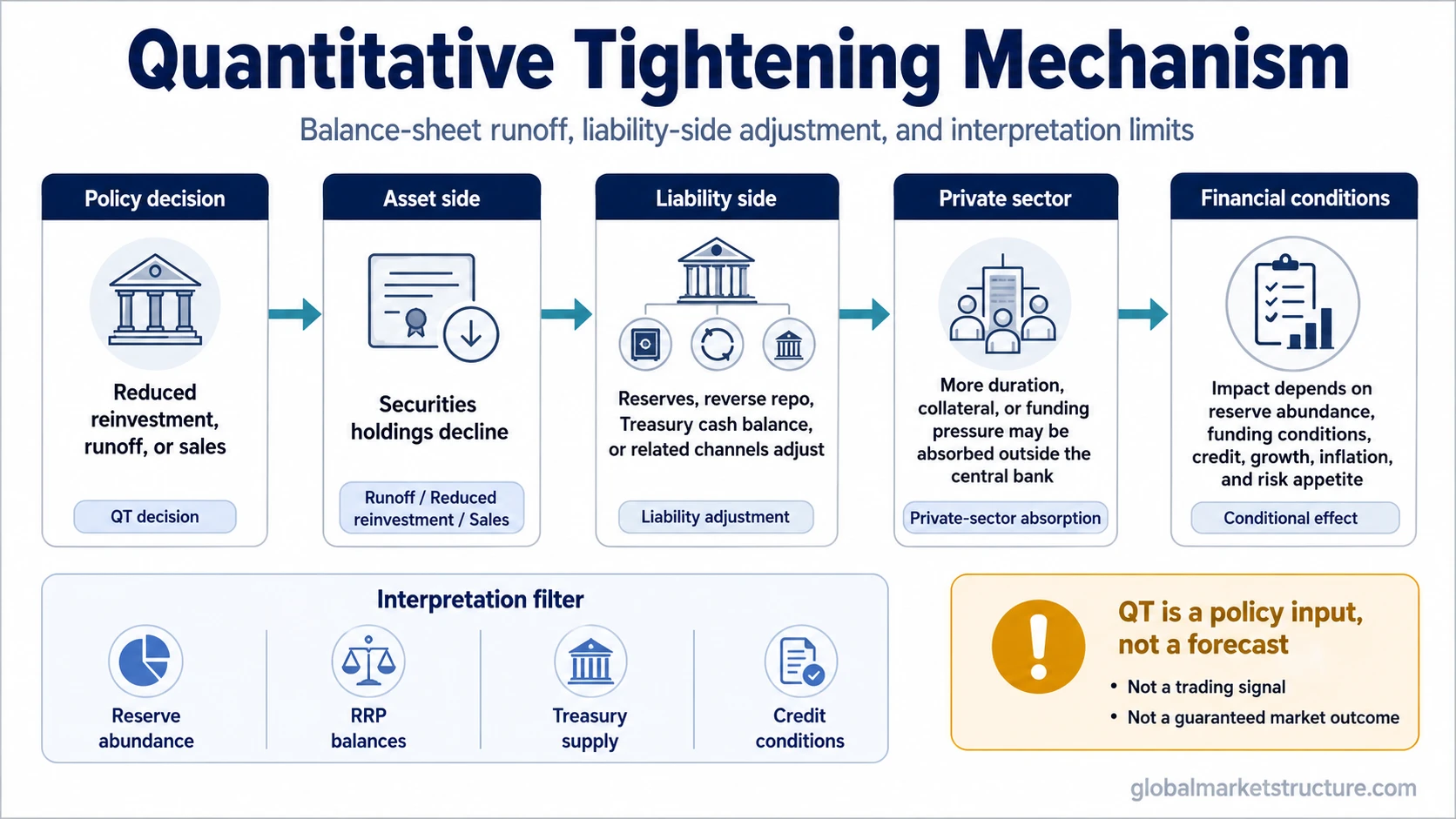
QT begins with a central-bank decision to reduce reinvestment, allow securities to roll off the balance sheet, or sell assets. Securities holdings decline on the asset side. The liability side then adjusts through reserves, reverse repo balances, Treasury cash balances, currency, or other balance-sheet channels. The private sector may need to absorb more duration or Treasury supply, and the final market effect depends on how easily the financial system absorbs that shift.
Mechanism sequence:
- The central bank reduces reinvestment or sells assets.
- Securities holdings decline on the asset side of the balance sheet.
- Liabilities adjust through reserves, reverse repo balances, Treasury cash balances, or related channels.
- Private-sector balance sheets absorb more duration, collateral, or funding pressure depending on the operating environment.
- Financial conditions may tighten, loosen less than otherwise, or remain buffered if reserves and liquidity conditions are still ample.
The key distinction is between the policy operation and the market outcome. QT describes the balance-sheet direction. It does not, by itself, determine the path of equities, bonds, credit spreads, currencies, or recession risk.
How QT Reduces a Central Bank Balance Sheet
A central bank balance sheet has assets and liabilities. On the asset side, central banks often hold government bonds, agency securities, or other policy-related assets. On the liability side, reserves, reverse repo balances, Treasury balances, currency in circulation, and other items reflect how the financial system is funded and settled.
QT works because the asset side stops expanding or begins shrinking. If a bond matures and the central bank does not fully reinvest the proceeds, the securities portfolio declines. If the central bank sells assets, the decline can happen more directly. In both cases, the balance sheet moves in the opposite direction from large-scale asset purchases, but the transmission is not always symmetric with QE.
The phrase “liquidity drain” can be too simple if it ignores the liability side. A decline in securities holdings does not automatically mean the same market effect in every environment. The impact depends on whether reserves remain abundant, whether reverse repo balances absorb part of the adjustment, how Treasury issuance is financed, and whether private balance sheets are already under pressure.
The broader central-bank balance sheet context matters because QT is a balance-sheet operation before it becomes a market-interpretation issue.
Passive Runoff vs Active Asset Sales
QT can happen through passive runoff or active asset sales. The distinction matters because the speed, signaling effect, and market absorption burden can differ.
| QT method | How it works | Market-structure implication |
|---|---|---|
| Passive runoff | Maturing securities are not fully replaced. | The balance sheet shrinks gradually as securities mature. The effect can be slower and easier to plan around, depending on caps and maturity schedules. |
| Active asset sales | The central bank sells securities before maturity. | The balance sheet can shrink more directly. The market must absorb additional supply more visibly, which may affect yields or liquidity conditions depending on demand. |
| Reduced reinvestment | The central bank reinvests less than the amount of maturing securities. | The balance sheet declines without requiring full active selling. The effect depends on reinvestment rules and the maturity profile of the portfolio. |
In many central-bank contexts, runoff is the cleaner default explanation because it reduces holdings without implying that the central bank is selling every asset. Active sales are possible, but QT should not be automatically read as forced liquidation of the entire portfolio.
How QT Can Affect Liquidity and Financial Conditions
QT can affect liquidity through several channels rather than one single “money disappears” path. The most important channels are reserves, reverse repo balances, Treasury financing, funding markets, and private-sector risk appetite.
| Channel | Why it matters | Interpretation limit |
|---|---|---|
| Bank reserves | Reserves are settlement balances held by banks at the central bank. If reserves decline toward a less comfortable level, funding sensitivity can rise. | Reserve decline is not automatically stress if reserves remain abundant relative to the system’s needs. |
| Reverse repo balances | Reverse repo balances can absorb part of the adjustment before reserve scarcity becomes more visible. | A decline in reverse repo balances may buffer reserve drain for a time, but the effect depends on money-market behavior and collateral conditions. |
| Treasury cash balance | Changes in the Treasury’s cash balance can move reserves independently of QT’s asset-side runoff. | QT should be interpreted alongside Treasury cash management, not in isolation. |
| Treasury issuance and private demand | If the central bank is buying less or holding less, private investors may need to absorb more supply. | Strong private demand can buffer the effect. Weak demand can contribute to higher term premium or tighter conditions. |
| Funding markets | Reduced liquidity support can make secured funding, collateral use, and balance-sheet capacity more important. | Funding stress depends on the surrounding regime, not QT alone. |
| Risk appetite | QT may reduce the liquidity backdrop that previously supported duration demand or risk-taking. | Risk assets can still rise during QT if earnings, growth, positioning, or other liquidity channels offset the pressure. |
QT is therefore best interpreted as a liquidity and balance-sheet input. It can influence yields, term premium, credit conditions, and risk appetite, but those effects remain conditional. Growth data, inflation expectations, fiscal supply, dollar liquidity, credit spreads, and market breadth can all change the final reading.
QE vs QT
Quantitative easing and QT move the central-bank balance sheet in opposite directions, but the market interpretation is not a simple mirror image. QE expands holdings through asset purchases. QT reduces holdings through runoff or sales. The broader effect depends on starting conditions, reserve levels, private-sector absorption, and the policy regime.
| Feature | Quantitative easing | Quantitative tightening |
|---|---|---|
| Balance-sheet direction | Expansion | Reduction or normalization |
| Main operation | Central-bank asset purchases | Runoff, reduced reinvestment, or asset sales |
| Common liquidity effect | Can add reserves or liquidity support | Can reduce reserves or liquidity support |
| Market interpretation | Often associated with easier financial conditions | Often associated with less liquidity support or tighter financial conditions |
| Important limit | QE does not guarantee asset-price gains | QT does not guarantee asset-price declines |
The separate QE vs QT comparison can carry the deeper side-by-side distinction. The QT concept itself should stay focused on balance-sheet reduction, liquidity channels, and interpretation limits.
QT vs Tapering vs Rate Hikes
QT is often confused with tapering and rate hikes because all three can belong to a tightening policy environment. They do not operate through the same channel.
| Policy term | Primary meaning | Core channel | Common confusion |
|---|---|---|---|
| QT | Central-bank balance-sheet reduction | Runoff, reduced reinvestment, or asset sales | Often mistaken for rate hikes or direct market selling pressure |
| Tapering | Slowing the pace of asset purchases | Less new balance-sheet expansion | Often mistaken for immediate balance-sheet shrinkage |
| Rate hikes | Higher policy-rate settings | Short-term interest-rate channel | Often grouped with QT even though the operating tool is different |
| Forward guidance | Central-bank communication about expected policy direction | Expectations and signaling channel | Often confused with the balance-sheet operation itself |
Forward guidance can change expectations around rates, reinvestment, and policy duration, but the communication channel is different from QT’s balance-sheet mechanics.
Why QT’s Market Impact Is Conditional
QT can matter for markets because it changes the liquidity backdrop, but the effect is conditional rather than mechanical. The same balance-sheet reduction can have different market implications depending on reserve abundance, funding-market conditions, Treasury supply, private-sector demand, credit spreads, inflation pressure, and growth expectations.
Limitation: QT is not a forecast. It can contribute to tighter financial conditions, but it does not automatically produce falling equity prices, higher yields, wider credit spreads, recession, or systemic stress. The operation must be interpreted alongside the broader liquidity and macro regime.
Reserve abundance is one of the key reasons QT does not always transmit immediately. If banks and money markets still have enough reserves and collateral flexibility, the system may absorb balance-sheet runoff without obvious stress. If reserves become less abundant while credit spreads widen and funding markets become more sensitive, the same QT process can carry a stronger tightening implication.
Treasury issuance also matters. A central bank that is no longer reinvesting at the same scale may leave more duration for private buyers to absorb. If demand is strong, the effect can be muted. If demand is weak or balance-sheet capacity is constrained, yields, term premium, and risk appetite may become more sensitive.
The broader central-bank liquidity context helps separate QT from other liquidity tools, emergency facilities, swap lines, and policy-rate decisions.
Illustrative QT Scenario
A central bank allows part of its bond portfolio to mature without full replacement while Treasury issuance continues. Money-market funds absorb some supply through short-term instruments, so reserves decline slowly rather than abruptly. The first read may be that QT is draining liquidity and tightening every market at once. That read is incomplete if reverse repo balances are still falling, bank reserves remain comfortable, credit spreads are calm, and risk appetite is stable.
The stronger QT tightening case develops when reserve decline coincides with weaker demand for new issuance, higher funding sensitivity, wider credit spreads, and deteriorating breadth across risk assets. The weaker case appears when the system absorbs the runoff through existing liquidity buffers and private demand remains strong. QT becomes more useful when compared with reserves, RRP usage, Treasury supply, credit spreads, yields, dollar liquidity, and market breadth rather than treated as a single stand-alone signal.
Common Misreadings of Quantitative Tightening
Misreading 1: QT means markets must fall. QT can reduce liquidity support, but asset prices also respond to earnings, growth expectations, inflation, positioning, fiscal policy, global liquidity, and risk appetite.
Misreading 2: QT is always active selling. QT often works through runoff or reduced reinvestment. Active sales are possible, but they are not the only form of QT.
Misreading 3: QT is the same as tapering. Tapering slows asset purchases. QT reduces or normalizes the balance sheet after purchases have already slowed or stopped.
Misreading 4: QT is the same as raising rates. Rate hikes change the policy-rate setting. QT changes the balance sheet. Both can tighten conditions, but the operating channels differ.
Misreading 5: QT removes all liquidity. QT can reduce central-bank liquidity support, but reserves, reverse repo balances, Treasury cash movements, private demand, and global liquidity conditions can buffer or redirect the effect.
Related Central-Bank Liquidity Concepts
QT is easiest to interpret when it is separated from adjacent central-bank tools and then reconnected to the broader liquidity regime.
- Quantitative easing explains the balance-sheet expansion side of asset purchases and liquidity support.
- QE vs QT comparison separates balance-sheet expansion from balance-sheet reduction without treating either process as a guaranteed market outcome.
- Forward guidance explains the expectations channel that can shape how markets interpret future policy settings.
- Central-bank balance sheet gives the broader asset-and-liability framework behind QE, QT, reserves, and other policy tools.
FAQ
Is quantitative tightening the opposite of QE?
QT moves the balance sheet in the opposite direction from QE, but the market impact is not a perfect mirror image. QE expands central-bank holdings through asset purchases, while QT reduces holdings through runoff, reduced reinvestment, or sales. The effect depends on reserve levels, private demand, funding conditions, and the broader macro regime.
Is QT the same as tapering?
No. Tapering means the central bank slows the pace of new asset purchases. QT means the balance sheet is being reduced or normalized. Tapering reduces the speed of expansion, while QT moves into contraction or runoff.
Is QT the same as raising interest rates?
No. Rate hikes change the policy-rate setting. QT changes the size or composition of the central-bank balance sheet. Both can influence financial conditions, but they work through different policy channels.
Does QT always make markets fall?
No. QT can reduce liquidity support and may contribute to tighter financial conditions, but asset prices also depend on growth, earnings, inflation, credit, positioning, fiscal supply, global liquidity, and risk appetite.
Does QT mean the central bank is selling all of its assets?
No. QT often happens through passive runoff, where maturing securities are not fully replaced. Active sales can be part of QT, but QT does not automatically mean the central bank is selling its entire portfolio.