
Central-bank liquidity questions cover several different mechanisms: reserve and balance-sheet conditions, asset purchases or runoff, money-market operations, policy communication, cross-border liquidity backstops, and the transmission of those changes into financial conditions. Start with the mechanism behind the observation, then move to the concept that owns that mechanism.
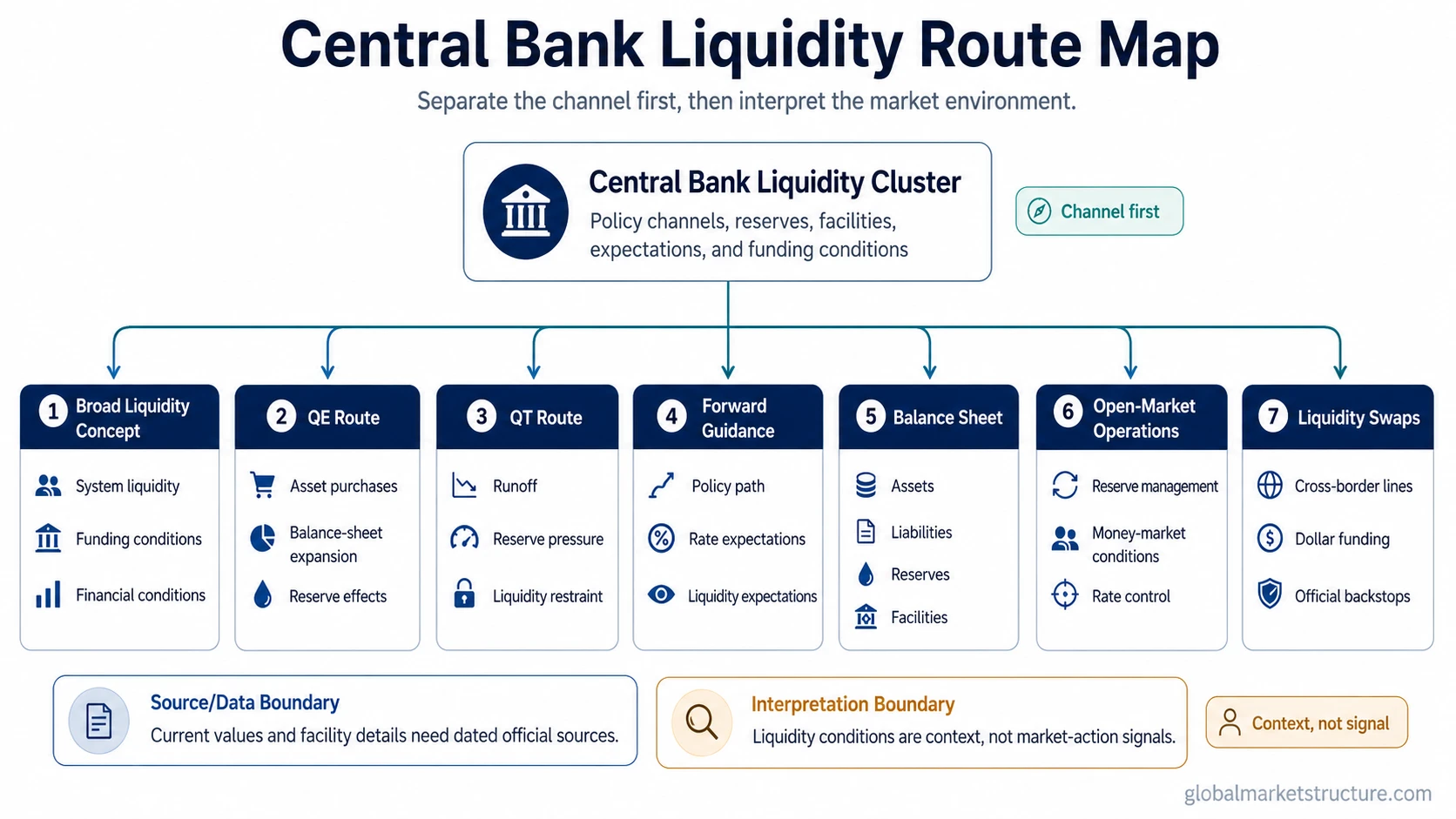
Choose the Central Bank Liquidity Route
| If the question is about | Best next concept | What that route owns |
|---|---|---|
| The broad meaning of official liquidity provision and reserve conditions | central bank liquidity | Reserves, facilities, balance-sheet actions, liquidity lines, and the boundary between the official liquidity source and the later market interpretation. |
| Large-scale asset purchases and balance-sheet expansion | quantitative easing | Asset purchases, expansion of securities holdings, reserve creation, and QE-specific transmission. |
| Balance-sheet runoff, reduced reinvestment, or asset sales | quantitative tightening | Runoff, balance-sheet reduction, reserve conditions, and QT-specific implementation. |
| Policy communication and expectations about future settings | forward guidance | Communication about future policy rates, policy persistence, and expected policy conditions. |
| Assets, liabilities, reserves, and balance-sheet composition | central bank balance sheet | The accounting structure behind securities holdings, lending, reserves, currency, government deposits, and other balance-sheet items. |
| Day-to-day reserve management and monetary-policy implementation | open-market operations | Market operations used to manage reserves, short-term rates, and money-market conditions. |
| Cross-border or foreign-currency funding backstops | central bank liquidity swaps | Official swap arrangements and foreign-currency liquidity provision during funding stress. |
| The difference between balance-sheet expansion and reduction | QE vs QT | The direct comparison between asset purchases, runoff or sales, reserve effects, and the limits of treating QT as a mechanical reverse of QE. |
| How QE may reach yields, portfolios, credit, and asset prices | How QE affects asset prices | The transmission from asset purchases into duration supply, yields, portfolio balance, expectations, financial conditions, and market prices. |
Official Liquidity Channels Use Different Mechanisms
The ECB describes central-bank liquidity management through the supply of liquidity consistent with short-term interest-rate control and implements that framework through market operations. BIS analysis separates reserve creation on the liability side from the refinancing operations or asset purchases that can create the corresponding asset-side change. Central-bank swap arrangements form another specific channel for foreign-currency funding support. Source: European Central Bank. Source: Bank for International Settlements. Source: Federal Reserve Bank of New York.
Current reserve balances, facility usage, operation schedules, and liquidity-line activity can change and should be checked against dated primary sources. A change in one channel also does not summarize market liquidity, private funding conditions, credit, or the direction of asset prices.