
QE and QT describe opposite directions in central-bank balance-sheet policy. Quantitative easing expands securities holdings through asset purchases. Quantitative tightening reduces or normalizes those holdings through runoff, reduced reinvestment, active sales, or a combination. The balance-sheet direction is straightforward; the market transmission depends on how the policy is implemented and the conditions around it.
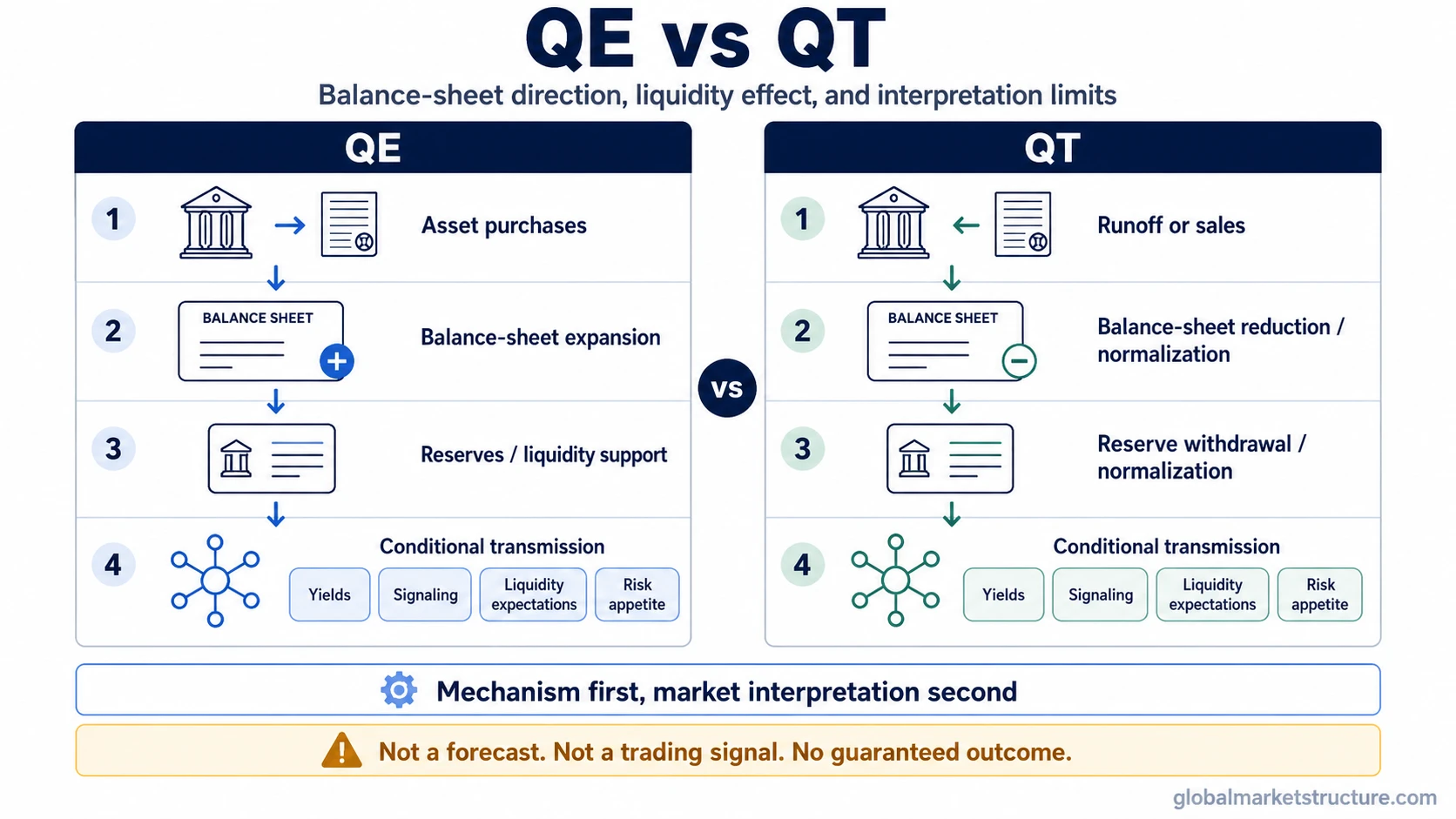
QE vs QT: Balance Sheet and Transmission
| Comparison point | QE | QT |
|---|---|---|
| Full term | Quantitative easing | Quantitative tightening |
| Core operation | Central-bank purchases of securities. | Runoff, reduced reinvestment, active sales, or a combination. |
| Balance-sheet direction | Asset holdings expand. | Asset holdings decline or normalize. |
| Reserve effect | Purchases generally increase reserve or settlement balances as the balance sheet expands. | Balance-sheet reduction can contribute to lower reserve balances, although the liability-side effect also depends on other balance-sheet flows and the operating framework. |
| Typical implementation | Requires active asset purchases. | Can rely largely on predictable runoff, with outright sales used in some frameworks. |
| Relationship to policy rates | A separate balance-sheet channel that can operate alongside rate policy. | A separate balance-sheet channel that can continue even when the policy-rate path changes. |
| Transmission | Can work through duration supply, yields, portfolio balance, reserves, liquidity conditions, and policy expectations. | Can work through private absorption of securities, reserve conditions, money markets, term premium, and policy expectations. |
| Market interpretation | The QE label alone does not determine the direction of risk assets. | The QT label alone does not determine the direction of risk assets. |
Federal Reserve balance-sheet reduction plans have relied primarily on reducing reinvestment of principal payments from securities holdings. The Bank of England describes QT as non-reinvestment at maturity, active asset sales, or a combination of the two. A 2025 Bank of England staff study also found asymmetric preferred-habitat demand effects between QE and QT auctions in its UK sample, which is one reason to separate the accounting direction from the transmission assumption. Source: Federal Reserve Board. Source: Bank of England. Source: Bank of England Staff Working Paper.
Why QT Is Not a Mechanical Reverse of QE
QE requires the central bank to buy assets. QT can be much less active. Securities may simply mature without full reinvestment, while some central banks can also use outright sales. Those implementation choices change the amount and timing of securities that private investors must absorb.
The starting reserve environment matters as well. Balance-sheet reduction from abundant reserves can be absorbed differently from the same reduction when reserves are closer to the level needed for smooth money-market functioning. Treasury or government-bond supply, money-market conditions, credit spreads and expectations can change at the same time.
The central-bank balance sheet shows the accounting change. It does not, by itself, establish how strongly that change is reaching yields, funding conditions, credit or risk appetite.
How to Read a QE or QT Signal
Asset purchases and expanding holdings point to QE. Runoff, reduced reinvestment or sales that reduce holdings point to QT.
Reserve abundance, the pace of purchases or runoff, policy rates, government-security supply and money-market conditions affect how the operation is absorbed.
Yields, funding conditions, credit spreads, market liquidity and broader risk capacity show whether the balance-sheet change is materially altering the financial environment.
When to Use QE, QT, or Asset-Price Transmission
Use Quantitative easing when the main question concerns asset purchases, balance-sheet expansion, reserve creation, or the expansion side of central-bank balance-sheet policy.
Use Quantitative tightening when the main question concerns runoff, reduced reinvestment, asset sales, reserve withdrawal, or balance-sheet normalization.
Use QE and asset-price transmission when the balance-sheet operation is already clear and the remaining question is how purchases may affect yields, portfolio balance, liquidity conditions, expectations, credit and risk assets.
The same balance-sheet direction can produce different market effects depending on reserve conditions, policy rates, inflation and growth expectations, government-security supply, credit conditions, currency pressure, positioning and risk appetite.