
Economic expansion is a business-cycle phase in which broad economic activity rises after a trough and before a peak. The label becomes stronger when output, employment, income, production, sales, investment, and confidence improve together, not when one data point rises in isolation.
An expansion label does not prove that stocks will rise, that every sector or household is improving, or that the current economy has already been officially classified. It describes a phase of the business cycle, not a market-timing rule.
What economic expansion means
Economic expansion means a broad increase in economic activity across the economy. It is usually associated with rising output, stronger labor conditions, higher income, improving demand, increased production, and stronger business activity.
The important distinction is that expansion is a phase, not a single indicator. Real GDP can be part of the evidence, but GDP alone should not be treated as the complete definition. A stronger expansion reading depends on whether several parts of the economy are improving together.
Official cycle dating is also different from a simplified real-time reading. A business-cycle phase can be easier to classify after evidence has accumulated and after earlier data has been revised.
Where expansion sits in the business cycle
In a standard business-cycle sequence, expansion begins after a business-cycle trough and continues until a business-cycle peak. After a peak, the peak-to-trough phase is commonly described as contraction or recession, depending on the framework and severity of the downturn.
The simplified sequence is:
- trough
- expansion
- peak
- contraction or recession
- trough
Expansion can overlap with recovery, especially early in the phase. Recovery usually describes the repair after a downturn, while expansion can continue after the economy has regained lost ground.
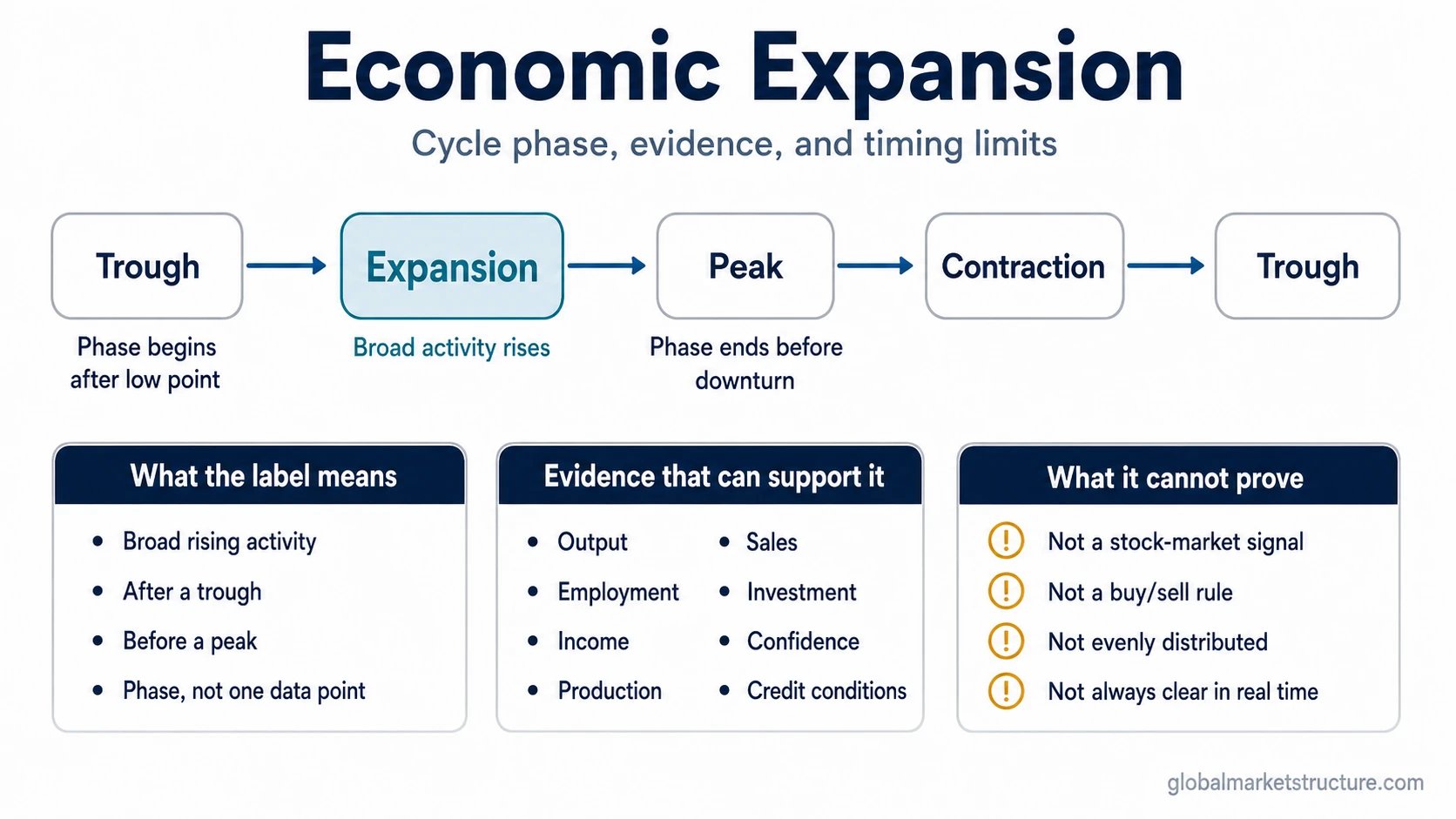
Evidence that can support an expansion label
Evidence for economic expansion becomes stronger when multiple indicators point in the same direction. A single strong report may support the case, but it should not be treated as complete proof.
| Evidence area | What it can support | Limitation |
|---|---|---|
| Output / real GDP | Broad production and spending are increasing. | GDP can be revised and may not show uneven sector conditions. |
| Employment | Labor demand is improving and firms are adding workers. | Labor data can lag turning points and may hide job-quality differences. |
| Income | Household earning power is improving. | Aggregate income can rise while gains are unevenly distributed. |
| Industrial production | Factory, mining, or utility activity is strengthening. | Production can be sector-specific and sensitive to temporary shocks. |
| Sales / demand | Consumers or businesses are spending more. | Nominal sales can be affected by inflation, not only real activity. |
| Investment / business activity | Firms may be expanding capacity, inventories, or capital spending. | Investment is supporting context and can weaken before headline activity turns down. |
| Confidence | Households and firms may be more willing to spend, hire, or invest. | Sentiment is supporting context because it can move faster than actual activity. |
| Credit / financial conditions | Financing conditions may support borrowing, spending, and risk appetite. | Credit conditions are market context, not official proof of expansion by themselves. |
The strongest interpretation comes from confirmation across output, labor, income, demand, and production. Supporting indicators such as investment, confidence, and credit conditions can add context, but they should not be treated as official proof on their own.
What economic expansion does not prove
Economic expansion is not a stock-market timing signal. Equity markets can anticipate economic improvement, lag the data, or diverge from macro conditions because prices also reflect valuation, liquidity, rates, earnings expectations, and positioning.
Economic expansion is not a buy or sell rule. The label describes broad economic activity. It does not tell investors when to enter, exit, increase risk, reduce risk, or assume that returns will be positive.
Economic expansion is not evenly distributed. Some sectors, regions, industries, households, or balance sheets can remain under pressure even while aggregate activity improves.
Economic expansion is not always obvious in real time. Data arrives with delays, revisions, and conflicting signals. A phase label can become clearer only after enough evidence accumulates.
Economic expansion vs recovery, growth, and market performance
Economic expansion is often confused with nearby concepts. The differences matter because each label answers a different question.
| Concept | Meaning | Common confusion |
|---|---|---|
| Expansion | A business-cycle phase of broad rising activity between a trough and a peak. | It is sometimes reduced to GDP growth alone. |
| Recovery | The repair phase after a downturn, often early in the expansion. | It is sometimes treated as identical to the full expansion phase. |
| Long-term growth | The economy’s underlying capacity to produce more over time. | It is sometimes confused with the cyclical upswing. |
| Market performance | The behavior of asset prices during or around the economic phase. | It is sometimes assumed to follow the economy mechanically. |
Why expansion can be hard to identify in real time
Economic expansion can look clearer in hindsight than it does while data is still arriving. Early in the phase, some indicators may improve while others remain weak. Later in the phase, headline activity may still look strong while more sensitive indicators begin to soften.
Revisions also matter. GDP, income, employment, and production data can change after initial release. That is why a real-time expansion reading should be treated as an evidence-based interpretation, not as an immediate official classification.
The practical risk is overconfidence. A few positive reports can support an expansion case, but they do not remove the need to check breadth, persistence, and consistency across the broader economy.
How expansion connects to market-cycle interpretation
For market-cycle analysis, economic expansion provides macro context. It can help explain why earnings expectations, credit appetite, sector leadership, or risk sentiment may improve. But the economic label is only one layer of interpretation.
Markets can move before the economic data confirms a phase, and they can weaken before the expansion is officially over. A market-cycle view therefore needs separate evidence from liquidity, rates, valuation, credit, breadth, positioning, and cross-asset behavior.
Related concepts
Expansion belongs inside the broader business-cycle framework. Recovery describes the early repair after a downturn. Contraction describes the downward phase after a peak. Recession, depression, and business-cycle stages require separate evidence and should not be collapsed into the expansion label.
FAQ
What is economic expansion in economics?
Economic expansion is a business-cycle phase in which broad economic activity rises after a trough and before a peak. It is usually associated with stronger output, employment, income, production, sales, and business activity.
What happens during an economic expansion?
During an economic expansion, real activity usually improves across several parts of the economy. Output, labor demand, income, production, sales, investment, and confidence may strengthen, although not every sector or household benefits equally.
Is economic expansion the same as recovery?
No. Recovery usually describes the early repair after a downturn, while expansion can continue after lost activity has been regained. Recovery can be part of an expansion, but the two terms are not identical.
Does economic expansion mean the stock market will rise?
No. Economic expansion does not guarantee stock-market gains. Asset prices also depend on valuation, liquidity, interest rates, earnings expectations, positioning, and investor sentiment.
How is economic expansion measured?
Economic expansion is usually assessed through a broad evidence set that can include real output, employment, income, industrial production, sales, and other supporting indicators. Official dating and real-time interpretation are not the same thing.
When does an economic expansion end?
An economic expansion ends at a business-cycle peak. After that point, the peak-to-trough phase is commonly described as contraction or recession, depending on the framework and severity of the downturn.