
A secular bear market is a long-duration market regime in which the broad market struggles to make durable progress across many years. It is different from a cyclical bear market, which is a shorter decline inside the larger cycle. Strong rallies can occur inside a secular bear market, so the label is not a market-bottom signal, buy/sell rule, or current-cycle call.
Definition: A secular bear market describes a prolonged market regime where broad trend progress is weak, interrupted, or difficult to sustain over a long period. The focus is the long-cycle market environment, not one correction, one recession, or one short-term decline.
The useful role of the term is classification. It separates a long-cycle market regime from shorter market declines, economic-cycle labels, and current-market opinions. A secular bear market can include powerful advances, but those rallies do not automatically end the longer regime.
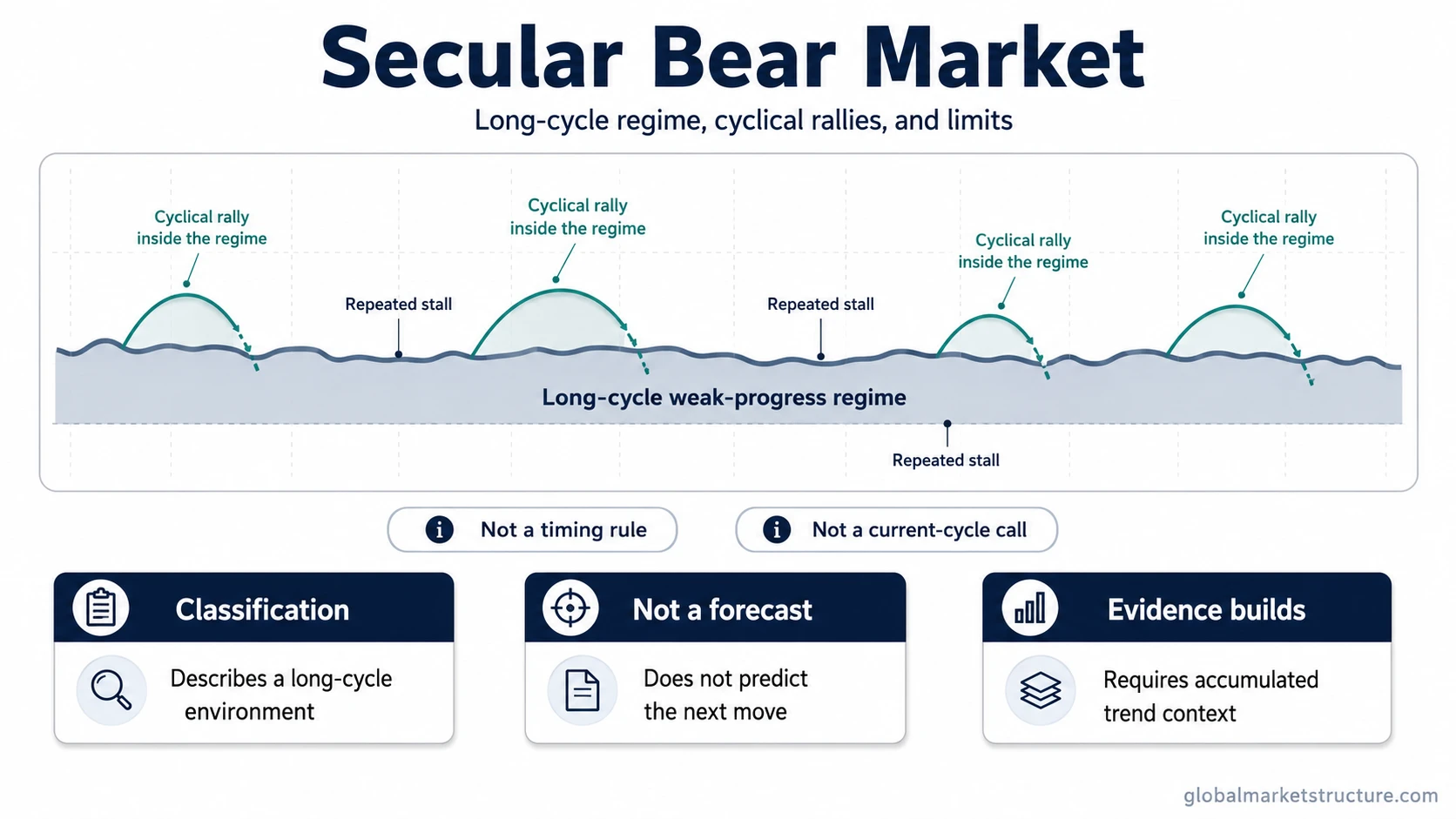
What a Secular Bear Market Is and Is Not
The term becomes clearer when it is separated from the claims people often attach to it. A secular bear market is a regime description. It is not a trading system, valuation formula, recession label, or prediction that the next market move must be lower.
| Statement | Correct interpretation | What it does not mean |
|---|---|---|
| Long-duration regime | The market struggles to sustain durable long-cycle progress across many years. | It does not describe every short correction or ordinary bear market. |
| Can include rallies | Strong cyclical rallies can occur inside the longer weak regime. | A rally does not automatically prove the secular bear market is over. |
| Weak real-return progress | The label often focuses on whether broad market gains persist after inflation and valuation pressure are considered. | It does not require prices to fall in a straight line. |
| Different from a cyclical bear market | A cyclical bear market is shorter and can occur inside a larger secular regime. | The terms should not be used as interchangeable labels. |
| Different from recession or depression | A secular bear market is a market-regime label, while recession and depression describe economic downturn conditions. | It does not prove that the economy is in recession or depression. |
| Not a timing signal | The label may help describe the broader environment after evidence accumulates. | It does not identify the next bottom, top, entry, exit, or future return. |
Secular Bear Market vs Cyclical Bear Market
A cyclical bear market is a shorter market decline within the normal cycle of advances and pullbacks. A secular bear market is broader and longer. It describes a regime where the market repeatedly struggles to make lasting progress, even if individual rallies inside that period are large.
The distinction matters because the two labels answer different questions. A cyclical bear market asks whether the market is in a shorter downside phase. A secular bear market asks whether the longer market environment is still dominated by weak trend progress, valuation pressure, or repeated failure to sustain durable real gains.
A secular bear market can contain cyclical bull phases. Those rallies may be large or meaningful in market history, but the secular label depends on the larger pattern. The opposite long-cycle label is a secular bull market, where the broader regime is defined by sustained long-duration progress rather than repeated long-cycle frustration.
How Secular Bear Markets Can Develop
Secular bear markets can develop when the prior market regime leaves behind conditions that make durable progress harder. Those conditions may include elevated valuations, weak real-return progress, repeated macro shocks, tightening liquidity conditions, or long periods where rallies fail to reset the broader trend in a lasting way.
The mechanism is not one single data point. A short selloff does not create a secular bear market by itself. The label becomes more defensible only when evidence accumulates across time: price behavior, inflation-adjusted progress, valuation pressure, participation, and the market’s ability or inability to sustain new long-cycle highs.
That is why secular bear market analysis should be cautious in real time. The pattern is often easier to classify after a long period of evidence has already formed. Calling it too early can turn a regime concept into a prediction, which is not the role of the term.
What Evidence Can Support the Label?
A secular bear market label is stronger when several kinds of evidence point in the same direction. The evidence should describe a broad market environment, not one bad quarter, one policy event, or one index drop.
| Evidence area | What it can show | Why it is not enough alone |
|---|---|---|
| Long trend behavior | Whether broad market progress is repeatedly interrupted or reversed over many years. | Short-term trend weakness can happen inside many regimes. |
| Real-return context | Whether nominal gains remain meaningful after inflation is considered. | Inflation-adjusted analysis still needs a long enough evidence window. |
| Valuation pressure | Whether starting valuations or multiple compression make sustained progress harder. | Valuation does not provide precise timing by itself. |
| Rally quality | Whether advances restore durable trend progress or fade into another long-cycle stall. | A failed rally is not enough unless it fits a broader pattern. |
| Cycle breadth | Whether weakness is broad enough to describe the market environment rather than a narrow segment. | Weakness in one sector or theme may not define the whole market. |
The strongest use of the concept is therefore descriptive and evidence-based. It can help organize long-cycle interpretation, but it should not be used as a standalone forecast.
Practical Illustrative Scenario
Imagine a broad market that rises sharply after several declines, but each advance fails to sustain durable progress once inflation, valuation pressure, and the longer trend are considered. Over time, the market produces several strong rallies, yet the larger environment still looks range-bound, pressured, or unable to compound meaningfully.
That scenario can resemble the logic of a secular bear market, but only after enough evidence builds across time. The label still does not reveal the next market bottom, the next rally size, or the correct portfolio action. It only describes the possibility that the larger regime remains difficult despite shorter cyclical advances.
What the Label Cannot Prove
A secular bear market label does not prove what happens next. It does not say that the market must fall tomorrow, that rallies should be sold, that investors should change allocation, or that a new low is unavoidable.
The label also does not prove that the economy is in recession. A recession is an economic-cycle downturn, while a secular bear market is a market-regime classification. The two can overlap, but one does not automatically establish the other.
It is also not the same as an economic depression. Depression refers to a severe, prolonged, economy-wide downturn. A secular bear market may reflect long-term market difficulty, but it does not by itself prove depression-level economic conditions.
Questions like “are we in a secular bear market now?” require current evidence, not just the definition of the term. Without a current-cycle evidence review, the concept should remain a classification tool rather than a live market call.
The most common mistake is using a long-cycle label as if it were a near-term signal. A secular bear market can describe the backdrop, but market timing still depends on separate evidence. The label does not provide buy, sell, hedge, or allocation instructions.
Related Cycle Concepts
Secular bear market belongs inside the broader cycle-phase vocabulary. It is closest to ordinary bear market terminology, but it operates on a longer horizon and should not be reduced to a single decline. For comparison, the broader bear market concept covers the shorter decline label separately.
The cleanest contrast is with secular bull market, where the long-cycle environment supports durable progress across many years. Economic depression is a separate boundary because it classifies severe economy-wide contraction rather than long-cycle market trend behavior.
FAQ
What is a secular bear market?
A secular bear market is a long-duration market regime where broad market progress is weak, interrupted, or difficult to sustain across many years. It is a regime label, not a short-term trading signal.
Can markets rally during a secular bear market?
Yes. Strong cyclical rallies can occur inside a secular bear market. A rally can be meaningful without automatically ending the larger long-cycle regime.
Is a secular bear market the same as a recession?
No. A recession is an economic downturn label. A secular bear market is a market-regime label. They can overlap, but they are not the same concept.
Is a secular bear market a buy or sell signal?
No. The label does not identify entries, exits, bottoms, tops, future returns, or portfolio actions. It describes a possible long-cycle market environment.
Can you know a secular bear market in real time?
Usually not with certainty. The label often becomes more defensible only after accumulated evidence across trend behavior, real returns, valuation pressure, and repeated failed progress.