
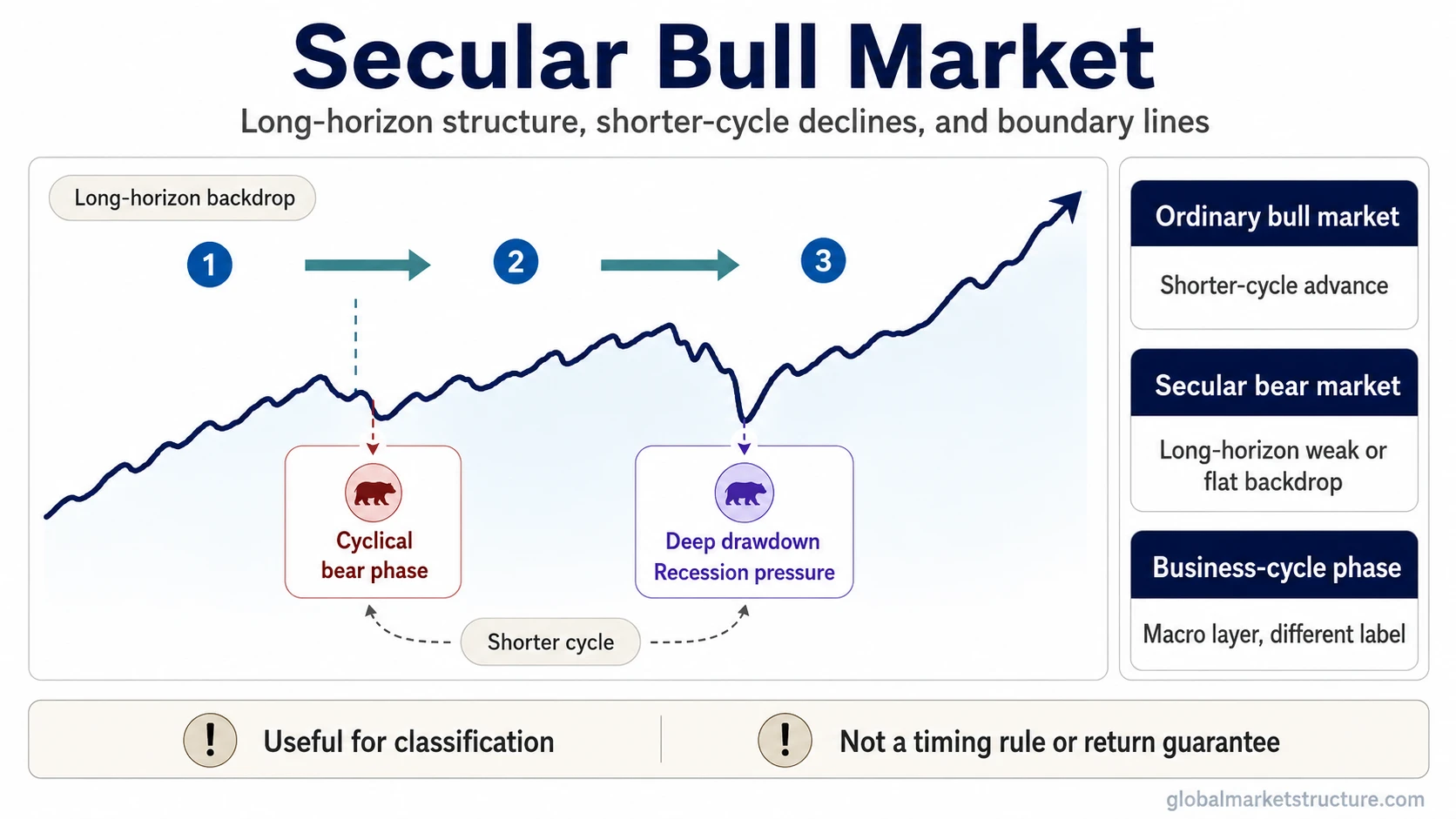
A secular bull market is a long-duration upward market trend that persists across shorter cycles. It describes dominant market structure over years, not a promise of uninterrupted gains. Deep corrections, cyclical bear markets, and recession-linked drawdowns can still occur inside it. The term is most useful as a classification label, not as a timing rule, return guarantee, or asset-allocation signal.
Core idea: Secular bull market refers to the broader upward structure. Shorter rallies and selloffs still happen inside that broader structure, so the label should not be read as a claim that risk disappears or that every shorter decline is irrelevant.
How It Differs From Shorter Bull-Market Language
The easiest mistake is to treat secular bull market as a more dramatic way to say bull market. That is not the same thing. Ordinary bull-market language is often used for a shorter advance or a local recovery phase. Secular bull market points to the longer structural backdrop that remains in place even while several shorter cycles unfold inside it.
| Label | Main meaning | Usual horizon | Main caution |
|---|---|---|---|
| Secular bull market | Long-horizon upward market structure | Multi-year | Can still include cyclical bear phases and large drawdowns |
| Bull market | Upward market phase or sustained advance | Shorter-cycle or context-dependent | Does not automatically describe the broader secular backdrop |
| Secular bear market | Long-horizon weak, flat, or structurally pressured backdrop | Multi-year | Should not be reduced to one local selloff |
| Business-cycle phase | Economic expansion, contraction, peak, or trough | Macro cycle | Economic phases and market secular labels are related but not identical |
That distinction matters because a market can remain inside a broader secular bull structure while experiencing shorter periods of real stress. The label is about the dominant long-horizon direction, not about denying that shorter-cycle weakness exists.
How the Term Is Usually Used
The term is usually used to describe a market that keeps making long-horizon progress despite meaningful interruptions. One strong rally by itself is not enough. The broader structure matters more than one isolated move, because the term tries to classify the dominant trend across time rather than summarize one short episode.
Practical reading: The label becomes more defensible when the market repeatedly recovers from major setbacks, reasserts its broader upward trend, and continues to make long-horizon structural progress. That still does not remove uncertainty about exact turning points, because the boundaries of a secular phase are often clearer only after more evidence accumulates.
For that reason, the term should be read as interpretive classification language. It helps organize the broader backdrop, but it does not act like a precise timing tool. It is possible for market participants to debate whether a secular phase has begun, ended, or merely paused, especially near major turning points.
Why Deep Declines Can Still Happen Inside It
A secular bull market does not require a smooth path. The broader structure can remain upward even while shorter periods of fear, economic weakness, tighter financial conditions, or valuation pressure produce large drawdowns. Those shorter declines may feel decisive in real time, but they do not automatically settle the longer structural question.
A simple illustrative scenario is a market that trends upward across several years, then falls sharply during recession pressure, and later resumes its broader advance. The recession-linked selloff is still real, and the damage can still be severe. What matters for the secular label is whether that decline turns out to be an interruption inside the broader structure or evidence that the longer structure has genuinely changed.
Key limitation: The label does not prove that every selloff should be ignored, that risk is low, or that recovery will be fast. It only says that the dominant long-horizon structure is interpreted as upward. Real-time market decisions still require separate work on risk, valuation, macro conditions, and timing uncertainty.
What the Label Can and Cannot Prove
Most confusion around secular bull market comes from overreading it. The term can clarify how a market is being classified across a long horizon, but it cannot do the work of prediction, allocation, or certainty.
| What it can do | What it cannot do |
|---|---|
| Describe the dominant long-horizon market structure | Guarantee future returns |
| Help separate secular structure from cyclical noise | Rule out recessions, corrections, or cyclical bear markets |
| Support broader market-structure interpretation | Act as a timing rule for entry, exit, or allocation decisions |
| Clarify why shorter declines may not settle the bigger trend on their own | Prove that a current market phase is already confirmed in real time |
| Organize discussion of long-horizon trend behavior | Provide a universal fixed duration formula |
The label is therefore strongest when it stays inside its own job. It can clarify structure. It becomes weak when it is stretched into a prediction about what must happen next.
Why Timing Uncertainty Matters
Secular labels are often easiest to apply after enough evidence has accumulated. That matters because turning points are rarely obvious when they first appear. A long-duration market phase can overlap very different shorter environments, including periods associated with a business cycle trough, recession pressure, or rapid recovery. Those shorter phases may influence interpretation, but they do not automatically define the secular label.
That is why secular bull market should be treated as a disciplined description of the broader backdrop rather than as a claim that near-term market direction is settled. The longer the horizon, the more important it becomes to separate classification from certainty.
Related Long-Horizon Contrast
The closest opposite concept is secular bear market. Reading the two side by side helps separate a persistent upward structural backdrop from a persistent weak or range-bound one. That contrast is more useful than collapsing both ideas into ordinary bull-versus-bear language, because the secular labels are trying to describe the longer structure beneath shorter market swings.
FAQ
Can a secular bull market include bear markets?
Yes. A secular bull market can still include cyclical bear phases, deep corrections, and recession-linked drawdowns. The label describes the broader long-horizon structure, not a smooth path without setbacks.
Is a secular bull market the same as economic expansion?
No. Economic expansion belongs to the business-cycle layer, while secular bull market belongs to long-horizon market classification. The two can interact, but they are not interchangeable terms.
Does a secular bull market predict future returns?
No. It can help classify the dominant long-horizon trend, but it does not guarantee returns, remove downside risk, or replace separate judgment about valuation, timing, and macro conditions.
How long does a secular bull market last?
There is no universal rule. Secular phases are often discussed in broad historical terms, but exact start and end points are usually debated and become clearer only after more evidence accumulates.