
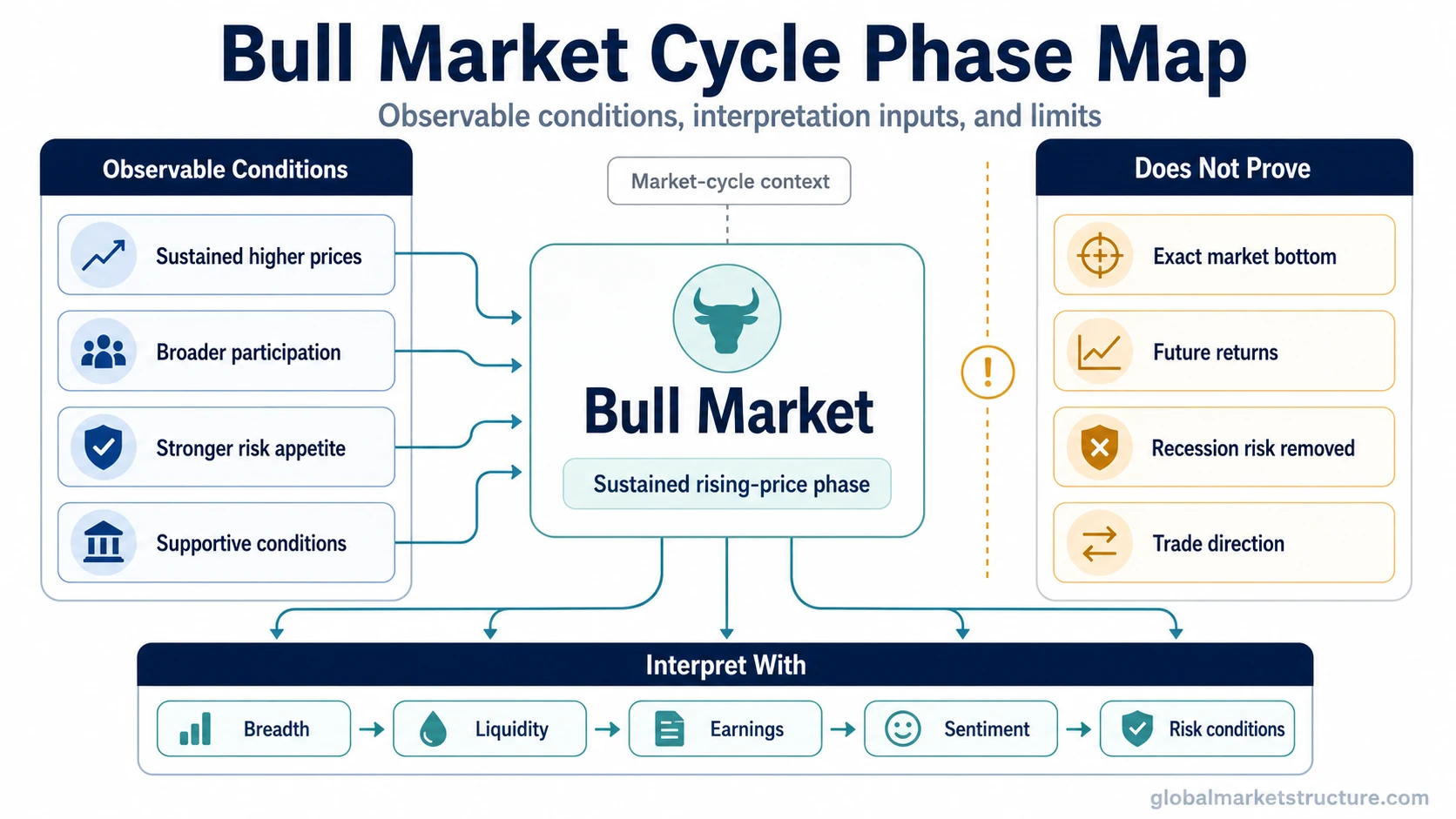
A bull market is a sustained rising-price phase used to classify market-cycle conditions. It can describe stronger price behavior, broader participation, improving confidence, or stronger risk appetite, but it does not prove the exact market bottom, predict the next return, remove recession risk, or justify a trade by itself.
Many market explanations use a roughly 20% rise from a prior low as a broad convention, but the threshold is not a precise real-time timing rule. Markets can cross a threshold after the turning point has already passed, and the label can still be revised as new price and participation evidence develops.
What Is a Bull Market?
A bull market is a market-cycle phase in which prices rise in a sustained way rather than only bouncing for a few sessions or reacting to one event. In Global Market Structure context, the concept is most useful as a descriptive regime label. It helps classify the direction and quality of market behavior, not a guaranteed outcome.
The label usually becomes more credible when rising prices are supported by broader participation, stronger leadership, improving risk appetite, and fewer signs of forced selling. None of those conditions removes uncertainty. A bull market can still contain corrections, pullbacks, failed rallies, and periods where macro data remain mixed.
How a Bull Market Fits Into Cycle Phases
A bull market sits inside the broader market-cycle framework as an upward phase in asset prices. It may appear after a recovery, continue during an expansion, or overlap with changing liquidity and earnings expectations. The key point is that the label describes market behavior; it does not independently identify why that behavior is happening.
This is why bull markets are often easier to label after the fact than at the exact turning point. Early in a new advance, the same price action can still look like a bear-market rally, a recovery attempt, or a temporary rebound. The classification becomes stronger only as price behavior, participation, and risk appetite keep confirming the phase.
What a Bull Market Can Show
A bull-market reading can show that buyers are absorbing supply over time and that risk appetite is improving. It can also suggest that market leadership is becoming broader, liquidity conditions are less restrictive, or earnings expectations are becoming less negative. These are observations to evaluate together, not automatic conclusions.
In practice, a market can rise for several months with wider participation and stronger confidence. That may support a bull-market classification, but it still does not prove that the bottom was recognized in real time or that future returns are guaranteed. The useful reading is contextual: the phase may be improving, while timing and outcome risk remain open.
What a Bull Market Does Not Prove
The main mistake is treating a bull-market label as a signal. A bull market does not prove the exact bottom, does not identify the next top, does not guarantee future gains, and does not remove the possibility of recession, volatility, or a later reversal.
It also does not create an allocation rule. The same bull-market label can appear in different environments: broad participation, narrow leadership, strong liquidity, fading liquidity, improving earnings, or speculative excess. Each environment changes the interpretation of the label.
Practical boundary: A bull market helps classify market context. It should be read with breadth, liquidity, earnings, sentiment, and risk conditions rather than used as a standalone instruction.
Observable Conditions vs What They Do Not Prove
| Observable condition | What it may suggest | What it does not prove |
|---|---|---|
| Sustained higher prices | The market may be shifting into an upward cycle phase. | It does not prove the exact bottom or guarantee the next advance. |
| Broader participation across more sectors or assets | The advance may be healthier than a narrow rally led by a few names. | It does not prove that risk has disappeared or that all assets will rise. |
| Improving confidence and stronger risk appetite | Market participants may be more willing to hold risk exposure. | It does not prove that macro conditions are strong or that recession risk is gone. |
| Pullbacks that remain contained | The phase may be absorbing selling pressure without breaking trend structure. | It does not prove that the trend cannot fail later. |
| Support from liquidity, earnings, or sentiment | The bull-market reading may have a stronger underlying basis. | It does not prove that those supports will persist. |
Bull Market vs Related Cycle Concepts
A Bear Market is the opposite phase, where prices fall in a sustained way and risk appetite usually weakens. The deeper distinction belongs on the Bull Market vs Bear Market comparison page, because that intent is about separating the two conditions directly.
A Secular Bull Market is a longer-term structural environment, not just a cyclical upswing. A normal bull-market phase can occur inside a larger secular context, but the two labels answer different questions.
For broader navigation across phase labels, the Cycle Phases route separates bull markets from recovery, expansion, contraction, recession, trough, peak, and other cycle-stage concepts.
Practical Reading Boundary
A bull-market label is most useful when it prevents vague language. Instead of saying that markets are simply “good” or “risk-on,” the label forces a clearer question: are prices rising in a sustained way, is participation broadening, and are the conditions behind the advance still supportive?
The label becomes weaker when the advance is narrow, when liquidity conditions deteriorate, when earnings expectations weaken, or when risk appetite becomes speculative without broader support. Those conditions do not automatically end a bull market, but they change the quality of the interpretation.
Final Clarification
A bull market is a descriptive cycle-phase label. It can help classify a market environment, but it should not be treated as proof of timing, future returns, recession probability, or trade direction. The strongest reading comes from combining price behavior with participation, liquidity, earnings, sentiment, and risk conditions.