
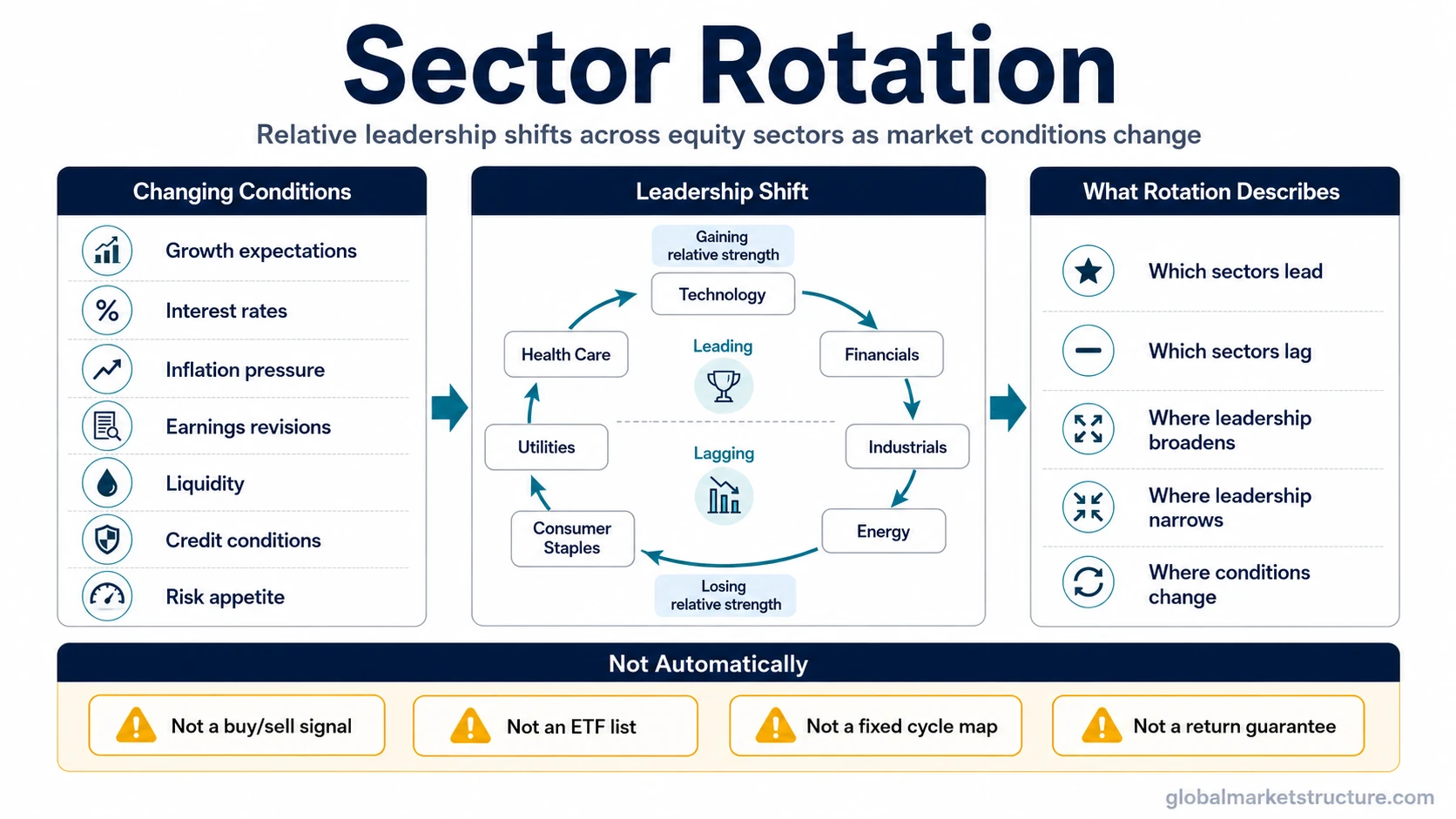
Sector rotation is the shift in relative leadership among equity sectors as investors reprice growth, interest rates, inflation, earnings expectations, liquidity, credit conditions, and risk appetite. It is a market-structure concept, not automatically a timing rule, ETF allocation method, sector recommendation, or return guarantee.
Short answer: sector rotation describes which equity sectors are leading, lagging, gaining relative strength, or losing relative strength during a market cycle. The concept helps explain leadership distribution across the market, but it does not by itself tell an investor which sector to buy, when to rotate, or how long the shift will last.
What Sector Rotation Measures
Sector rotation measures relative performance across sector groups rather than the absolute direction of the whole market. A broad equity index may be rising while leadership moves from one set of sectors to another. A market may also be weak overall while some defensive or rate-sensitive areas lose less than the index and therefore show relative leadership.
The useful question is not only whether stocks are rising or falling. The useful question is which parts of the equity market are carrying the move. When leadership is concentrated in a few sectors, market structure looks different from a phase where many sectors participate. When leadership shifts repeatedly, the market can become harder to interpret because the surface index may hide changing conditions underneath.
Sector rotation is therefore connected to market leadership, but it is narrower. Market leadership can describe leadership by sector, style, region, factor, index, or asset class. Sector rotation focuses specifically on leadership movement among equity sectors.
Why Sectors Rotate
Sectors rotate because different parts of the equity market respond differently to changes in the economic and market environment. Growth expectations, interest rates, inflation pressure, margins, earnings revisions, liquidity, credit spreads, and risk appetite can change which sectors investors prefer at a given point in the cycle.
Growth-sensitive areas may attract more attention when investors expect stronger demand, improving earnings, or rising risk appetite. Lower cycle-sensitivity areas may become more important when investors focus on earnings resilience, balance-sheet quality, or reduced exposure to economic weakness. The distinction between cyclical sectors and defensive areas is one reason sector rotation is often discussed alongside the business cycle.
Rates also matter. Some industries are more sensitive to discount rates, financing conditions, and yield changes than others. A move in yields can change valuation pressure, earnings expectations, and investor preference across rate-sensitive sectors, even when the broad equity index does not immediately show the full effect.
The mechanism is not mechanical. A sector does not lead simply because a textbook cycle map says it should. Markets often price expectations before the economic data fully confirms them, and sector leadership can shift for several reasons at the same time.
Sector Rotation vs Related Concepts
Sector rotation is easier to interpret when it is separated from nearby terms. Several related concepts overlap with it, but they do not mean the same thing.
| Concept | What it means | How it differs from sector rotation |
|---|---|---|
| Sector rotation | Relative leadership shifts among equity sectors. | This is the core concept: which sectors lead or lag as conditions change. |
| Market leadership | Leadership across sectors, styles, factors, regions, indexes, or assets. | Broader than sector rotation because leadership does not have to be sector-based. |
| Style rotation | Leadership shifts between styles or factors such as growth, value, quality, or momentum. | Style rotation is factor-oriented, while sector rotation is industry-group oriented. |
| Cyclical sectors | Sector groups whose earnings and demand tend to be more sensitive to economic growth. | They are a sector classification, not the rotation process itself. |
| Defensive sectors | Sector groups whose demand and earnings expectations tend to be less sensitive to the cycle. | Defensive sectors may lead in some risk-off or late-cycle conditions, but leadership is context-dependent. |
| Rate-sensitive sectors | Sector groups that can react strongly to interest-rate and yield changes. | Rate sensitivity is one driver that can influence rotation, not the whole concept. |
| Sector rotation strategy | A framework for applying sector rotation analysis in portfolio or market process. | A strategy framework addresses monitoring, process design, and implementation. Sector rotation itself is only the concept being observed. |
What Sector Rotation Is Not
Sector rotation is often confused with implementation. The concept describes changing leadership across sectors. A sector rotation strategy is a separate application framework that may involve rules, portfolio process, timing methods, or risk controls.
| Sector rotation is | Sector rotation is not automatically |
|---|---|
| A way to describe relative sector leadership. | A buy or sell signal. |
| A market-cycle and leadership-distribution concept. | A guarantee that one sector will outperform. |
| A lens for observing how market preferences change. | A complete allocation model. |
| A way to compare sector behavior under different conditions. | A current ranking of the best sectors now. |
| A possible input into broader market interpretation. | An ETF list, tool workflow, or mechanical trading system. |
How Sector Rotation Can Appear in Practice
A common scenario is a shift from higher-growth leadership toward lower cycle-sensitivity leadership while bond yields are falling. That shift may look defensive at first, but the interpretation depends on the surrounding evidence. Falling yields can reflect lower inflation pressure, weaker growth expectations, demand for safety, or a mix of several forces.
The same sector move can have different meanings if credit spreads are calm, liquidity conditions are stable, and earnings revisions remain broad. It can carry a different message if credit spreads widen, market breadth weakens, and leadership narrows into only a few resilient groups. Sector rotation becomes more useful when it is read as part of a broader market structure, not as an isolated signal.
This example is illustrative, not a historical claim. It shows why sector rotation should be interpreted with context rather than treated as a standalone forecast.
Limits and False Readings
Sector rotation can false-start. A sector may lead for a few weeks because of positioning, a short-term rate move, an earnings surprise, or a temporary change in sentiment. That does not prove that a durable market-cycle transition has started.
Sector movement can also reflect anticipation rather than confirmation. Equity sectors often respond to what investors expect next, not only to current economic data. A rotation can therefore appear before macro data confirms the story, and it can reverse if expectations change.
Important limitation: sector rotation does not prove a cycle phase by itself. The signal becomes more useful when it is compared with breadth, liquidity, credit, rates, earnings revisions, and broader leadership behavior.
Stronger vs weaker reading: one rotation reading is weaker when a sector leads briefly while breadth, credit, liquidity, and earnings context remain unchanged. The reading becomes stronger when sector leadership changes alongside broader confirmation, such as shifting breadth, credit conditions, liquidity pressure, or earnings revisions.
Another common mistake is treating every shift in leadership as an instruction. Sector rotation can describe market behavior without implying that a sector should be bought, sold, overweighted, or avoided. Interpretation and implementation are different tasks.
When Sector Rotation Matters Most
Sector rotation matters most when it changes the character of market leadership. A broad move led by economically sensitive sectors can tell a different story from a narrow move concentrated in defensive or rate-sensitive groups. The index level may be similar in both cases, but the internal message is different.
The concept is especially useful when the broad market sends mixed signals. If the index remains near highs while leadership weakens, rotates rapidly, or narrows into fewer sectors, the surface trend may not show the full market structure. If leadership broadens across multiple sectors, the move may have a stronger participation base.
This does not make sector rotation a prediction tool. It makes it a way to read participation, preference, and leadership distribution across the equity market.
When the Question Becomes Strategic
Use the concept of sector rotation to understand what is changing inside the equity market. The question becomes strategic when the focus shifts toward process: how to monitor rotation, how to compare sectors, how to combine sector behavior with other indicators, or how to translate rotation into a portfolio or research workflow.
The distinction matters because observing sector leadership is different from designing a process around it. Sector rotation explains the market behavior. A strategy framework addresses monitoring rules, portfolio process, and implementation boundaries.
FAQ
What is sector rotation?
Sector rotation is the shift in relative leadership among equity sectors as investors reprice growth, rates, inflation, earnings expectations, liquidity, credit conditions, and risk appetite.
Is sector rotation the same as a sector rotation strategy?
No. Sector rotation is the concept of changing sector leadership. A sector rotation strategy is an application framework that may use the concept as one input.
Does sector rotation predict market returns?
Not by itself. Sector rotation can show how leadership is changing, but it does not guarantee future returns or prove that a specific sector will outperform.
How is sector rotation different from market leadership?
Market leadership is broader. It can include leadership by sector, style, factor, region, index, or asset class. Sector rotation focuses specifically on leadership shifts among equity sectors.
How is sector rotation different from style rotation?
Sector rotation compares equity sectors. Style rotation compares styles or factors, such as growth versus value, quality versus cyclicality, or momentum versus defensive characteristics.
Can sector rotation give false signals?
Yes. A sector can lead temporarily because of positioning, earnings surprises, rate moves, or short-term sentiment. Rotation becomes more meaningful when it aligns with broader evidence from breadth, credit, liquidity, rates, and earnings context.