
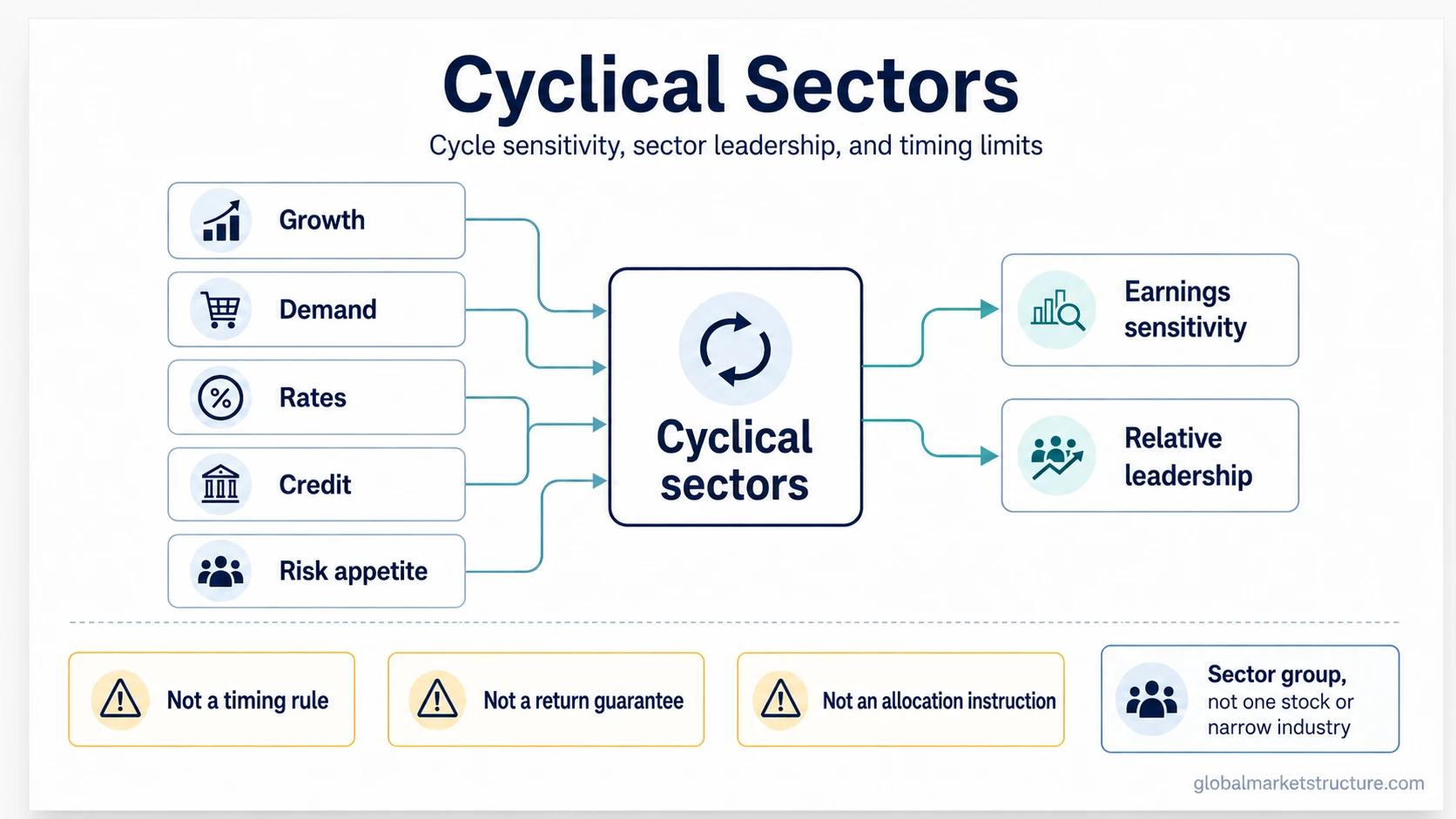
Cyclical sectors are sector groups whose demand, earnings expectations, and relative market leadership tend to be more sensitive to economic growth, rates, credit conditions, and risk appetite. They help classify market-cycle sensitivity inside sector rotation analysis, but they are not a timing rule, return guarantee, or allocation instruction.
The term works at the sector level, not at the level of one stock, one industry, or one portfolio decision. A cyclical sector is usually watched because its revenue base, margin outlook, financing needs, and valuation sensitivity can change more when the economic cycle accelerates or slows.
Key Points
- Cyclical sectors are broad sector groups that tend to respond more to changes in growth, demand, credit, rates, and risk appetite.
- The label is useful for market-cycle interpretation because it helps separate growth-sensitive leadership from more defensive leadership.
- Common sector-level groups often discussed as cyclical include consumer discretionary, industrials, materials, and financials. Narrower cyclical industries can include autos, construction, transportation, travel, and leisure.
- Cyclical strength or weakness does not prove the current cycle phase by itself and should not be treated as a buy, sell, or allocation signal.
What Cyclical Sectors Mean
Definition: Cyclical sectors are sector groups whose business activity and market leadership tend to fluctuate more with the economic cycle than more defensive groups. Their sensitivity usually comes from discretionary spending, business investment, financing conditions, commodity demand, credit availability, or risk appetite.
The concept is a classification tool. It helps describe which parts of the equity market may be more exposed to improving or weakening growth conditions. It does not identify the economic cycle with precision, and it does not convert a sector label into an investment instruction.
The most useful reading is relative. Cyclical sectors matter when their behavior is compared with other groups, broader market breadth, credit conditions, rates, earnings expectations, and the behavior of sector rotation across the market.
How Cyclical Sectors Connect To Market Cycles
Cyclical sectors are linked to market cycles because their underlying businesses often depend on demand that can expand or contract with economic confidence. When households spend more freely, companies invest, credit remains available, and financing costs are manageable, cyclical groups may receive stronger earnings expectations.
That relationship also works in reverse. When growth expectations weaken, credit becomes tighter, margins come under pressure, or financing costs rise, the same groups can lose leadership because their future earnings become less certain. The market may discount that uncertainty before reported earnings fully reflect it.
This is why the label is useful for market-structure analysis. It connects sector behavior to the broader environment: growth expectations, rate pressure, credit conditions, valuation sensitivity, risk appetite, and leadership breadth.
Cyclical Sector Mechanism
The mechanism is not one signal. It is a chain of conditions that can strengthen or weaken the interpretation.
| Component | What it means | What can mislead the reading |
|---|---|---|
| Demand sensitivity | Revenue can respond more to consumer confidence, business investment, housing activity, travel, capital spending, or commodity demand. | Short bursts of demand can look cyclical even when they are driven by one temporary event or narrow industry factor. |
| Earnings sensitivity | Earnings expectations may move more when sales volumes, margins, input costs, or operating leverage change. | A sector can rise on lower discount rates even if earnings quality has not improved. |
| Rate and financing sensitivity | Higher or lower financing costs can affect capital-intensive groups, credit demand, construction activity, and valuation multiples. | Falling rates can support valuations even when the growth outlook is weakening. |
| Credit conditions | Easier credit can support borrowing, investment, spending, and risk appetite. | Credit stress can weaken the interpretation even if equity-sector performance still looks strong. |
| Relative leadership | Cyclical sectors may lead when the market is pricing stronger growth or improving risk appetite. | Narrow leadership in one industry does not prove broad cyclical leadership. |
Common Cyclical Sector Groups
Common sector-level groups often discussed as cyclical include consumer discretionary, industrials, materials, and financials. These groups are not identical, and they do not respond to the same drivers in the same way.
Consumer discretionary may be more sensitive to household confidence, financing costs, employment, and real income. Industrials may be more sensitive to capital spending, production activity, infrastructure demand, and business confidence. Materials may respond to commodity demand, global manufacturing, and construction. Financials may respond to credit demand, rate structure, loan growth, asset quality, and risk appetite.
Narrower industries can also be cyclical. Autos, construction, transportation, travel, leisure, and some commodity-linked industries may be discussed as cyclical because demand can fluctuate with broader economic conditions. That does not mean every company inside those groups behaves the same way.
Cyclical Sectors Versus Defensive Sectors
Cyclical sectors are usually contrasted with Defensive sectors. The distinction is based on how sensitive a group tends to be to the economic cycle.
Defensive sectors are usually discussed as groups where demand may be less sensitive to the cycle, such as essential consumer goods, utilities, and some healthcare-related activity. Cyclical sectors are usually discussed as groups where revenue, margins, earnings expectations, and market leadership can change more with growth expectations and risk appetite.
The contrast is useful, but it should not be treated as a fixed ranking of quality. A defensive sector can become expensive or rate-sensitive. A cyclical sector can have strong balance sheets or stable sub-industries. The classification helps organize cycle sensitivity; it does not replace company, valuation, liquidity, or macro analysis.
What Cyclical Sector Strength Can Suggest
Cyclical sector strength can suggest that markets are pricing better growth expectations, easier financial conditions, stronger demand, or improving risk appetite. The interpretation becomes stronger when leadership broadens across several cyclical groups and is supported by earnings revisions, credit conditions, breadth, and liquidity.
It becomes weaker when only one narrow industry is leading, when credit spreads are widening, when earnings revisions are deteriorating, or when the move appears driven mainly by falling discount rates instead of stronger business activity.
The label should therefore be read as part of a broader evidence set. Cyclical leadership can support a market-cycle interpretation, but it cannot identify the cycle phase on its own.
What Cyclical Sectors Do Not Prove
Limit: Cyclical sectors do not prove that an expansion has started, that a recession has ended, that a market bottom is in place, or that a portfolio should be changed. They are one classification layer inside sector rotation and market-cycle analysis.
Cyclical strength can appear during recoveries, mid-cycle rebounds, rate-driven valuation rallies, short squeezes, commodity moves, or narrow industry-specific episodes. Cyclical weakness can appear before recessions, during temporary growth scares, after strong prior performance, or when interest-rate pressure changes valuation assumptions.
For that reason, cyclical sector behavior should be interpreted with other evidence rather than used as a standalone rule. The same leadership pattern can mean different things depending on credit conditions, rates, earnings revisions, breadth, liquidity, and the position of the broader market cycle.
False Readings And Common Mistakes
A common mistake is treating cyclical sector strength as confirmation that the economy is already in expansion. Markets can anticipate changes before the economic data is clear, but they can also overreact to short-term changes in rates, positioning, or sentiment.
Another mistake is mixing sector and industry language. A broad sector may contain several industries with different sensitivities. A narrow industry rally does not automatically mean that the whole cyclical category is leading.
A third mistake is treating cyclical sectors as the opposite of risk. Cyclical exposure can become attractive or unattractive depending on valuation, balance-sheet quality, earnings durability, rate pressure, and the surrounding macro, credit, and cross-asset evidence.
A clean interpretation usually requires confirmation beyond sector labels. The market may rotate into cyclical groups for reasons that are temporary, valuation-driven, rate-driven, or concentrated in a narrow industry. Cyclical sectors work best as one input inside a broader market-structure process.
Practical Scenario
Example scenario: Growth expectations begin to improve, financial conditions become easier, and leadership starts to broaden from defensive groups into industrials, consumer discretionary, financials, and materials. That can support the interpretation that the market is pricing a stronger growth environment.
The same scenario becomes less reliable if credit spreads widen, margins deteriorate, or leadership narrows into only a few groups. It also becomes weaker if cyclicals rise mainly because discount rates fall while earnings revisions and breadth remain soft. In that case, cyclical strength may reflect a temporary rotation rather than a durable market-cycle shift.
How Cyclical Sectors Fit Sector Rotation
Cyclical sectors are one category used inside sector rotation analysis. They help show whether market leadership is moving toward growth-sensitive areas or away from them. That leadership pattern can be useful, but it needs context from rates, credit, earnings revisions, liquidity, and breadth.
A sector-level label should stay separate from a strategy framework. Broader application belongs with sector rotation strategy, where the focus can be signal sequencing, confirmation, and limitations without converting a category label into investment guidance.
Related path: Cyclical sectors define the growth-sensitive category. Sector rotation explains the broader leadership process, defensive sectors cover the contrast category, and the cyclical-versus-defensive distinction separates the two groups directly.
FAQ
What are cyclical sectors?
Cyclical sectors are sector groups whose demand, earnings expectations, and market leadership tend to be more sensitive to economic growth, rates, credit conditions, and risk appetite. They are used to classify market-cycle sensitivity, not to identify exact timing or prescribe allocation.
Which sectors are commonly cyclical?
Commonly cyclical areas include consumer discretionary, industrials, materials, financials, transportation, autos, construction, travel, and leisure. The exact classification can vary by taxonomy, region, and business mix.
Are cyclical sectors the same as cyclical stocks?
No. Cyclical sectors are broad sector-level groups. Cyclical stocks are individual companies or equity groups whose business results and valuations may be sensitive to the economic cycle.
Are cyclical sectors a timing signal?
No. Cyclical sector strength or weakness can support market-cycle interpretation, but it does not prove recovery, recession, expansion, contraction, or exact timing by itself.
What is the difference between cyclical and defensive sectors?
Cyclical sectors tend to be more sensitive to growth, credit, demand, and risk appetite. Defensive sectors are usually discussed as groups with demand that may be less sensitive to the economic cycle.