
Growth stocks are shares of companies expected to grow revenue, earnings, or business scale faster than the broader market, sector, or peer group. In market-cycle and style-rotation analysis, they represent a growth-oriented style category, not a buy or sell rule. Growth leadership can help interpret expectations around future earnings, rates, liquidity, and risk appetite, but it does not forecast returns or prove a cycle phase.
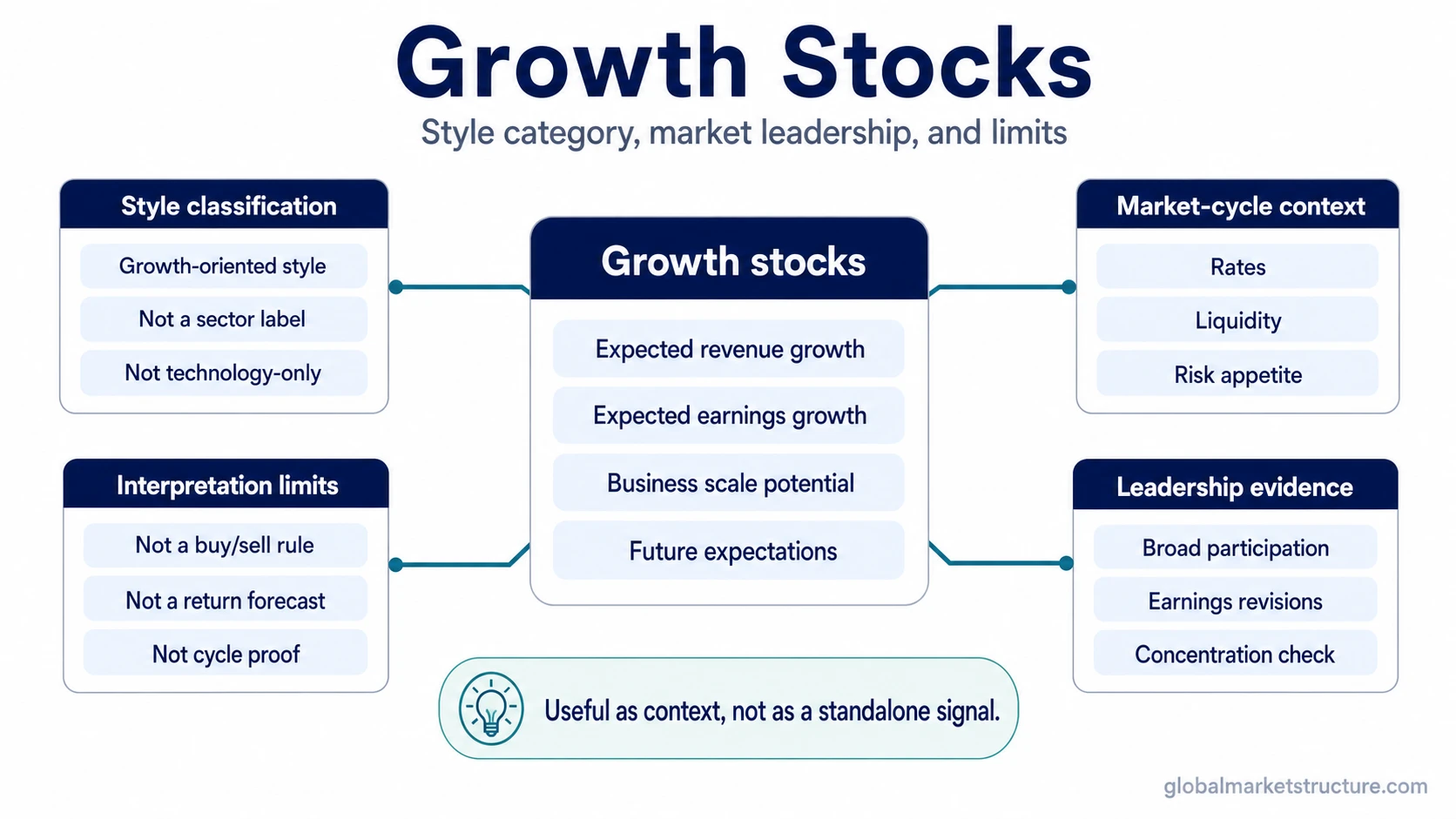
What Makes a Stock a Growth Stock
A growth stock is usually defined by expectations about future business growth rather than by current income, dividend yield, or low valuation. The market often pays attention to revenue growth, earnings growth, market share expansion, product adoption, margin potential, or a business model that can scale over time.
Many growth companies reinvest cash into expansion instead of emphasizing dividends. That reinvestment may support future growth, but it also raises the bar for execution. If earnings expectations weaken, valuation can compress quickly because part of the stock’s value may depend on future results that have not yet been delivered.
The label is therefore about expected business characteristics and market classification. It does not mean the share price must rise, and it does not mean the company is automatically high quality.
Growth Stocks in Market-Cycle and Style-Rotation Context
Growth stocks matter in market-cycle analysis because style leadership can reveal what investors are rewarding. When growth leadership broadens, markets may be placing more weight on future earnings potential, lower discount-rate pressure, easier liquidity conditions, or stronger risk appetite.
That interpretation is conditional. Growth stocks can be more sensitive to discount rates because a larger share of their expected value may sit further in the future. Higher discount-rate pressure can make those future earnings less valuable in present-value terms, while easier rate or liquidity conditions can sometimes make long-duration growth expectations more attractive.
Liquidity and risk appetite also matter. When markets become more willing to price future growth, growth leadership may expand beyond a narrow group. When risk appetite weakens, investors may demand stronger current cash flows, lower valuation risk, or more defensive characteristics.
What the Growth Label Means and What It Does Not Mean
| What the label means | Useful interpretation | What it does not mean |
|---|---|---|
| Style classification | Growth stocks belong to a style group based on expected business expansion. | The label is not a recommendation or a portfolio rule. |
| Future earnings expectations | Markets may value growth stocks partly on future revenue, earnings, or business scale. | Expected growth may not materialize. |
| Style leadership | Growth leadership can be one clue in market leadership and style-rotation analysis. | Leadership alone does not prove a business-cycle phase. |
| Rate sensitivity | Growth stocks can react to changes in discount-rate pressure because future earnings expectations matter. | Falling rates do not guarantee growth-stock outperformance. |
| Sector association | Some growth exposure may appear in technology, communication services, consumer, healthcare, or other sectors. | Growth stocks are not always technology stocks. |
| Market optimism | Broad growth participation may suggest stronger willingness to price future expansion. | Narrow leadership can distort the signal. |
Growth Stocks vs Value Stocks
Growth stocks are usually judged by expected future expansion, while value stocks are usually judged by a lower price relative to fundamentals such as earnings, book value, cash flow, or assets.
The distinction is useful because growth and value can lead under different market conditions, but the two labels are not opposites in every case. A company can grow quickly and still become expensive, or trade cheaply while facing weak growth prospects. A fuller distinction belongs in the dedicated growth vs value comparison.
Practical Scenario
A common market scenario is that discount-rate pressure eases while earnings expectations for faster-growing companies remain stable or improve. In that environment, investors may become more willing to pay for future growth, and growth leadership can begin to strengthen.
The signal becomes more useful when it is supported by broader participation, positive earnings revisions, improving liquidity conditions, and leadership that is not concentrated in only a few large names. If growth leadership is narrow, valuation-driven, or unsupported by earnings revisions, the style move may say less about the broader cycle than it appears to at first.
Common Misreadings and Limits
Growth leadership is not cycle proof. A growth-led market can appear in different environments, including periods of improving risk appetite, falling rate pressure, narrow mega-cap concentration, or strong earnings optimism. The surrounding evidence matters.
The growth label is not a return forecast. A company can have strong expected growth and still produce weak stock returns if expectations were too high, valuation compresses, or earnings disappoint.
Growth stocks are not automatically risk-on proof. Broad growth participation may carry a different message than narrow leadership concentrated in a small group of stocks.
Defensive contrast can change the interpretation. If growth leadership strengthens while defensive sectors also lead, the market may be sending a mixed message about risk appetite, earnings durability, and macro uncertainty.
FAQ
Are growth stocks always technology stocks?
No. Technology can contain many growth-oriented companies, but growth is a style classification, not a sector label. Growth exposure can appear wherever companies are expected to expand revenue, earnings, or business scale faster than peers or the broader market.
Are growth stocks a buy signal?
No. Growth stocks describe a category of expected business growth and market style exposure. The label does not create a buy signal, sell signal, return forecast, or allocation rule.
Why can growth stocks be sensitive to rates?
Growth stocks can be sensitive to rates because investors may value part of their expected earnings further in the future. Changes in discount-rate pressure can affect how much the market is willing to pay for those future expectations, but the effect is not mechanical.