
Defensive sectors are broad equity-market sector groups whose demand, earnings expectations, and relative market behavior tend to be less sensitive to economic growth swings than cyclical sectors. The term is used in sector rotation and market-cycle analysis. It is not a buy or sell signal, not a return guarantee, and not a reference to defense contractors.
In market-cycle language, a sector is called defensive when its underlying demand is considered less tied to discretionary spending, industrial production, credit expansion, or economic acceleration. That does not mean every company inside the sector is safe, stable, cheap, or protected from losses. It means the sector group is often classified as less cyclical than areas whose revenues and margins usually depend more heavily on growth conditions.
Common defensive groups often include consumer staples, healthcare, and utilities. Some classification systems may also treat parts of telecommunications or other lower-cyclicality areas as defensive, but the list is not universal across every index provider, country, or methodology.
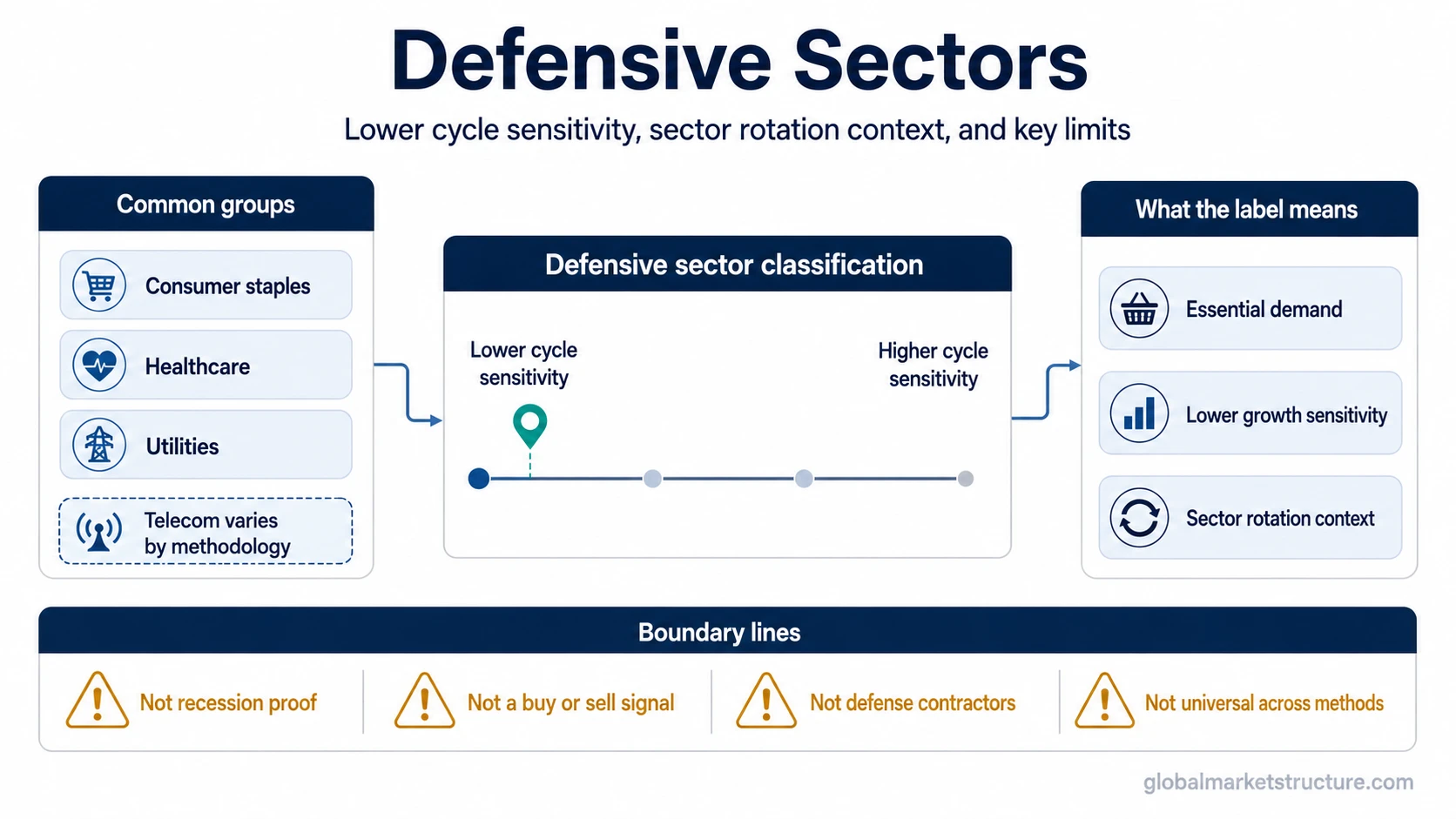
What Sectors Are Commonly Considered Defensive?
Defensive-sector classification usually starts with the stability of end demand. The logic is simple: households and businesses may reduce discretionary spending during weak growth, but they still need food, basic household goods, medical services, electricity, water, and other essential services.
| Common defensive group | Why it is often treated as defensive | Caveat |
|---|---|---|
| Consumer staples | Demand for basic food, household products, and everyday necessities tends to be less discretionary. | Valuation, margins, input costs, and company-specific execution can still change stock behavior. |
| Healthcare | Medical demand can be less tied to short-term economic swings than many discretionary categories. | Regulation, drug cycles, reimbursement risk, and company fundamentals can create very different outcomes inside the sector. |
| Utilities | Electricity, gas, water, and regulated infrastructure services often have steadier demand profiles. | Interest-rate sensitivity, leverage, regulation, and capital spending can strongly affect relative performance. |
| Telecom or communication-related areas | Some recurring service demand can be less cyclical than discretionary consumption. | Classification varies, and modern communication services can include businesses with very different growth and advertising sensitivity. |
The classification is a starting point, not a conclusion. A defensive-sector label describes a broad group tendency, while actual market behavior depends on valuation, interest rates, earnings revisions, balance-sheet risk, liquidity conditions, and investor positioning.
Defensive Sectors vs Cyclical Sectors
Defensive sectors are usually contrasted with cyclical sectors, which tend to be more sensitive to economic acceleration, discretionary demand, credit conditions, commodity demand, industrial activity, and risk appetite.
The basic distinction is about economic sensitivity. Defensive sectors are generally associated with steadier demand and lower earnings cyclicality. Cyclical sectors are generally associated with stronger upside sensitivity when growth improves and greater downside sensitivity when growth expectations weaken.
For a full side-by-side breakdown, the cyclical versus defensive sectors comparison separates both classifications in more detail. Here, the key point is that defensive sectors are defined by lower relative cycle sensitivity, not by guaranteed safety.
Why Defensive Sectors Can Lead in Some Market Environments
Defensive-sector leadership can appear when investors become more concerned about economic growth, earnings cyclicality, liquidity, or risk appetite. In that environment, sectors with steadier demand may become relatively more attractive than sectors that rely on strong growth, credit expansion, or discretionary spending.
| Market condition | Possible defensive-sector interpretation | Required caution |
|---|---|---|
| Growth expectations weaken | Lower-cyclicality earnings may be valued more highly on a relative basis. | This does not prove that a recession is coming. |
| Risk appetite falls | Market leadership may rotate toward sectors perceived as less economically sensitive. | Temporary risk-off moves can reverse quickly. |
| Interest rates fall | Some defensive groups, especially utilities, may benefit from lower-rate sensitivity. | The move may reflect rates, not only economic caution. |
| Earnings revisions diverge | Investors may favor sectors with more stable expected earnings. | Sector-level stability does not guarantee stock-level stability. |
This is why defensive sectors are useful for market interpretation, but weak as standalone signals. Their meaning changes when the surrounding evidence changes.
Related Concepts Map
Market-cycle discussions often blur defensive sectors with nearby concepts. Separating them keeps the term useful inside sector rotation and market-cycle analysis.
| Concept | What it means | What it is not |
|---|---|---|
| Defensive sectors | Broad sector groups that tend to have lower sensitivity to economic growth swings. | Not a guarantee that every stock in the sector is defensive. |
| Cyclical sectors | Sector groups that tend to be more tied to economic growth, credit, industrial demand, and risk appetite. | Not automatically better or worse than defensive sectors. |
| Defensive stocks | Individual companies that may show lower sensitivity to economic cycles because of business model, demand stability, balance sheet, or earnings profile. | Not identical to the entire sector category. |
| Defensive portfolio | A portfolio positioned with lower risk, lower cyclicality, more cash, hedges, or more stable exposures. | Not the definition of defensive sectors. |
| Sector rotation | The movement of relative leadership between sectors as growth, rates, liquidity, and risk appetite change. | Not a mechanical timing model by itself. |
| Defense sector companies | Companies tied to military, aerospace, defense contracting, or related government spending. | Not what “defensive sectors” means in market-cycle classification. |
What Defensive Sectors Do Not Prove
Defensive-sector leadership is a clue, not a conclusion. It can support a risk-off or slowing-growth interpretation when other evidence agrees, but it does not prove that the market is entering a recession, that a bear market is starting, or that defensive sectors will outperform.
- It does not mean defensive sectors are safe.
- It does not mean defensive sectors are recession-proof.
- It does not mean every stock inside the sector will behave defensively.
- It does not create an allocation instruction.
- It does not confirm a market-cycle turning point by itself.
- It does not remove valuation, rate, liquidity, regulatory, or crowding risk.
A false reading can occur when defensive leadership is caused by something other than broad economic caution. Utilities may react to falling yields. Healthcare may move because of sector-specific earnings or regulation. Consumer staples may become crowded or expensive. A short-lived risk-off move may also make defensive sectors look strong for reasons that do not persist.
Illustrative Scenario
A practical scenario is a slowing-growth environment where industrial and discretionary sectors start weakening, market breadth narrows, and yields move lower. At the same time, consumer staples and utilities hold up better on a relative basis.
That pattern may suggest that investors are becoming more cautious about growth and earnings cyclicality. The interpretation becomes stronger if credit spreads widen, liquidity conditions tighten, and earnings revisions weaken in more cyclical areas. It remains weaker if credit is calm, breadth is stable, and the defensive move is mostly explained by falling yields or sector-specific earnings.
The useful lesson is not that defensive sectors should be bought. The useful lesson is that defensive leadership can help classify the market environment when it is checked against broader evidence.
How to Read Defensive Leadership Responsibly
Defensive sectors are most useful when they are read as part of a broader market-structure picture. Their relative strength becomes more meaningful when it lines up with other signs of weaker risk appetite or slowing growth.
| Evidence layer | What to check | Why it matters |
|---|---|---|
| Yields | Are yields falling because growth expectations are weakening, or because inflation expectations are changing? | Rate-sensitive defensive sectors can move for reasons that are not purely defensive. |
| Credit spreads | Are credit markets showing stress, or are they still calm? | Defensive leadership carries more risk-off meaning when credit also deteriorates. |
| Market breadth | Is weakness broadening across cyclical and high-beta areas? | A narrow defensive move is less informative than a broad rotation in leadership. |
| Liquidity | Are financial conditions tightening or easing? | Liquidity can change the meaning of sector leadership and risk appetite. |
| Earnings revisions | Are earnings expectations weakening more in cyclical areas than in defensive areas? | Relative earnings stability can explain why defensive sectors attract attention. |
| Valuation and crowding | Are defensive sectors already expensive or heavily owned? | A defensive label does not eliminate downside risk if expectations are already crowded. |
The stronger interpretation comes from alignment. Defensive leadership means more when rates, credit, breadth, liquidity, earnings revisions, and risk appetite point in the same direction. It means less when those signals conflict.
FAQ
What are defensive sectors?
Defensive sectors are broad equity-market sector groups that tend to be less sensitive to economic growth swings than cyclical sectors. They are used in sector rotation and market-cycle analysis, not as a guarantee of safety or outperformance.
Which sectors are usually defensive?
Consumer staples, healthcare, and utilities are commonly treated as defensive sectors. Some methodologies may also include telecom or other lower-cyclicality areas, but the exact list can vary by classification system and market.
Are defensive sectors the same as defense companies?
No. Defensive sectors refer to lower-cyclicality sector groups. Defense companies are businesses tied to military, aerospace, defense contracting, or related government spending. The terms sound similar but describe different ideas.
Do defensive sectors always outperform in recessions?
No. Defensive sectors may hold up better in some downturns, but they do not always outperform. Valuation, interest rates, earnings, regulation, liquidity, and investor positioning can all change how a defensive sector behaves.
How are defensive sectors different from cyclical sectors?
Defensive sectors tend to have lower sensitivity to economic growth swings. Cyclical sectors tend to be more tied to economic acceleration, discretionary demand, credit conditions, industrial activity, and risk appetite.