
Sector and style rotation means shifts in market leadership between industry sectors and equity styles. It helps classify whether leadership is moving among cyclical, defensive, rate-sensitive, growth-oriented, or value-oriented areas.
The useful question is not “what should be bought now?” The useful question is how leadership, rates, growth expectations, liquidity, earnings, breadth, credit, and risk appetite fit together.
Sector rotation points to industry leadership, style rotation points to growth and value leadership, market leadership points to breadth and concentration, and comparison concepts separate terms that are easy to confuse.
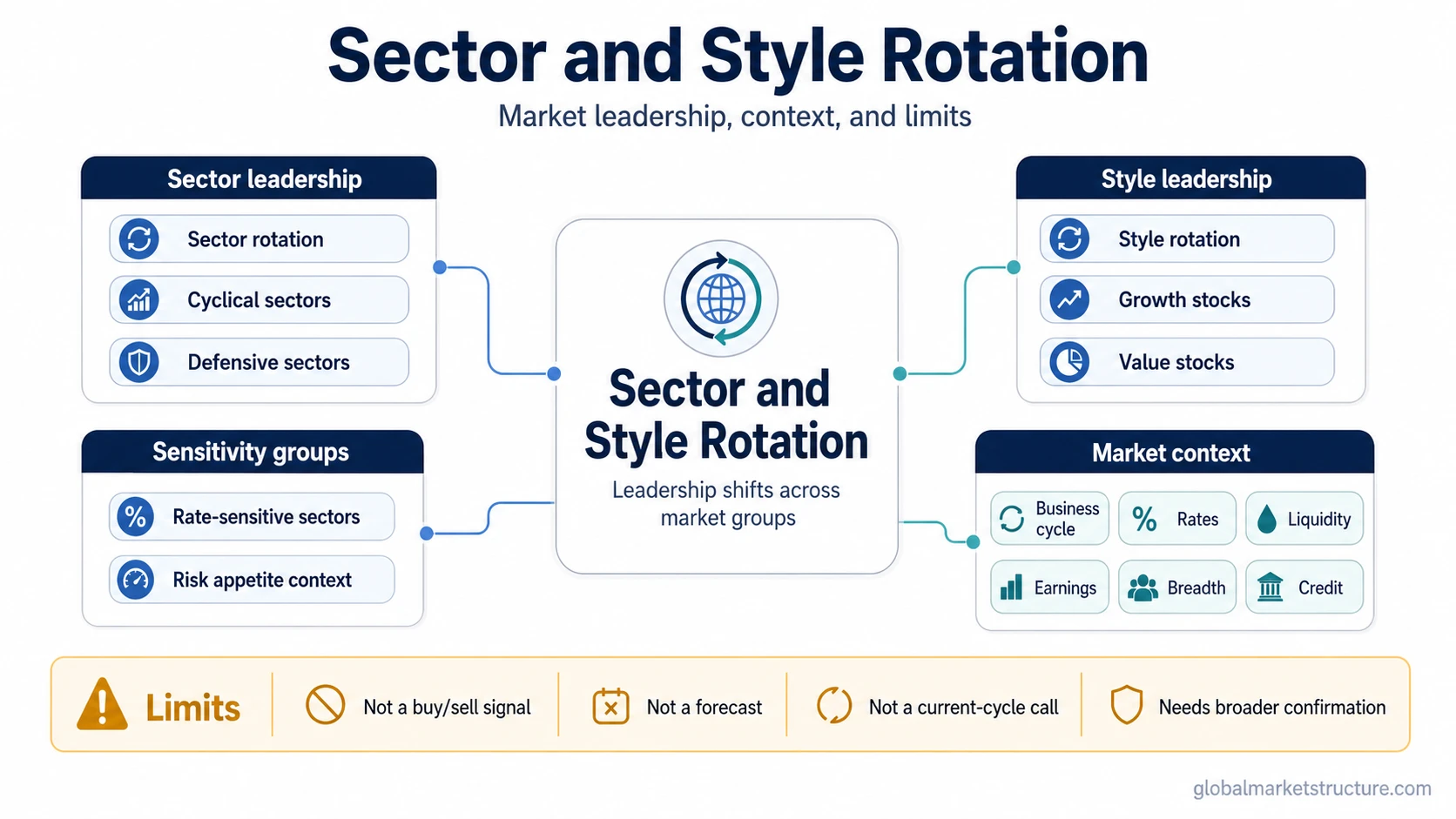
What sector and style rotation means
Sector rotation focuses on leadership shifts between parts of the equity market, such as technology, financials, industrials, utilities, staples, energy, or other sector groups. It is usually used to interpret whether capital is favoring growth-sensitive, defensive, rate-sensitive, or economically cyclical areas.
Style rotation focuses on leadership shifts between equity styles. The most common distinction is growth versus value, but style leadership can also relate to duration sensitivity, earnings expectations, valuation pressure, and broader risk appetite.
Together, sector and style rotation create a market-leadership lens. They can help organize evidence, but they do not create a buy signal, sell signal, or reliable current-cycle forecast by themselves.
How the concepts fit together
Each concept answers a different leadership question. Sector and style definitions carry the deeper explanations, comparison concepts separate commonly confused ideas, and framework or business-cycle concepts help when the question becomes more interpretive.
| Concept group | What it explains | Best next topic |
|---|---|---|
| Sector rotation | Leadership shifts between sectors or industries | Sector rotation |
| Style rotation | Leadership shifts between equity styles such as growth and value | Style rotation |
| Market leadership | Which sectors, styles, or groups are carrying the broader market | Market leadership |
| Cyclical sectors | Sectors more exposed to economic growth and risk appetite | Cyclical sectors |
| Defensive sectors | Sectors often discussed as less growth-sensitive | Defensive sectors |
| Growth stocks | Groups priced more around future growth expectations | Growth stocks |
| Value stocks | Groups often framed around valuation, earnings, or cyclicality | Value stocks |
| Rate-sensitive sectors | Sectors where interest-rate changes can affect interpretation | Rate-sensitive sectors |
| Cyclical vs defensive sectors | The difference between growth-sensitive and defensive sector behavior | Cyclical vs defensive sectors |
| Growth vs value | The difference between two common equity style categories | Growth vs value |
| Sector rotation strategy | A framework for interpreting rotation evidence | Sector rotation strategy |
| Business-cycle sector rotation | How sector leadership is often mapped to business-cycle phases | Business-cycle sector rotation |
Sector rotation vs style rotation
Sector rotation asks which industry groups are leading or lagging. It is usually tied to business-cycle sensitivity, defensive behavior, rate sensitivity, earnings expectations, and risk appetite.
Style rotation asks which equity style is leading. Growth and value are the clearest examples, but the interpretation can also involve duration, rates, earnings durability, valuation, and liquidity conditions.
The two can overlap without meaning the same thing. Growth leadership may appear inside certain sectors, while sector leadership may change for reasons that are not purely growth-versus-value. The distinction matters because a sector move and a style move can have different drivers.
Core concepts
Sector rotation is the main concept for industry leadership and how different parts of the equity market can lead or lag as macro conditions change.
Style rotation is the main concept for growth, value, duration sensitivity, and factor-like leadership. It is better suited to questions about why one type of equity exposure may lead while another lags.
Market leadership focuses on breadth, concentration, and whether a market move is being carried by a narrow or broad set of groups.
Cyclical versus defensive sectors separates growth-sensitive sector behavior from defensive behavior. Growth versus value separates two common style categories.
How rotation can appear in practice
A practical scenario is a change in rate expectations. If yields fall because growth fears are rising, leadership may move toward defensive areas while highly cyclical groups weaken. If yields fall because liquidity conditions improve and earnings expectations remain stable, growth-oriented groups may respond differently.
The same visible rotation can therefore have different meanings depending on the surrounding evidence. The interpretation becomes stronger when breadth, liquidity, earnings, credit, rates, and broader risk conditions point in the same direction. It weakens when leadership shifts are narrow, temporary, or unsupported by other market evidence.
What rotation cannot prove
Sector and style rotation are classification and interpretation tools. They are not trade signals, allocation instructions, or a reliable way to forecast the next market move.
- Rotation can look obvious in hindsight before it is clear in real time.
- Business-cycle labels can remain uncertain while the cycle is still unfolding.
- Sector leadership and style leadership can change for different reasons.
- Defensive leadership does not automatically prove recession risk.
- Cyclical leadership does not automatically prove expansion.
- Rate-sensitive leadership does not have one fixed meaning.
- Leadership shifts need confirmation from breadth, rates, liquidity, earnings, credit, and risk appetite.
Where to go next
Start with the routing table above if the goal is to choose the most relevant concept. Use sector rotation for industry leadership, style rotation for growth and value leadership, and market leadership when the question is about breadth or concentration.
Use the comparison pages when the issue is conceptual confusion. Use the framework and business-cycle pages only when the question moves from definition into interpretation.
Sector and style rotation FAQ
What is sector and style rotation?
Sector and style rotation means leadership shifts between industry sectors and equity styles. It helps classify which groups are leading, which are lagging, and what kind of market environment may be influencing that change.
What is the difference between sector rotation and style rotation?
Sector rotation looks at industry groups. Style rotation looks at equity styles such as growth and value. They can overlap, but they are not the same classification.
Is sector rotation the same as business-cycle sector rotation?
No. Business-cycle sector rotation is one way to interpret sector leadership through cycle phases. Sector rotation is broader and can also reflect rates, liquidity, earnings, risk appetite, and market structure.
Is growth vs value part of style rotation?
Yes. Growth versus value is one of the clearest style-rotation distinctions. It often relates to valuation, earnings expectations, duration sensitivity, and interest-rate context.
Is sector rotation a buy or sell signal?
No. Sector rotation can organize evidence, but it does not provide a buy signal or sell signal by itself. Leadership shifts need broader confirmation before they can support market interpretation.