
Market leadership describes which parts of the market are leading in relative performance during a cycle. In market-structure context, it refers to leadership distribution across sectors, styles, regions, market caps, risk groups, or broader market segments, not a company being the largest business in an industry.
That distinction matters because the same phrase is often used in business language to describe a dominant company. Here, market leadership is a public-market concept. It helps describe where participation is strongest, whether leadership is broad or concentrated, and whether leadership is rotating across groups. It does not identify the best stocks, create a timing signal, forecast returns, or tell investors which sector to buy.
Direct answer: Market leadership means the area of the market showing stronger relative performance than other areas. The leading area can be a sector, style group, market-cap segment, region, risk bucket, or a small set of dominant securities. The useful question is not only what is rising, but how widely leadership is shared and whether it is persistent or rotating.
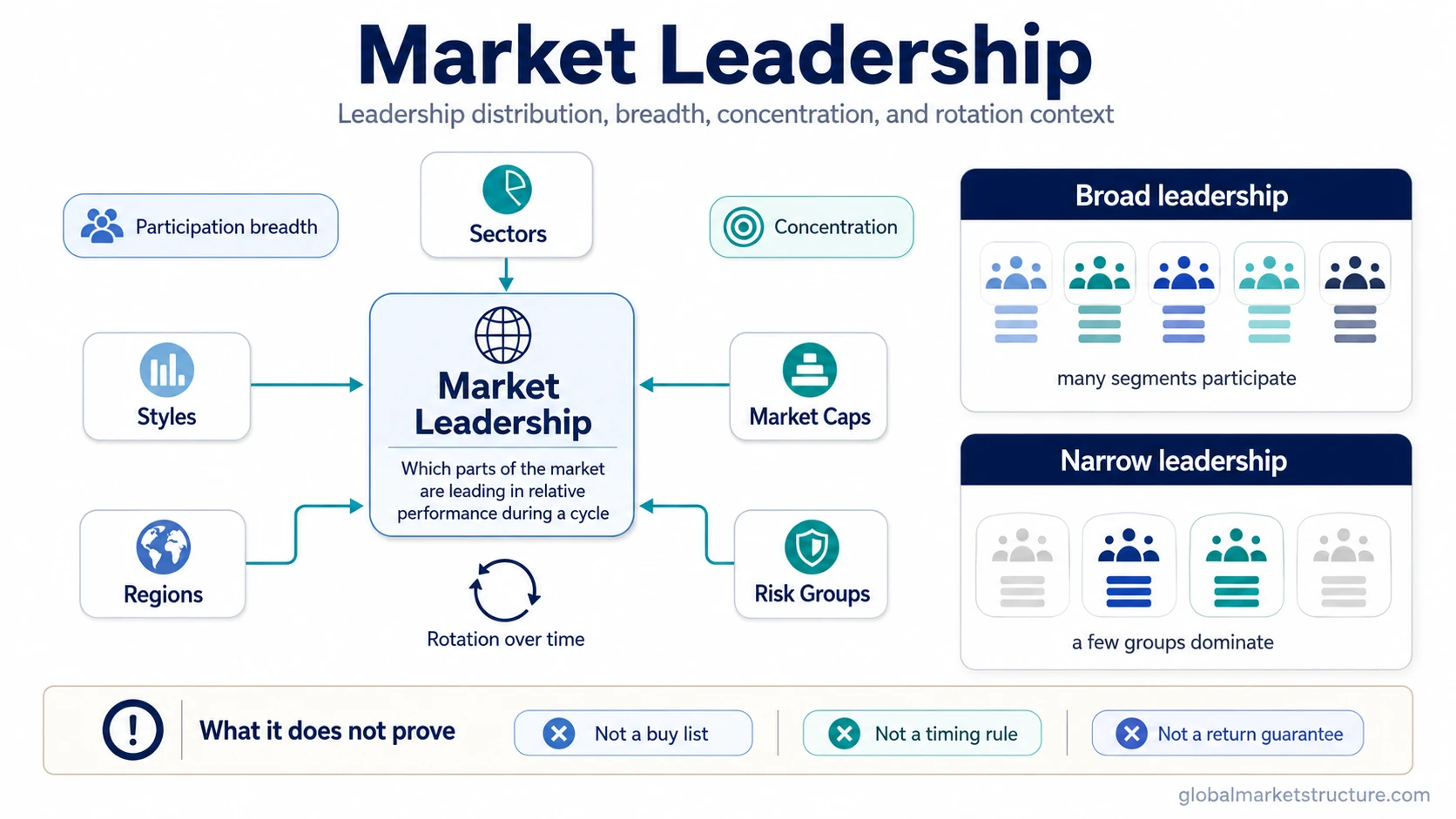
What Market Leadership Is and Is Not
Market leadership is most useful when it is separated from nearby meanings that sound similar. The concept is descriptive. It classifies participation and relative strength inside a market, but it does not become a stock list or allocation model on its own.
| Term or interpretation | Meaning in this context | What it does not mean |
|---|---|---|
| Market leadership | The market segments leading in relative performance during a cycle. | It is not automatically a signal to buy the leading group. |
| Company market leader | A business with a strong position in its industry or category. | It is not the main meaning used here. |
| Sector leadership | Leadership concentrated in one or more sectors. | It is not the full concept if styles, regions, or market caps also matter. |
| Style leadership | Leadership from groups such as growth, value, defensive, cyclical, or rate-sensitive stocks. | It is not the same as a complete market-cycle signal. |
| Narrow market leadership | Leadership concentrated in a small number of securities or groups. | It does not prove a market top by itself. |
| Stock-picking list | A list of individual securities selected for attention. | Market leadership is not that list and should not be treated as a recommendation. |
How Market Leadership Is Observed
Market leadership is usually observed through relative performance, participation, and persistence. A leading group does not need to rise every day. It only needs to perform better than other groups over the relevant observation window.
| Observation area | What it can show | Key limitation |
|---|---|---|
| Relative performance | Which segment is outperforming another segment or broad benchmark. | Outperformance can occur in both rising and falling markets. |
| Sector participation | Whether leadership is concentrated in cyclical, defensive, rate-sensitive, or other sector groups. | Sector behavior needs macro, liquidity, earnings, and valuation context. |
| Style participation | Whether leadership is coming from growth, value, quality, defensive, or speculative groups. | Style leadership can rotate without confirming a complete cycle change. |
| Breadth | Whether many securities or only a small group are participating. | Breadth can improve or weaken before the index trend changes. |
| Concentration | Whether index performance depends heavily on a few securities or groups. | Concentration is a risk context, not a reversal signal by itself. |
| Persistence | Whether the same groups continue to lead over multiple periods. | Short-term persistence can still reverse when liquidity or earnings expectations change. |
Why Leadership Distribution Matters in Market Cycles
Leadership distribution matters because broad index performance can hide very different underlying conditions. A market can look strong at the index level while participation narrows beneath the surface. It can also look uneven while leadership quietly broadens across more groups.
In a healthier leadership structure, gains are shared across a wider set of sectors, styles, regions, or market-cap groups. In a more concentrated structure, a small number of groups may carry most of the visible performance. Neither condition gives a complete forecast, but each changes the interpretation of market strength.
For example, leadership concentrated only in large growth stocks can tell a different story from leadership shared across cyclicals, defensives, small caps, and value stocks. The first structure may show strong headline performance but weaker participation. The second may show broader risk appetite, depending on liquidity, rates, credit, and earnings expectations.
Important limit: Broad leadership is not automatically bullish, and narrow leadership is not automatically bearish. Leadership distribution is one part of market-structure interpretation. It must be read alongside breadth, liquidity conditions, credit stress, rates, volatility, earnings revisions, and valuation context.
Broad, Narrow, Persistent, and Rotating Leadership
Market leadership can be described by how widely it is shared and how stable it is over time. Four common descriptions are broad leadership, narrow leadership, persistent leadership, and rotating leadership.
| Leadership pattern | What it means | Interpretation limit |
|---|---|---|
| Broad leadership | Many sectors, styles, or securities participate in relative strength. | It still needs confirmation from macro and liquidity conditions. |
| Narrow leadership | A small number of groups or securities drive most of the strength. | It may show concentration risk, but it does not prove immediate weakness. |
| Persistent leadership | The same groups keep leading across several observation windows. | Persistence can become crowded or vulnerable if the underlying conditions change. |
| Rotating leadership | Leadership shifts from one group to another over time. | Rotation can reflect changing conditions, but it can also be temporary noise. |
A market can also combine these patterns. Leadership can be narrow but persistent, broad but rotating, or concentrated in one style while broadening inside that style. That is why the question is not simply which group is leading. The more useful question is how leadership is distributed and whether the distribution is changing.
Market Leadership vs Sector and Style Rotation
Market leadership and rotation are related, but they are not identical. Market leadership describes which groups are leading. Rotation describes the movement of leadership from one group to another.
Sector rotation focuses on changes between sector groups, such as cyclical sectors, defensive sectors, rate-sensitive sectors, or commodity-linked groups. Style rotation focuses on changes between styles such as growth, value, quality, defensive, speculative, large-cap, or small-cap exposure.
Useful distinction: Market leadership is the current distribution of relative strength. Rotation is the process by which that leadership changes. A page about leadership should not become a sector allocation guide, and a rotation framework should not be treated as a forecast by itself.
Common Misreadings of Market Leadership
Market leadership is often misread when relative strength is treated as a direct recommendation or when a narrow group of leading stocks is treated as proof that the whole market is healthy. The concept is more useful when it is kept descriptive and evidence-aware.
| Common misreading | Why it is risky | Better interpretation |
|---|---|---|
| The leading group is automatically the best group to buy. | Relative strength can be late, crowded, valuation-sensitive, or liquidity-dependent. | Leadership identifies where relative performance has been strongest, not what should be bought. |
| Narrow leadership proves a market top. | Concentration can persist for long periods. | Narrow leadership is a concentration warning that needs confirmation from breadth, liquidity, credit, and trend behavior. |
| Broad leadership guarantees a healthy market. | Broad participation can occur during temporary rebounds or short-covering phases. | Broad leadership is constructive only when supported by stronger underlying conditions. |
| Sector leadership explains the whole market. | Style, region, market-cap, currency, and liquidity context may also matter. | Sector leadership is one layer inside the broader leadership map. |
| A company market leader is the same as market leadership. | A dominant company may not reflect broad participation across the market. | Company dominance and public-market leadership should be separated. |
How to Use Market Leadership Safely
Market leadership is safest when used as a diagnostic layer. It can help describe where strength is concentrated, whether participation is broadening or narrowing, and whether leadership is consistent with the wider market environment.
A practical reading starts with the leading groups, then checks whether the leadership is broad or narrow. The next step is to compare that structure with market breadth, liquidity conditions, interest-rate pressure, credit stress, volatility, earnings expectations, and valuation. If the evidence agrees, the leadership pattern becomes more meaningful. If the evidence conflicts, the interpretation should remain cautious.
Practical use: Treat market leadership as a context tool. It can help organize market-cycle interpretation, but it should not be used alone as a timing rule, return forecast, sector allocation instruction, or list of stocks to buy.
FAQ
What does market leadership mean?
Market leadership means the part of the market that is leading in relative performance during a cycle. It can refer to sectors, styles, regions, market-cap groups, risk buckets, or other market segments.
Is market leadership the same as a company being a market leader?
No. A company market leader usually means a business with a strong industry position or market share. In market-structure analysis, market leadership refers to relative performance leadership across public-market segments.
Does market leadership predict future returns?
No. Market leadership can help describe participation and rotation, but it does not predict future returns by itself. It needs context from breadth, liquidity, rates, earnings expectations, valuation, and risk appetite.
What is narrow market leadership?
Narrow market leadership means performance is concentrated in a small number of securities, sectors, or groups. It can show concentration risk, but it does not prove that a market top or reversal is near.