
Style rotation is the shift in relative leadership among equity styles such as growth, value, quality, momentum, size, and low volatility. It helps explain which types of equities are being favored as market-cycle conditions change. The main limit is that style rotation describes relative strength, not a forecast, allocation instruction, return guarantee, or buy/sell signal.
For market-cycle interpretation, style rotation is useful because it separates the type of equity exposure being rewarded from the direction of the whole market. Growth stocks may lead while broad indices rise, but a different style can still improve on a relative basis even when absolute returns are weak. That distinction matters because relative strength and absolute market strength are not the same thing.
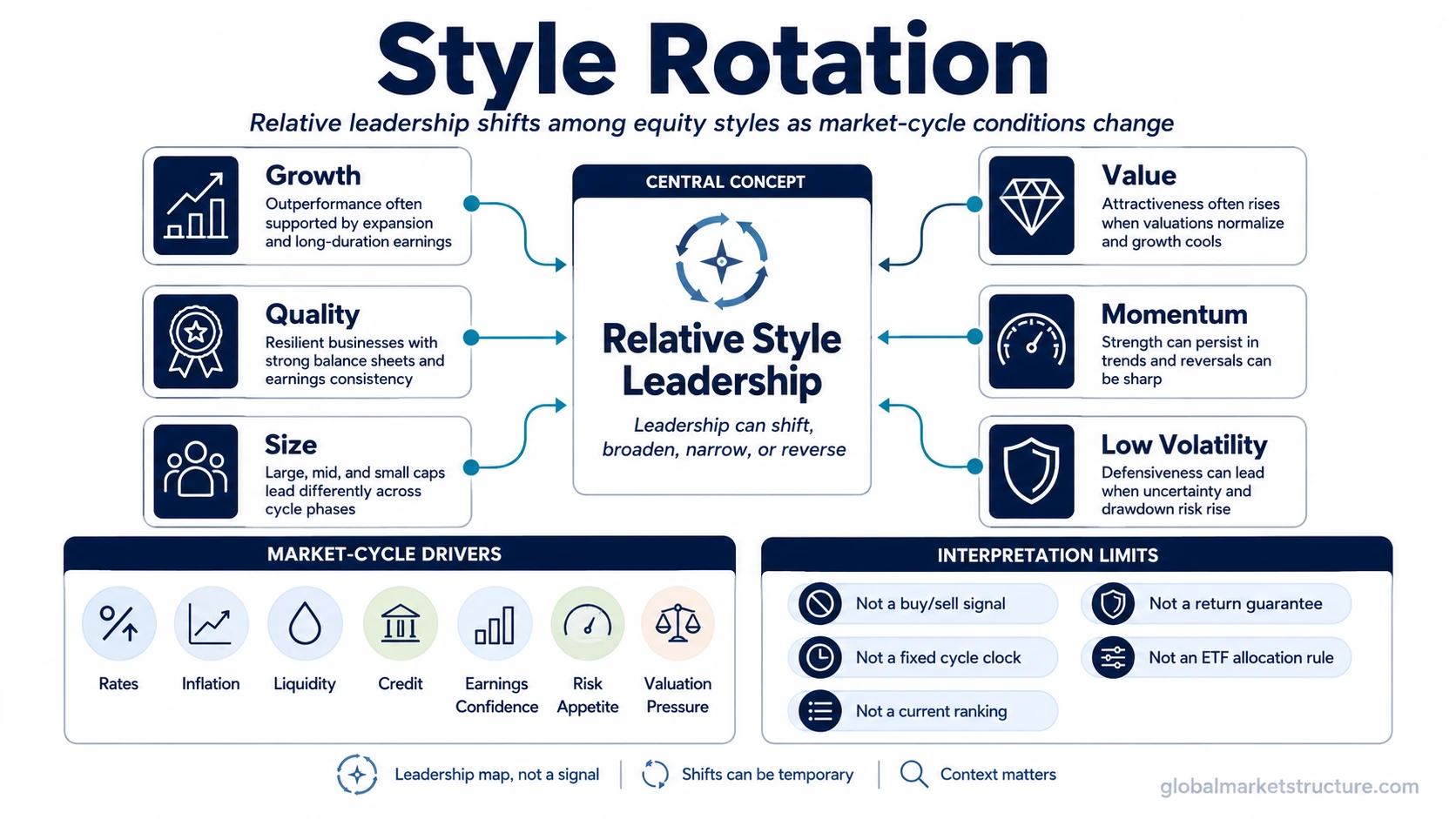
What Style Rotation Means
Style rotation describes a change in leadership between groups of stocks that share similar characteristics. These groups are usually called equity styles. Common examples include growth, value, quality, momentum, size, low volatility, dividend-oriented exposure, and other factor-like classifications.
The concept is related to market leadership, but it is narrower. Market leadership can include sectors, industries, regions, market-cap groups, breadth, concentration, and individual leadership baskets. Style rotation focuses specifically on how equity characteristics rise or fall in relative importance across different market environments.
A style shift does not automatically mean that one group is attractive in absolute terms. It may only mean that one style is falling less, recovering earlier, or holding up better than another. That is why style rotation is best read as a leadership map, not as a standalone market signal.
Which Equity Styles Can Rotate
Style rotation is often reduced to growth versus value, but that is only one part of the concept. A cleaner view includes several style categories, because market leadership can move through more than one dimension at the same time.
| Style | What it represents | Possible driver | Interpretation limit |
|---|---|---|---|
| Growth | Companies priced around future earnings expansion | Lower discount-rate pressure, stronger earnings confidence, easier liquidity | Growth leadership can weaken if valuation sensitivity rises |
| Value | Companies priced at lower valuation multiples or tied to current cash flows | Inflation pressure, higher rates, cyclical recovery, valuation reset | Value leadership does not guarantee strong fundamentals across every value stock |
| Quality | Companies with stronger balance sheets, margins, or earnings durability | Uncertainty, tighter credit, demand for resilient earnings | Quality can lead defensively even if broad risk appetite is weak |
| Momentum | Stocks or groups already showing persistent relative strength | Trend persistence, crowding, liquidity support, earnings upgrades | Momentum can reverse quickly when leadership becomes crowded |
| Size | Large-cap versus small-cap leadership | Credit conditions, domestic growth expectations, funding costs | Small-cap improvement can fail if credit or earnings breadth remains weak |
| Low volatility | Stocks with steadier price behavior or defensive characteristics | Risk aversion, uncertainty, defensive positioning | Low-volatility leadership may reflect caution rather than market strength |
What Drives Style Rotation
Style rotation is usually tied to changes in macro, liquidity, earnings, and risk conditions. It is not driven by one variable alone. Several forces can push investors toward one style and away from another.
Interest rates and discount-rate pressure can affect long-duration growth stocks because more of their valuation depends on future expected earnings. Inflation can change leadership by altering margin pressure, nominal revenue growth, commodity sensitivity, and the relative appeal of present cash flows. Liquidity conditions can support or weaken risk-taking across more speculative or higher-duration groups.
Credit conditions also matter. When credit is easy, smaller companies and cyclical value areas may have more room to recover. When credit tightens, investors may prefer balance-sheet strength, earnings durability, or low-volatility exposure. Earnings confidence can shift leadership as investors reward companies with better forward visibility and punish groups where estimates are being revised down.
Important distinction: a driver can explain why a style is leading without proving that the leadership will continue. Style rotation is an observation framework. It is not a timing model.
How Style Rotation Is Observed
Style rotation is usually observed through relative performance rather than isolated price movement. Analysts may compare growth versus value, large-cap versus small-cap, high-quality versus low-quality, momentum versus the broad market, or low-volatility exposure versus more cyclical risk groups.
The important part is the comparison. A style can rise in absolute terms and still underperform another style. A style can also fall in absolute terms but outperform because it is declining less. For that reason, style rotation should be read through relative leadership, breadth, persistence, and context rather than through one price chart alone.
A stronger observation usually has several confirming features: the leadership persists for more than a brief window, related styles behave consistently, sector and industry behavior does not contradict the interpretation, and macro conditions provide a plausible reason for the shift. A weaker observation may be only a short rebound, a crowded unwind, or a temporary reaction to one data point.
Style Rotation vs Sector Rotation
Style rotation and sector rotation are related, but they are not the same. Sector rotation tracks leadership across economic sectors such as technology, financials, energy, consumer staples, healthcare, industrials, and utilities. Style rotation tracks leadership across equity characteristics such as growth, value, quality, momentum, size, and volatility.
| Comparison | Style rotation | Sector rotation |
|---|---|---|
| Main lens | Equity characteristics | Economic sectors and industries |
| Typical examples | Growth, value, quality, momentum, size, low volatility | Technology, energy, financials, healthcare, utilities, consumer staples |
| Useful for | Understanding what type of equity exposure is being rewarded | Understanding which parts of the economy are leading or lagging |
| Main risk | Over-reducing the concept to growth versus value | Assuming every sector follows a fixed cycle schedule |
The two can overlap. For example, a growth-led market may also be led by technology, while a value-led market may include financials, energy, or industrials. But the overlap is not automatic. A sector can contain both growth and value companies, and a style can appear across several sectors at the same time.
Why Style Rotation Matters
Style rotation matters because broad index performance can hide what is happening underneath the surface. A market may look strong because a narrow group of growth stocks is leading, while value, small caps, or lower-quality cyclicals are weak. Another market may look less exciting at the index level while leadership is becoming broader and more balanced.
This makes style rotation useful for interpreting market leadership. It can show whether risk appetite is concentrated, broadening, defensive, or rotating into different forms of exposure. It can also help separate a broad market advance from a leadership change that is narrower or more fragile.
The concept is especially useful when combined with breadth, valuation, earnings revisions, liquidity, credit spreads, rate trends, and sector behavior. Style leadership by itself is incomplete, but it can add context to how investors are positioning across the equity market.
Common Misreadings of Style Rotation
A common mistake is treating style rotation as a fixed cycle clock. Equity styles do not rotate in a guaranteed order. Growth does not always lead in one phase, value does not always lead in another, and low-volatility leadership does not always mean a bear market is near.
Another mistake is treating a relative move as an allocation instruction. Style rotation can describe what is leading, but it does not decide position size, timing, portfolio construction, or risk tolerance. Those decisions require a separate investment process.
It is also easy to confuse style leadership with company quality. A value index can lead even if many individual value stocks are weak. A quality basket can lag even when some high-quality companies perform well. Style rotation works at the group level and should not be turned into a stock-picking shortcut.
Practical limit: style rotation is most useful when it is read as a relative leadership condition. It becomes weaker when it is treated as a forecast, a buy/sell signal, or proof that a specific style will keep outperforming.
How to Use Style Rotation Carefully
A careful reading starts by asking what is actually being compared. Growth versus value is one comparison. Large caps versus small caps is another. Quality versus lower-quality cyclicals, or low volatility versus high beta, can reveal a different part of the market’s behavior.
The next step is to ask whether the leadership has a plausible macro or market-structure explanation. A style shift that aligns with rates, liquidity, earnings revisions, credit conditions, and breadth is more meaningful than a short move that has no supporting context.
Finally, the interpretation should remain conditional. A style can lead temporarily because positioning was stretched, because a crowded trade is unwinding, or because one macro release changed discount-rate expectations for a short period. Durable style rotation usually requires persistence, broader confirmation, and a coherent regime backdrop.
FAQ
What is style rotation in stocks?
Style rotation is the shift in relative leadership among equity styles such as growth, value, quality, momentum, size, and low volatility. It helps classify which characteristics investors are rewarding as market-cycle and regime conditions change.
Is style rotation the same as sector rotation?
No. Sector rotation tracks leadership changes among sectors or industries. Style rotation tracks leadership changes among equity characteristics, such as growth, value, quality, momentum, size, and volatility.
Does style rotation predict market returns?
No. Style rotation describes relative leadership. It does not guarantee returns, predict the next market move, or provide an allocation instruction. It should be interpreted with liquidity, valuation, breadth, earnings, credit, and risk context.
Why can style rotation be misleading?
Style rotation can be misleading when a short relative move is treated as a regime change. A style may lead because it is falling less, rebounding from oversold conditions, or benefiting from temporary positioning rather than a durable cycle shift.