
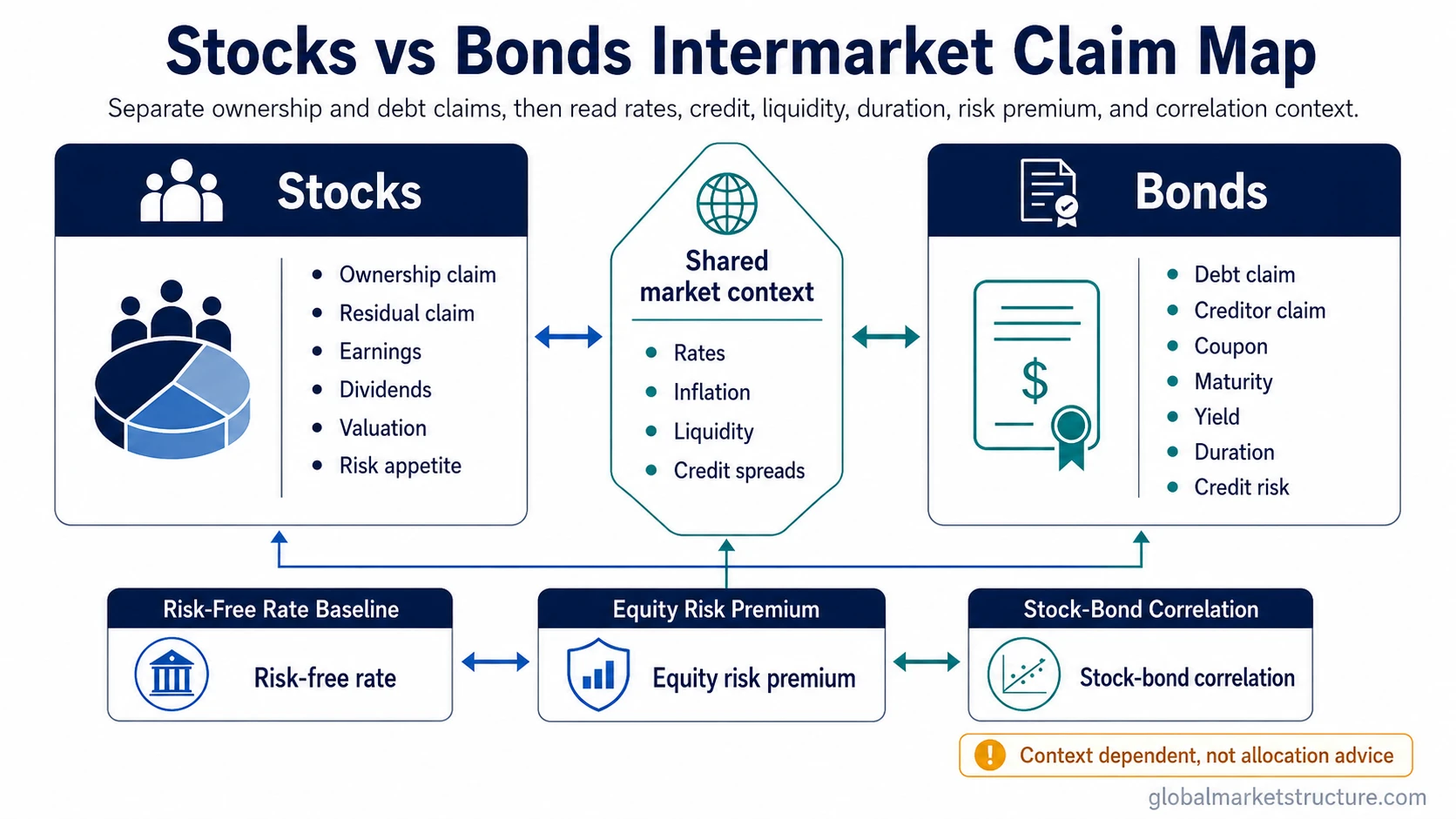
Stocks are ownership claims on businesses, while bonds are debt claims on issuers. That difference changes the rights attached to each security, where returns come from, how losses can appear, and how the same macro shock can move the two markets through different channels.
Stocks vs Bonds: Direct Comparison
| Comparison point | Stocks | Bonds |
|---|---|---|
| Claim type | Residual ownership claim on a business | Contractual debt claim on an issuer |
| Corporate issuer failure | Common equity generally ranks behind creditors in claims on remaining assets. | Bondholders are creditors and generally rank ahead of common shareholders in claims on remaining corporate assets. |
| Return and payment source | Dividends when declared and changes in the market value of the ownership claim | Contractual interest or coupon payments and principal repayment, subject to the issuer’s ability to pay, plus changes in market price |
| Main return driver | Business performance, earnings expectations, valuation, and risk appetite | Coupon income, yield changes, maturity, duration, and credit quality |
| Main risk lens | Business risk, earnings risk, valuation risk, and liquidity conditions | Interest-rate risk, duration risk, credit risk, inflation risk, and liquidity risk |
| Rate sensitivity | Often appears through discount rates, valuation pressure, and the equity risk premium | Often appears directly through the price-yield relationship and duration |
| Market-structure role | Ownership claim tied to business expectations and risk appetite | Rates and credit claim tied to yield, maturity, and issuer solvency |
Investor.gov explains that corporate bondholders are creditors and are paid before common stockholders when a company is liquidated. The same source also notes that bonds still carry default risk, so priority does not eliminate the possibility of loss. Source: Investor.gov.
How the Claim Structure Changes the Analysis
Equities are residual ownership claims. Their market value can change with earnings expectations, margins, valuation multiples, dividends, liquidity, and shifts in risk appetite.
The bond market represents contractual debt claims with defined payment terms. Bond prices can still move materially as yields, credit quality, inflation expectations, and liquidity change. Cash-flow timing also matters, which is why bond duration becomes important when yields move.
How Rates Connect Stocks and Bonds
The risk-free rate provides a baseline for required returns across markets. For stocks, the rate connection often appears through valuation and the equity risk premium. For bonds, changing market yields reprice fixed cash flows more directly, with the effect increasing or decreasing according to duration and other bond characteristics.
Same Macro Input, Different Transmission
| Macro input | Stock-market channel | Bond-market channel |
|---|---|---|
| Higher yields | Can raise discount-rate pressure, change valuation tolerance, and increase the return hurdle for equity risk | Can reduce prices of existing bonds, with sensitivity depending in part on duration |
| Wider credit spreads | Can accompany weaker risk appetite, tighter financing conditions, or concern about business outcomes | Can reduce prices of riskier bonds and increase the compensation investors demand for credit exposure |
| Tighter liquidity | Can reduce support for more speculative or higher-valuation equity exposure | Can worsen trading conditions and increase pressure on less-liquid or lower-quality debt |
| Falling growth expectations | Can weaken earnings expectations and equity leadership | Can support higher-quality bonds if yields fall, while weaker credit conditions can pressure riskier debt |
The broader equity transmission from changing yields is covered in how bond yields affect stocks.
When the Diversification Relationship Changes
Stock-bond correlation describes whether the two markets are moving together or in opposite directions over a given period. The relationship can change as inflation, policy expectations, growth risk, credit conditions, and liquidity become more or less important.
A shared inflation, rates, or liquidity shock can create periods when stocks and bonds fall together. In other regimes, falling growth expectations or defensive demand can support higher-quality bonds while equities weaken.
Equity weakness is accompanied by stronger demand for higher-quality bonds and lower yields.
Inflation, rapid rate repricing, or tighter liquidity can pressure both equity valuations and bond prices at the same time.
The comparison needs bond type, duration, credit quality, and the current correlation regime rather than a fixed assumption that bonds must offset stock weakness.
Stocks and bonds describe different claims, not fixed levels of safety or return. Equity risk varies with the business, valuation, financing conditions, and liquidity. Bond risk varies with issuer quality, seniority, maturity, duration, inflation exposure, and market liquidity. The comparison is most useful when those underlying exposures are identified before drawing a broader market conclusion.