
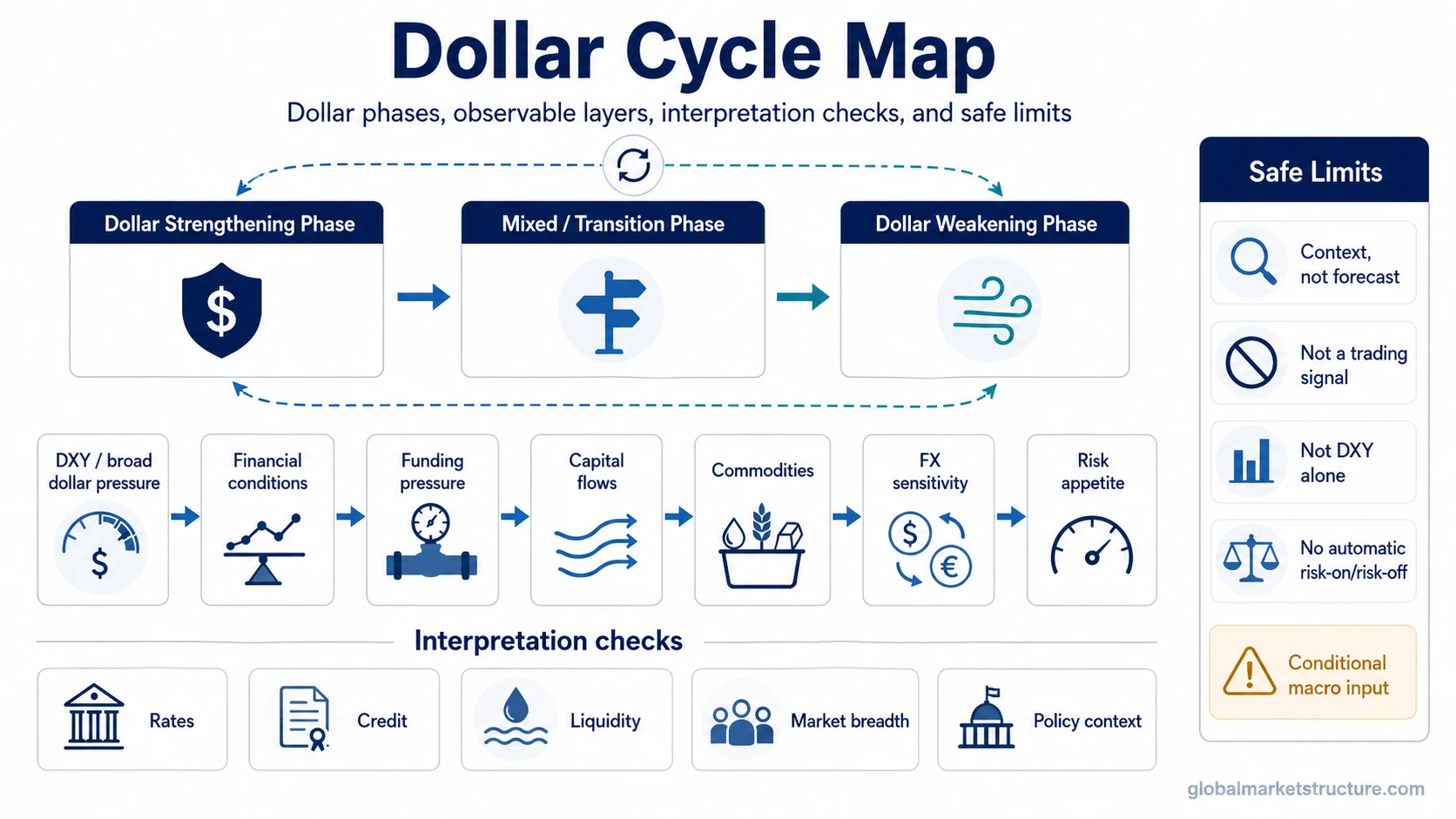
The dollar cycle is a recurring macro and intermarket phase in which broad U.S. dollar strength or weakness affects financial conditions, capital flows, commodity sensitivity, FX pressure, and risk appetite. It is not just a chart of the dollar index and it is not a forecast by itself. Dollar-cycle analysis works best as a macro/intermarket context concept, not as a market-timing model.
What Is the Dollar Cycle?
A dollar cycle describes a broad phase of U.S. dollar strength or weakness that can influence global liquidity, cross-border funding, capital flows, commodities, and foreign exchange behavior. In a strong-dollar phase, dollar funding can become more expensive or more difficult for some borrowers, global financial conditions can tighten, and non-U.S. assets may face additional pressure. In a weak-dollar phase, dollar pressure can ease, global liquidity conditions may become less restrictive, and some commodity and risk-asset relationships can change.
The concept is useful because it explains why the dollar can matter beyond currency markets. It does not prove timing, recession risk, commodity direction, de-dollarization, or a trade signal on its own.
Key Points
- The dollar cycle refers to broad phases of U.S. dollar strength or weakness, not a fixed calendar cycle.
- A rising dollar can tighten conditions through funding pressure, weaker external liquidity, and stress in dollar-sensitive markets.
- A falling dollar can ease some pressure, but it does not automatically create a risk-on regime.
- The DXY index can be one observable gauge, but the dollar cycle is broader than DXY alone.
- Dollar-cycle analysis is context, not a prediction, investment recommendation, or buy/sell signal.
How the Dollar Cycle Works
The dollar matters because many global transactions, liabilities, reserves, commodities, and funding markets are connected to U.S. dollar conditions. When the dollar strengthens broadly, the effect can move through several channels at the same time.
| Channel | What changes | Why it matters |
|---|---|---|
| Funding conditions | Dollar borrowing and refinancing pressure can rise. | Borrowers with dollar liabilities may face tighter conditions. |
| Capital flows | Capital may move toward dollar assets or away from more vulnerable markets. | External financing pressure can increase in dollar-sensitive economies. |
| Commodity pricing | Dollar strength can change the affordability and financial interpretation of dollar-priced commodities. | Commodity moves may reflect both supply-demand conditions and currency pressure. |
| FX sensitivity | Non-dollar currencies can weaken or strengthen depending on trade exposure, funding needs, and local policy conditions. | Currency moves can transmit pressure into inflation, trade balances, and financial conditions. |
| Risk appetite | Broad dollar strength can coincide with tighter liquidity or defensive positioning. | Risk assets may become more sensitive when dollar strength appears alongside credit stress, rising real yields, or weaker breadth. |
The mechanism is conditional. A stronger dollar does not always mean global stress, and a weaker dollar does not always mean easy conditions. The interpretation depends on why the dollar is moving, how rates and credit are behaving, and whether the move is confirmed by other market signals.
Dollar Cycle vs DXY
DXY is a quoted index that measures the U.S. dollar against a basket of major currencies. The dollar cycle is a broader macro interpretation of dollar strength or weakness across funding, capital flows, FX pressure, commodities, and risk conditions.
| Concept | What it shows | What it does not show by itself |
|---|---|---|
| DXY | A market index of the dollar against selected major currencies. | It does not fully capture dollar funding stress, emerging-market currency pressure, trade exposure, or global liquidity conditions. |
| Dollar cycle | A broader phase of dollar strength or weakness and its possible macro transmission channels. | It does not provide a precise timing model, recession signal, or asset-allocation rule. |
A DXY rise can be part of a strong-dollar cycle, but DXY alone is not enough. A useful dollar-cycle reading also checks funding markets, real yields, credit spreads, policy expectations, cross-border capital flows, and whether pressure is broad or concentrated in a few currency pairs.
Strong-Dollar and Weak-Dollar Phases
Dollar cycles are not fixed calendar periods. They are better understood as broad phases that can appear when the dollar strengthens or weakens across several markets at the same time.
Strong-Dollar Phase
A strong-dollar phase can tighten financial conditions when it raises the burden of dollar liabilities, pulls capital toward U.S. assets, weakens some foreign currencies, and pressures dollar-sensitive assets. The effect can be stronger when real yields are rising, credit spreads are widening, and global liquidity is deteriorating.
Weak-Dollar Phase
A weak-dollar phase can ease some external pressure by reducing dollar funding stress and improving the relative position of some non-dollar currencies, commodities, and global liquidity-sensitive assets. The effect is still conditional. A weaker dollar during a growth shock or policy panic may not carry the same meaning as a weaker dollar during improving liquidity and stronger risk appetite.
What to Watch in a Dollar Cycle
A dollar-cycle reading becomes more useful when it combines dollar behavior with related market evidence. The goal is not to find one perfect signal, but to check whether several conditions point toward the same macro pressure.
| Layer | Useful question | Interpretation limit |
|---|---|---|
| DXY and broad dollar measures | Is dollar strength broad or concentrated? | A single index move may miss pressure outside the index basket. |
| Rates and real yields | Is the dollar moving with rate expectations or safe-haven demand? | The same dollar move can have different meanings depending on the rate backdrop. |
| Credit spreads | Is dollar strength appearing with credit stress? | Credit confirmation matters because dollar strength alone is not a stress signal. |
| Liquidity conditions | Are funding and market liquidity tightening at the same time? | Liquidity must be assessed across several indicators, not assumed from currency movement. |
| Commodities | Are dollar-priced commodities moving because of currency pressure, demand, or supply? | Commodity direction cannot be inferred from the dollar alone. |
| FX pressure | Are weaker currencies linked to funding stress, inflation pressure, or local policy constraints? | Currency weakness may reflect local fundamentals as much as global dollar pressure. |
Dollar Cycle and Commodities
Many commodities are priced in U.S. dollars, so dollar strength can affect affordability, financial flows, and interpretation. A stronger dollar can make dollar-priced commodities more expensive for some non-dollar buyers, while a weaker dollar can reduce that currency pressure. This relationship is not mechanical.
Commodity prices also respond to supply constraints, demand expectations, inventory conditions, geopolitical risk, weather, industrial cycles, and positioning. A dollar move can be part of the story, but it should not replace commodity-specific evidence. A broader dollar and commodity prices framework is useful when separating currency pressure from supply-demand drivers.
Dollar Cycle and FX Pressure
Dollar-cycle analysis also matters for foreign exchange because currency pressure can transmit into inflation, trade balances, debt service, and policy choices. Economies with high dollar funding needs or heavy import exposure may experience a strong-dollar phase differently from economies with stronger external balances or commodity-linked export income.
This is why related concepts such as commodity currency behavior and FX pass-through can matter. The dollar cycle is not only a dollar chart. It is also a way to frame how dollar moves interact with local currency sensitivity and macro conditions.
What the Dollar Cycle Does Not Prove
- It does not prove that a recession is coming.
- It does not prove that commodities must rise or fall.
- It does not prove de-dollarization or dollar collapse.
- It does not provide a buy or sell signal.
- It does not replace credit, liquidity, rates, policy, or asset-specific analysis.
The safest use of the concept is as a context layer. A dollar-cycle reading can make market conditions easier to interpret, but it should remain one part of a broader macro and intermarket framework.
Example Scenario
A practical scenario is a period where the dollar strengthens while real yields rise, credit spreads widen, and market breadth weakens. In that setting, the dollar move may be interpreted as part of a broader tightening of financial conditions. The interpretation becomes weaker if credit remains calm, liquidity is stable, and the dollar move is mainly explained by a narrow currency-pair adjustment.
The important distinction is that the dollar is a pressure gauge, not a trade by itself. The dollar cycle can help frame the environment, but it does not decide market direction without confirmation from surrounding evidence.
Related Concepts
- Terms of trade can help explain why commodity exporters and importers experience dollar moves differently.
- Gold-dollar relationship analysis can add context where real yields, safe-haven demand, and currency pressure overlap.
- Real yields and gold should remain a separate framework because gold does not respond to the dollar alone.
FAQ
Is the dollar cycle the same as DXY?
No. DXY is an index that tracks the dollar against selected major currencies. The dollar cycle is a broader macro interpretation of dollar strength or weakness across liquidity, capital flows, commodities, FX pressure, and risk appetite.
Does a strong dollar always mean markets are under stress?
No. A strong dollar can reflect rate differentials, relative U.S. strength, safe-haven demand, or weakness in other currencies. It becomes more important as a stress signal when credit, liquidity, breadth, and funding conditions confirm pressure.
Can the dollar cycle predict market turning points?
No. Dollar-cycle analysis can help frame macro and cross-asset conditions, but it does not predict timing or turning points by itself. It should be used with broader evidence, not as a standalone signal.