
Terms of trade means the relative price of a country’s exports compared with its imports, commonly measured as an export price index divided by an import price index. It shows how much import purchasing power exports provide. A stronger ratio can improve external purchasing power, but it is not enough by itself to show a trade surplus, stronger welfare, currency appreciation, or a market signal.
Definition: Terms of trade is the export-price-to-import-price relationship. A common expression is: export price index ÷ import price index × 100. When the index rises, exports buy more imports than before. When it falls, exports buy fewer imports than before.
The concept separates a price relationship from broader economic outcomes. Export prices, import prices, exchange rates, commodity prices, inflation pressure, and pricing power can all affect the ratio, but the ratio itself is not a complete measure of national income, trade balance, current-account strength, or market direction.
What Terms of Trade Means
Terms of trade compares what a country receives for what it sells abroad with what it pays for what it buys from abroad. The numerator is the export price index. The denominator is the import price index. The result is usually read as an index, so movement above or below a base value shows whether the export side has gained or lost purchasing power against the import side.
A higher terms-of-trade reading usually means export prices have risen relative to import prices, import prices have fallen relative to export prices, or both have moved in a favorable combination. A lower reading usually means exports provide less import purchasing power than before.
The source of the move matters. Better terms of trade can come from rising export prices, falling import prices, or export prices falling less than import prices. Those cases can carry different macro implications even when the ratio moves in the same direction.
Terms of Trade Formula
The standard formula is simple, but the interpretation depends on what is happening inside the export and import price indexes.
Formula: Terms of trade = export price index ÷ import price index × 100.
An index value above the base period means export prices have improved relative to import prices. An index value below the base period means export prices have weakened relative to import prices. The formula does not measure export volume, import volume, trade surplus, trade deficit, or current-account balance.
For macro interpretation, the formula works best as a purchasing-power lens. It asks how much foreign purchasing power the export side can command against the import side, not whether the entire economy is improving.
Terms of Trade Components
The components are straightforward, but each one answers a different question. A component breakdown helps prevent the common mistake of treating a price ratio as a complete macro verdict.
| Component | What it means | Interpretation limit |
|---|---|---|
| Export price index | The price level of goods and services sold abroad, measured against a base period. | Higher export prices may help the ratio, but volumes, costs, and demand still matter. |
| Import price index | The price level of goods and services bought from abroad, measured against a base period. | Falling import prices may improve the ratio, but weak demand can also reduce import pressure. |
| Ratio or index | The export price index divided by the import price index, often multiplied by 100. | The ratio is a price relationship, not a trade-balance or current-account measure. |
| Improvement | Exports buy more imports than before because export prices rise relative to import prices. | Improvement should not be read as direct evidence of stronger welfare, growth, or currency appreciation. |
| Deterioration | Exports buy fewer imports than before because export prices fall relative to import prices. | Deterioration should be checked against volumes, policy, inflation, and external balances before drawing broader conclusions. |
| Purchasing power | The practical meaning of how much import capacity exports can support. | Purchasing-power gains can be offset by weaker export volumes, domestic inflation, or policy constraints. |
| Macro interpretation | The ratio can help classify external income pressure, commodity sensitivity, and import-cost conditions. | It should be read with exchange rates, inflation, trade volumes, capital flows, and policy context. |
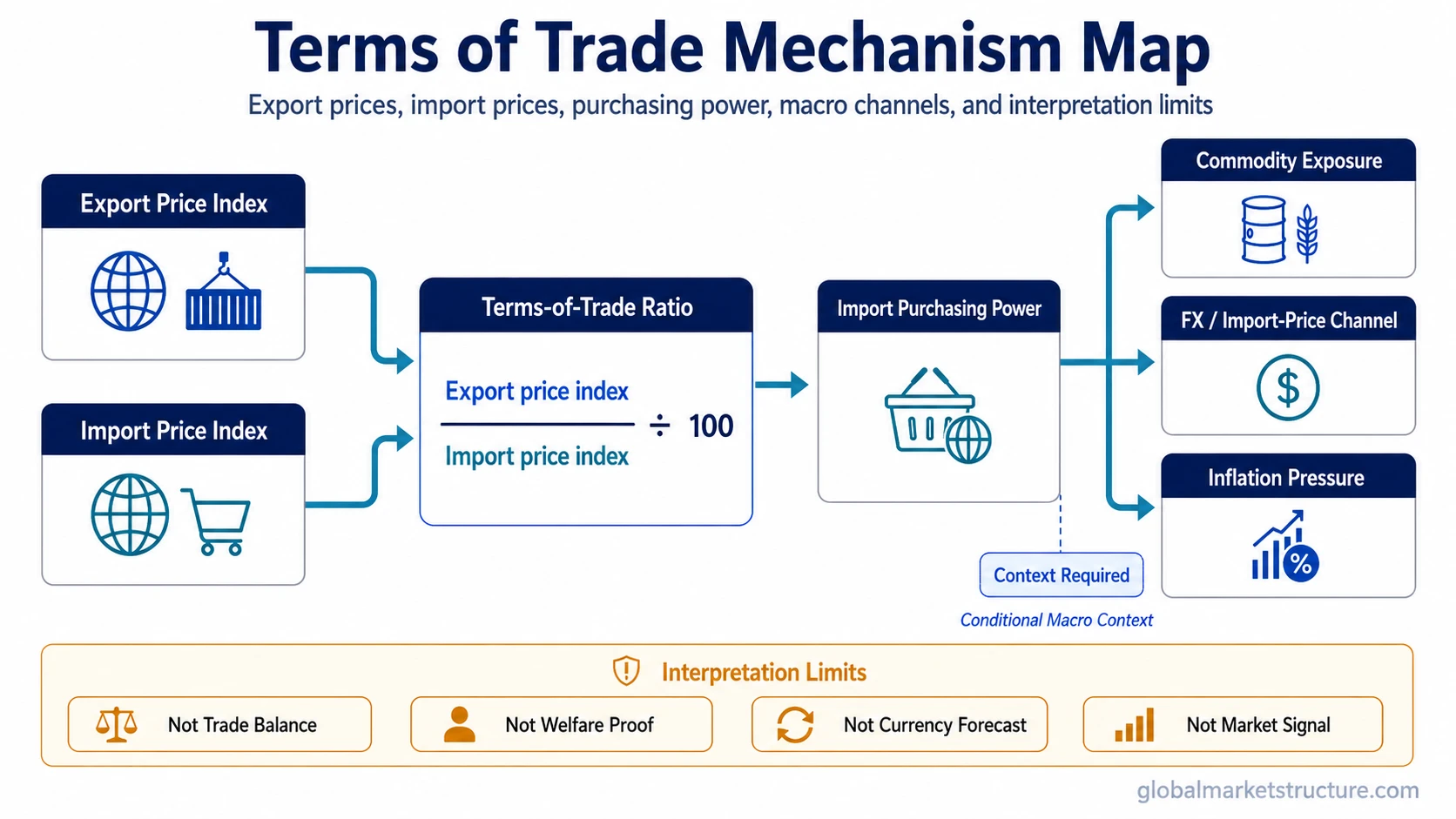
What Improves or Weakens Terms of Trade
Terms of trade improves when export prices rise faster than import prices, import prices fall faster than export prices, or both changes occur together in a favorable direction. For a commodity exporter, this can happen when export commodities rise while imported manufactured goods, energy inputs, or capital goods do not rise as quickly.
Terms of trade weakens when import prices rise faster than export prices, export prices fall faster than import prices, or both move in an unfavorable combination. That can pressure external purchasing power because the same export base buys fewer imports than before.
The same ratio movement can come from different macro conditions. Rising export prices may reflect strong external demand, supply constraints, or commodity-specific shocks. Falling import prices may reflect cheaper global inputs, weaker domestic demand, currency effects, or lower traded-goods inflation. The ratio shows where relative prices moved, not the full reason they moved.
Why Terms of Trade Matters in Macro and Intermarket Analysis
Terms of trade matters because external price relationships can influence income, inflation pressure, FX sensitivity, and cross-asset interpretation. A country that exports commodities and imports manufactured goods may receive a different macro impulse from a country that imports key commodities and exports finished products.
The connection is especially visible in a commodity currency, where export-price changes can affect external income, fiscal conditions, inflation sensitivity, and FX interpretation. The relationship remains conditional because currencies also respond to interest-rate expectations, capital flows, risk appetite, positioning, and liquidity conditions.
Exchange rates can also affect import prices through FX pass-through. A weaker currency can raise local-currency import costs if foreign-price changes are passed into domestic prices. The effect may be incomplete or delayed, so exchange-rate movement and terms-of-trade movement should not be collapsed into one signal.
For market-structure interpretation, terms of trade is most useful as a context layer. It can help explain why some economies face external income support while others face import-cost pressure. It can also help frame why commodity shocks, currency moves, and inflation pressure do not affect all markets in the same way.
Short Terms of Trade Example
A commodity-exporting economy can see its terms of trade improve when export prices rise faster than import prices. Export revenue may then command more import purchasing power than before. The broader interpretation still depends on export volumes, production constraints, domestic inflation pressure, fiscal policy, import needs, and exchange-rate transmission.
The opposite scenario can also occur. If import prices rise sharply while export prices lag, terms of trade can deteriorate even when export volumes remain stable. That can pressure purchasing power and inflation interpretation, but it still needs confirmation from trade volumes, policy conditions, currency behavior, and domestic demand before becoming a broader macro conclusion.
What Terms of Trade Does Not Prove
Terms of trade is often misread when the ratio is treated as a complete macro signal. It is a relative price measure, so it needs confirmation from volumes, domestic demand, inflation data, exchange rates, policy conditions, and external balances.
Important limits: Better terms of trade is not the same as a trade surplus, stronger GDP, higher welfare, currency appreciation, commodity gains, or a market signal. Weaker terms of trade is not direct proof of crisis, recession, currency depreciation, or a market call.
| Misreading | Cleaner interpretation |
|---|---|
| Better terms of trade means trade surplus. | Trade balance also depends on quantities, demand, imports, exports, and income flows. |
| Better terms of trade proves welfare is improving. | Distribution, volumes, domestic prices, employment, policy, and import needs still matter. |
| Better terms of trade means the currency should rise. | Currency direction also depends on rates, capital flows, risk appetite, liquidity, and positioning. |
| Commodity exporters always benefit from higher commodity prices. | Production costs, import costs, volumes, fiscal policy, hedging, and domestic inflation can change the outcome. |
| Terms of trade is a market signal. | It is a macro context measure, not an entry, exit, target, or forecast tool. |
Related Concepts
Commodity-linked economies often require a separate FX lens because export-price sensitivity can interact with interest rates, capital flows, and global risk appetite. That makes commodity-currency behavior related to terms of trade, but not identical to it.
Exchange-rate transmission also needs a separate lens because a currency move can change import prices before the full effect appears in domestic inflation. Terms of trade compares export and import prices, while pass-through explains how exchange-rate movement reaches local prices and margins.
FAQ
What is terms of trade in simple terms?
Terms of trade compares export prices with import prices. It shows how much import purchasing power a country’s exports provide relative to a base period.
What is the formula for terms of trade?
The common formula is export price index divided by import price index, usually multiplied by 100 when expressed as an index.
Is terms of trade the same as trade balance?
No. Terms of trade is a price ratio. Trade balance depends on the value and volume of exports and imports, not only their relative prices.
Do better terms of trade mean a stronger currency?
No. Better terms of trade can support external purchasing power, but currency direction also depends on rates, capital flows, policy expectations, risk appetite, and liquidity.