
Exchange rate pass-through is the process by which a currency movement transmits into domestic price conditions, especially import prices, input costs, consumer prices, and inflation pressure. It matters for intermarket analysis because FX moves can change the pricing environment across trade, commodities, margins, and policy expectations. The effect is usually incomplete and conditional, not a mechanical inflation or currency forecast.
Definition: Exchange rate pass-through means the transmission of exchange-rate changes into prices paid by importers, firms, and consumers. A weaker or stronger currency may affect import costs first, but the final consumer-price effect depends on pricing behavior, competition, invoicing currency, import exposure, policy credibility, and the type of shock behind the FX move.
Key Points
- Exchange rate pass-through links currency moves to domestic price pressure through import prices, input costs, margins, and consumer prices.
- The process is usually partial rather than one-for-one, because firms may absorb costs, hedge exposure, delay price changes, or face competitive constraints.
- Import-price pass-through can appear before consumer-price pass-through because firms and retailers may change final prices only after costs, margins, and demand conditions shift.
- FX pass-through is not the same as a currency forecast, an inflation forecast, or a trading signal.
- The concept works as a macro transmission layer connecting FX, trade exposure, commodities, margins, inflation expectations, and policy interpretation.
How Exchange Rate Pass-Through Works
The basic mechanism starts with a currency move. If the domestic currency weakens, imported goods priced in foreign currency can become more expensive in domestic-currency terms. If the domestic currency strengthens, those imported costs can ease. That first cost movement does not automatically reach consumer prices, but it can change the pricing environment faced by importers, producers, retailers, and policymakers.
Mechanism chain: FX move → import prices → input costs and firm margins → producer and retail pricing decisions → consumer prices and inflation pressure.
The chain is easier to understand if each step is kept separate. A currency move may pass quickly into import prices, more slowly into producer costs, and only partially into final consumer prices. The later the step in the chain, the more the effect depends on business pricing decisions, competition, demand, contracts, hedging, and policy credibility.
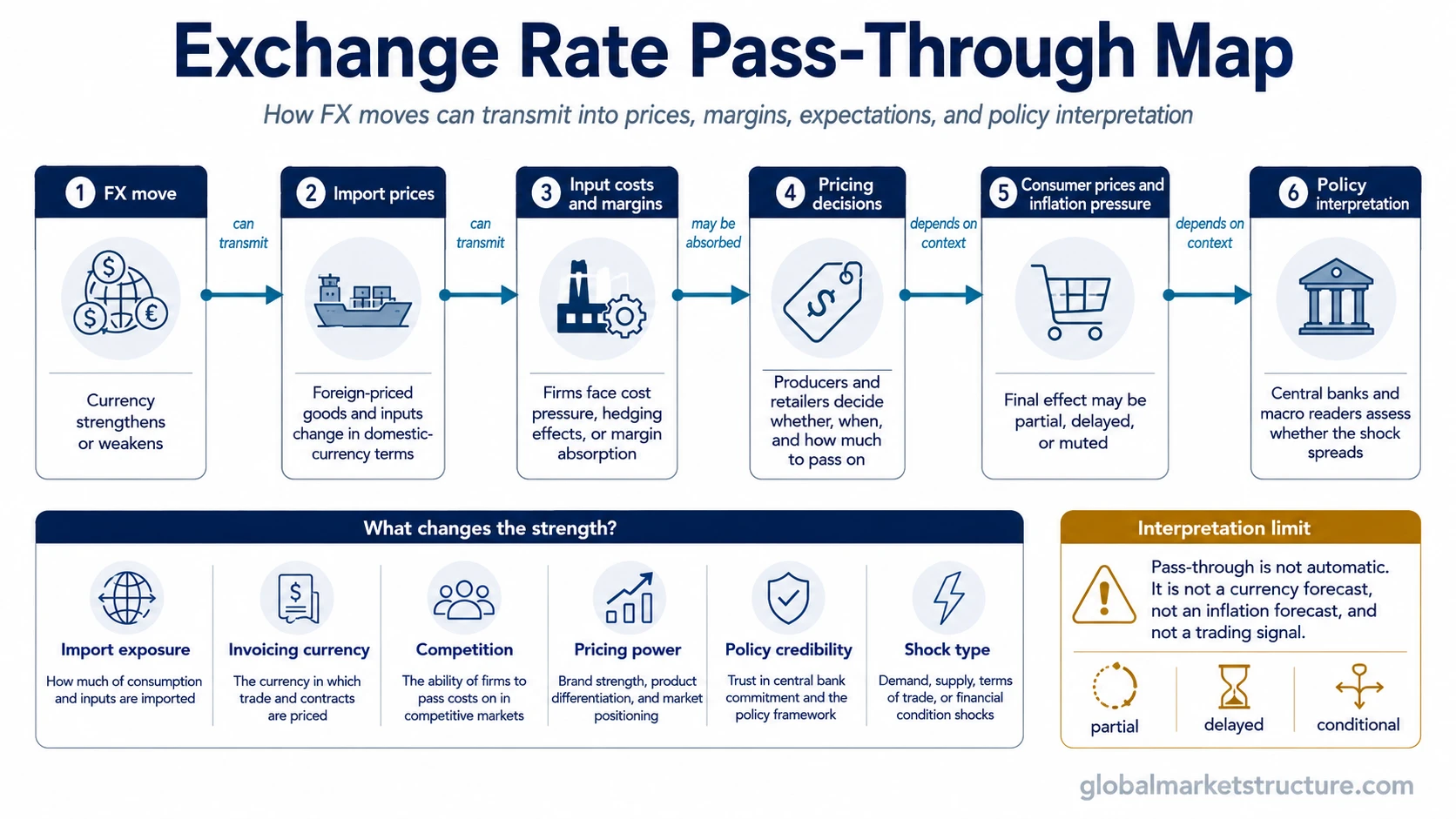
Import-Price Pass-Through vs Consumer-Price Pass-Through
Import-price pass-through and consumer-price pass-through are related, but they are not the same. Import-price pass-through describes how exchange-rate movements affect the domestic price of imported goods and inputs. Consumer-price pass-through describes how much of that cost movement eventually reaches the prices paid by households.
| Type | What changes first | Main interpretation | Main limitation |
|---|---|---|---|
| Import-price pass-through | Prices of imported goods, raw materials, and intermediate inputs | Shows how FX movements affect trade-linked costs | Does not prove final consumer prices will move by the same amount |
| Consumer-price pass-through | Retail prices and consumer inflation components | Shows how much of the FX effect reaches households | Depends on margins, competition, demand, policy credibility, and price-setting behavior |
| First-stage pass-through | Import and input prices | Captures the earlier cost shock from FX movement | Can be absorbed before reaching the consumer basket |
| Second-stage pass-through | Producer prices, retail prices, and consumer prices | Captures the later transmission into broader price conditions | Usually more conditional and slower than the first stage |
Direct and Indirect Channels
Direct pass-through occurs when exchange-rate changes alter the domestic-currency price of imported goods or inputs. A firm that imports components, energy, food, machinery, or consumer goods may face a different cost base after a currency move. That cost shift can then affect margins or pricing decisions.
Indirect pass-through works through broader economic channels rather than a simple import-price conversion. A currency move can affect export competitiveness, demand for domestic substitutes, commodity-linked costs, inflation expectations, and policy interpretation. Direct pass-through starts with the price of imported goods or inputs; indirect pass-through depends more on how firms, households, and policymakers respond to the same FX movement.
Interpretation note: A currency move can matter even when consumer prices do not adjust immediately. The useful question is not only whether inflation changes, but where the pressure first appears: imports, input costs, margins, expectations, or policy reaction.
Why Pass-Through Is Usually Incomplete
Exchange rate pass-through is usually incomplete because prices are not reset automatically after every FX move. Firms may absorb part of the cost change through margins. They may hedge currency exposure, rely on existing contracts, delay price changes, or keep prices stable to avoid losing market share. Retailers may also change final prices more slowly than import costs move.
Incomplete pass-through is the main reason a weaker currency should not be read as a one-for-one inflation forecast. The same exchange-rate move can create different price outcomes depending on the structure of imports, the competitive environment, the currency used for invoicing, the strength of demand, and the credibility of inflation expectations.
Core limitation: FX pass-through can indicate a transmission path from currency movement to price pressure, but it does not prove that inflation must rise, that a currency trend will continue, or that a market signal is actionable by itself.
What Changes the Strength of FX Pass-Through?
The strength of pass-through depends on the economic setting. A country or sector with high import dependence may feel exchange-rate changes more directly than one with lower import exposure. A market with strong competition may see firms absorb more of the currency shock, while firms with pricing power may pass more of it to buyers.
| Factor | Why it matters | Interpretation boundary |
|---|---|---|
| Import dependence | Higher reliance on imported goods or inputs can increase exposure to exchange-rate changes. | Import exposure alone does not determine final consumer inflation. |
| Invoicing currency | Prices set in a dominant foreign currency can shape how quickly FX changes affect domestic costs. | The invoicing effect depends on contracts, pricing frequency, and market structure. |
| Competition and pricing power | Firms with stronger pricing power may pass more cost pressure to buyers. | Competitive pressure can force firms to absorb part of the shock through margins. |
| Inflation environment | Pass-through can behave differently when inflation is already high or expectations are less anchored. | Do not infer a universal rule without country, period, and source evidence. |
| Policy credibility | Credible monetary policy and anchored expectations can reduce the chance that FX shocks spread broadly. | This is a conditional stabilizer, not a guarantee. |
| Shock type | A commodity shock, funding shock, policy shock, or growth shock can transmit through prices in different ways. | The cause of the FX move matters as much as the direction of the move. |
How FX Pass-Through Helps Macro Interpretation
For macro and intermarket analysis, exchange rate pass-through is most useful as a transmission map. It helps explain how FX moves can move through trade costs, commodity-linked imports, corporate margins, consumer prices, and policy expectations. It is not a standalone forecast tool.
The concept helps separate stronger and weaker interpretations. The relevant checks include the size of the currency move, the importance of imported inputs, the ability of firms to absorb pressure in margins, the state of inflation expectations, and the source of the FX move. A commodity shock, a dollar funding shock, and a domestic policy shift can produce different pass-through behavior.
This is also where exchange rate pass-through differs from terms of trade. Terms of trade compare export prices with import prices. Exchange rate pass-through focuses on how currency changes transmit into domestic price conditions.
What Exchange Rate Pass-Through Does Not Prove
FX pass-through is often misread because the concept sits close to inflation, central-bank policy, commodities, and dollar analysis. The clean boundary is simple: it describes a possible transmission channel, not a finished prediction.
| Misuse | Why it is wrong | Safer interpretation |
|---|---|---|
| A weaker currency always causes inflation | Pass-through is partial and conditional. | A weaker currency can raise price pressure if the transmission chain remains open. |
| DXY explains pass-through by itself | DXY is a dollar index, not a full domestic price-transmission model. | Use the DXY Index as one context input, not the entire explanation. |
| FX pass-through is an inflation forecast | The final price effect depends on firms, consumers, policy, and shock type. | Treat it as a channel to monitor, not a forecast outcome. |
| FX pass-through is a trading signal | The concept does not define entries, exits, timing, or expected returns. | Use it only as macro context inside broader market-structure analysis. |
A Simple Illustrative Scenario
Illustrative scenario: A domestic currency weakens while many imported inputs are priced in foreign currency. Importers may face higher domestic-currency costs. Some firms may raise prices, some may absorb the pressure through lower margins, and some may delay price changes because competition is strong. Consumer-price pass-through becomes stronger if the cost shock is persistent, demand remains resilient, and inflation expectations become less anchored. It becomes weaker if firms hedge exposure, margins absorb the move, or policy credibility limits second-round effects.
The scenario does not describe a specific country, date, asset, or policy episode. It shows why the same FX movement can produce different price outcomes under different conditions.
Exchange Rate Pass-Through in Market Structure
Exchange rate pass-through belongs in market-structure analysis because it connects currencies with real-economy pricing pressure. A currency move can alter the cost of imported goods, the relative pressure on domestic firms, the sensitivity of consumer inflation, and the way policymakers interpret the price environment.
The concept is especially useful when it is combined with other macro layers. Import dependence, commodity exposure, dollar sensitivity, inflation expectations, and central-bank credibility can all change the meaning of the same FX move. That makes pass-through a context layer rather than a signal layer.
Practical boundary: The correct question is not “what will the currency do next?” The better question is “where could this currency move transmit into prices, margins, expectations, and policy interpretation, and what could block that transmission?”
FAQ
Is exchange rate pass-through the same as inflation?
No. Exchange rate pass-through is a transmission process from currency movement into prices. Inflation is the broader change in consumer prices. Pass-through can influence inflation pressure, but it does not equal inflation by itself.
Is FX pass-through always complete?
No. FX pass-through is usually incomplete because firms may absorb cost changes through margins, hedge currency exposure, delay pricing changes, or face competition that limits their ability to raise prices.
What is the difference between import-price and consumer-price pass-through?
Import-price pass-through describes how currency movements affect the domestic price of imported goods and inputs. Consumer-price pass-through describes how much of that movement eventually reaches retail prices paid by households.
Is exchange rate pass-through the same as DXY analysis?
No. DXY can help describe broad U.S. dollar movement, but exchange rate pass-through is about how currency changes transmit into domestic import costs, firm pricing, consumer prices, and inflation pressure.
Does a weaker currency always raise consumer prices?
No. A weaker currency can increase price pressure through import costs, but the consumer-price effect depends on import exposure, firm pricing power, competition, contracts, margins, policy credibility, and the type of shock.