
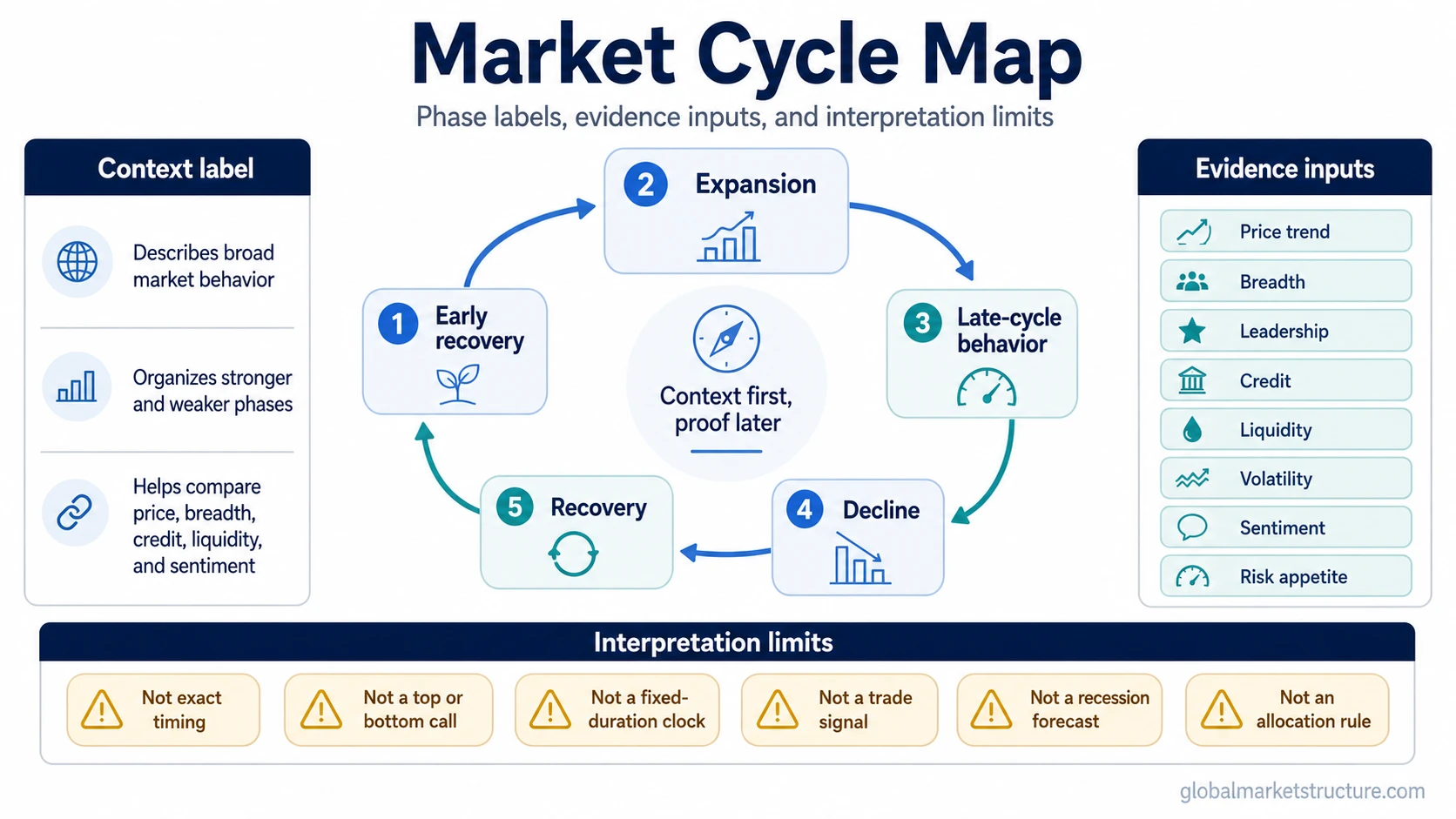
A market cycle describes changing conditions across financial markets as asset prices, participation, sentiment, liquidity, credit, and risk appetite strengthen or weaken. Phase labels help classify that behavior. Their interpretation depends on the market being examined, the time horizon, and whether the broader evidence agrees with the price trend.
How market cycles are commonly described
Market-cycle models use labels such as accumulation, expansion, distribution, decline, and recovery. Some frameworks use markup and markdown, while others distinguish early, middle, and late conditions. These are descriptive groupings rather than a universally fixed sequence.
| Cycle description | Market behavior to examine | Uncertainty in the reading |
|---|---|---|
| Early recovery or accumulation | Prices may stabilize after weakness. Downside pressure eases while participation and risk appetite begin to recover unevenly. | Stabilization may fail before a sustained advance develops. |
| Expansion or broad advance | Price trends strengthen, with broader participation and improving appetite for risk. | A rising index may still conceal narrowing leadership or weakening credit support. |
| Late-cycle or distribution behavior | Leadership may become concentrated while some breadth, liquidity, or volatility measures deteriorate. | These conditions can persist without an immediate market top. |
| Decline or risk-off phase | Prices and participation weaken as investors become less willing or able to hold risk. | The phase label provides no reliable measure of the remaining decline. |
| Repair or recovery | Breadth, leadership, liquidity, or risk appetite may improve after earlier stress. | Repair can be partial, interrupted, or limited to certain assets. |
A market can rotate between conditions, revisit an earlier pattern, or show different phases across asset classes. A phase comparison should therefore specify the market and observation period rather than assume that one index describes every asset.
Evidence used to interpret a market cycle
Price establishes the visible trend. Participation, financing conditions, and risk appetite help determine whether that trend reflects broader market behavior or a narrower move.
| Evidence input | What to examine | Alternative interpretation |
|---|---|---|
| Price trend | Direction, persistence, and the behavior of major assets. | A headline index can rise while other markets or components weaken. |
| Market breadth | How widely an advance or decline is shared across the relevant universe. | A narrow advance can continue; weak breadth does not date a reversal. |
| Leadership | Which sectors, styles, or asset groups drive the move. | Rotation between leaders can occur without a complete cycle change. |
| Credit conditions | Spreads, lending appetite, refinancing pressure, and risk pricing. | Credit may weaken before prices respond or remain resilient during an equity decline. |
| Liquidity conditions | Financing availability, trading depth, and the broader funding environment. | Liquidity conditions do not explain every price movement. |
| Volatility and sentiment | Changes in uncertainty, positioning, confidence, and willingness to hold risk. | An extreme reading need not be followed by an immediate reversal. |
Related indicators are not always independent. For example, weakening breadth and concentrated leadership may reflect the same participation problem. Agreement across genuinely different inputs is more informative than counting several versions of one signal.
When the index and internal conditions disagree
Consider a broad equity index that is still rising. The price trend alone suggests strength, but the internal reading changes when participation and financing conditions are included.
- Fewer sectors or stocks contribute to the advance.
- Credit spreads stop improving or begin widening.
- Volatility becomes less stable and liquidity support weakens.
The index remains strong, but the broader evidence is less supportive. This can justify a more cautious cycle interpretation without identifying a market top.
- Participation improves beneath the headline index.
- Leadership broadens while volatility eases.
- Credit or liquidity pressure begins to recede.
Improvement beneath weak prices can indicate developing repair. A sustained recovery remains unconfirmed until the relevant evidence develops further.
The two situations are illustrative. Their meaning depends on the instruments, time horizon, and quality of the underlying data. Neither condition establishes the next market move.
Market cycle versus business-cycle dating
A market cycle describes asset-market conditions. A business cycle describes economy-wide activity through expansion and contraction. Financial prices may respond to expectations before economic data changes, while market and economic turning points can also diverge.
The National Bureau of Economic Research dates U.S. business-cycle peaks and troughs using a range of real economic-activity measures, including employment, income, spending, sales, and industrial production. Its chronology does not assign phase labels to financial-market price patterns. Read the NBER business-cycle methodology.
Fidelity’s Asset Allocation Research Team uses a probabilistic business-cycle framework to examine equity-sector performance across changing economic conditions. That is a specific investment-research approach, not a universal clock for all financial markets. Read the Fidelity research.
Related cycle concepts
Each related concept has a separate analytical role. The broader market-cycle view can use their evidence without replacing their definitions.
| Concept | Separate focus |
|---|---|
| Business cycle | Expansion and contraction in economy-wide activity, including output, employment, income, and demand. |
| Stock cycle | Equity-market accumulation, advance, distribution, and decline, with emphasis on stock-market participation and leadership. |
| Credit cycle | Lending conditions, credit availability, financing costs, leverage, and borrower stress. |
| Boom-and-bust cycle | A sharper expansion-to-contraction pattern involving rapid build-up and subsequent unwind. |
For the direct comparison of financial-market behavior with economic activity, see market cycle vs business cycle.
Market cycles have no fixed calendar duration. Phase boundaries may become clearer only after conditions have changed, and different assets can show conflicting evidence. Classifying a market as early-, mid-, or late-cycle does not establish a top, bottom, recession probability, future return, allocation change, or trade direction. Those conclusions require separate evidence and an appropriate decision framework.