
A boom and bust cycle is a period of rapid expansion followed by a sharp slowdown or contraction. It can develop in economic activity, credit, an industry, or asset prices. During the boom, stronger demand, easier financing, rising confidence, investment, and leverage can reinforce one another. When enough of those supports weaken, the process can start running in the opposite direction.
Definition: a boom and bust cycle describes an expansion that builds momentum and then reverses as financing, demand, confidence, liquidity, leverage, or expectations deteriorate.
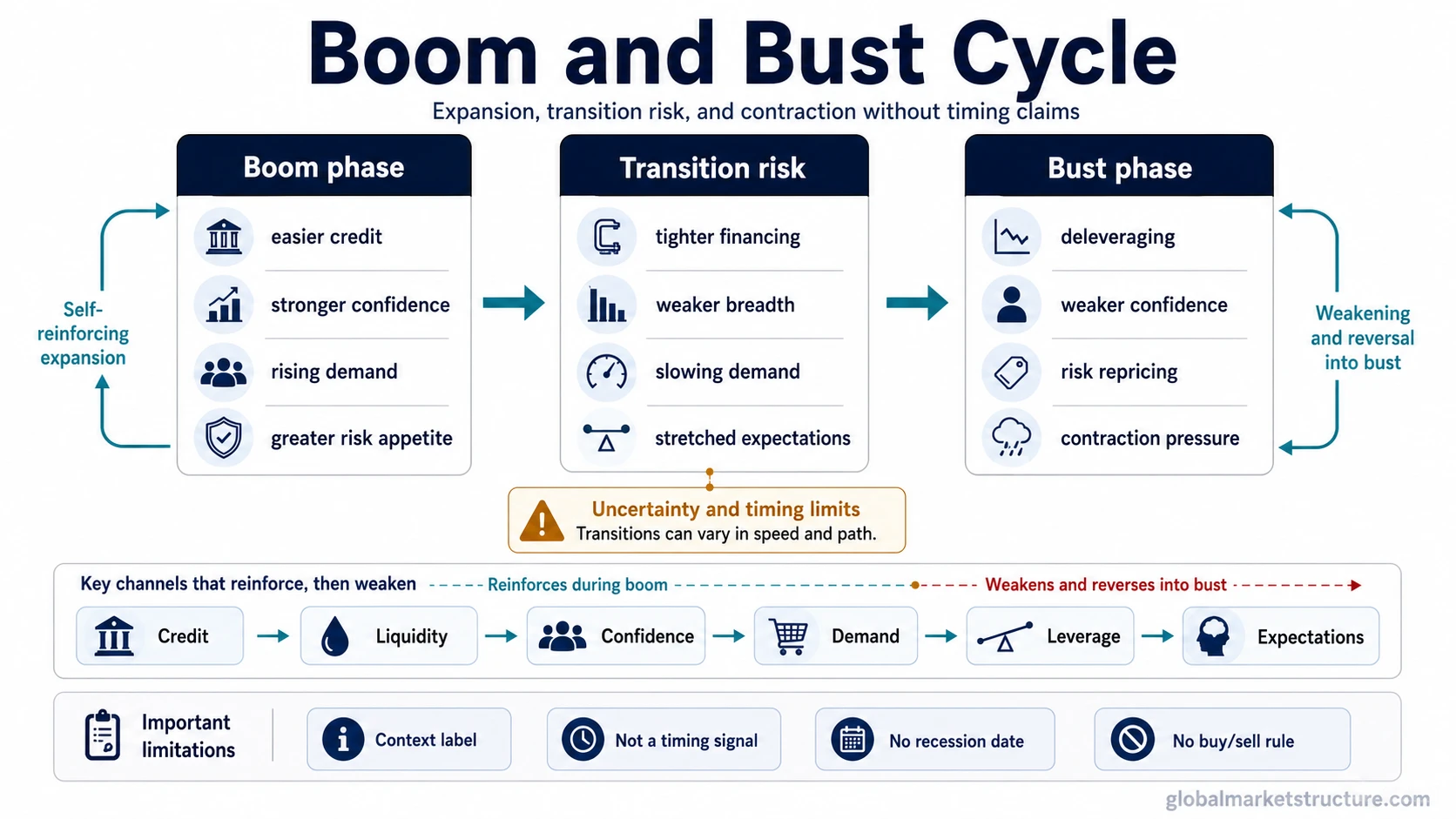
How a Boom and Bust Cycle Develops
The expansion can start from several places. Credit may become easier to obtain. Demand may improve. Policy or liquidity conditions may become more supportive. Businesses may increase investment as sales strengthen, while investors become more willing to take risk as prices rise.
These forces can feed back into one another. Easier financing supports borrowing and spending. Stronger activity can improve confidence. Higher confidence can encourage more investment, leverage, and risk-taking. Rising asset prices may strengthen the same process by making financial conditions feel easier.
The structure becomes more fragile when growth increasingly depends on those reinforcing conditions continuing. Tighter financing, weaker demand, lower liquidity, falling confidence, or pressure on leveraged balance sheets can interrupt the loop. Once participants begin cutting spending, reducing risk, or deleveraging, the contraction can also become self-reinforcing.
| Stage | Typical conditions | What is changing |
|---|---|---|
| Boom | Easier financing, stronger demand, rising confidence, more investment and risk-taking | The expansion is gaining support from several channels at once. |
| Transition | Tighter credit, slower demand, narrower participation, weaker expectations | Some of the forces that sustained the expansion are beginning to fade. |
| Bust | Deleveraging, weaker spending, tighter financing, falling activity or prices | The earlier expansion is being unwound and the contraction may begin to reinforce itself. |
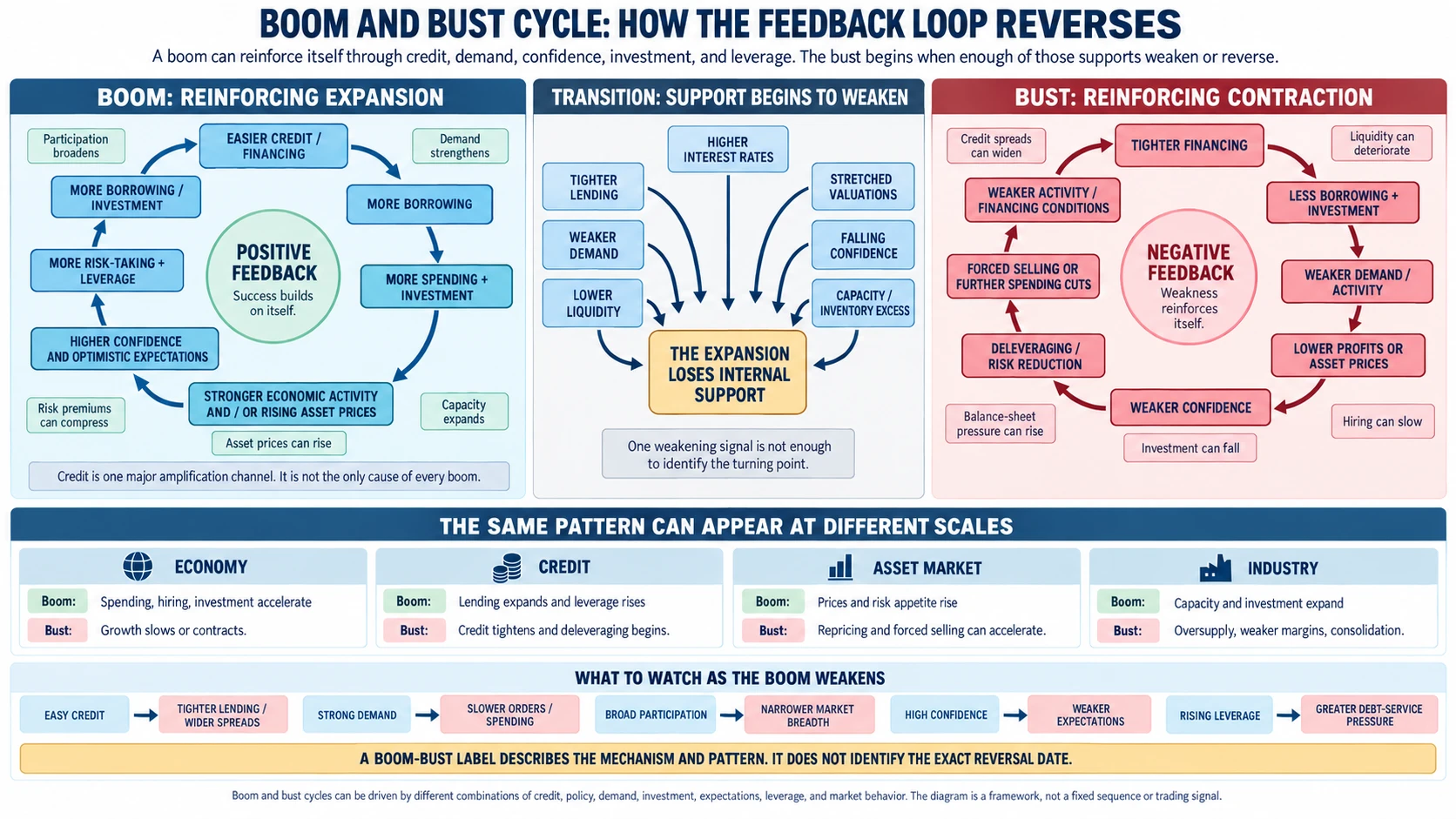
Which Support Is Holding the Boom Together?
Different booms depend on different forms of support. A credit-driven expansion can remain intact while demand is still firm, but become vulnerable once refinancing conditions tighten. An asset-price boom may continue while headline indexes are rising even as participation narrows underneath. An industry boom can persist until new capacity begins to outrun demand.
The useful diagnostic is to identify what is doing most of the work during the expansion, then watch whether that specific support is still strengthening, flattening, or beginning to reverse.
| Main support behind the boom | Early deterioration to watch | What would strengthen the bust interpretation |
|---|---|---|
| Credit expansion | Lending standards tighten, spreads widen, or refinancing becomes more selective. | Credit growth slows while debt-service and refinancing pressure increase. |
| Asset-price reflexivity | Market breadth narrows and price gains become concentrated. | Falling asset values begin to weaken collateral, liquidity, or leveraged balance sheets. |
| Real demand | Orders, spending, utilization, or pricing power begin to slow. | Inventory pressure rises, margins weaken, or businesses cut investment. |
| Leverage | Interest expense or debt-service burden begins to rise. | Borrowers reduce assets, spending, or investment to repair balance sheets. |
| Confidence and expectations | Surveys, expectations, or risk-taking become less optimistic. | Weaker expectations begin to affect actual investment, hiring, spending, or financing behavior. |
| Liquidity | Market depth deteriorates or financing becomes harder to absorb. | Funding pressure spreads across more markets or forces participants to reduce risk. |
A weakening signal becomes more useful when it appears in the same channel that helped sustain the boom. If the expansion was mainly credit-driven, deteriorating market breadth alone may be early context. Tighter lending combined with refinancing pressure would be more directly relevant to the structure that supported the expansion.
These signals rarely move on a fixed schedule. A boom can continue while one channel is already weakening. Confidence in the reversal grows when pressure reaches the support that drove the expansion and begins to spread into related channels.
Where Boom and Bust Cycles Can Appear
The term can describe several different kinds of cycles. The scope matters because a boom in one part of the system does not automatically describe the whole economy.
| Scope | Boom phase | Bust phase |
|---|---|---|
| Economy | Spending, hiring, investment, and activity accelerate. | Demand weakens, hiring slows, and activity may contract. |
| Credit | Lending expands, financing becomes easier, and leverage rises. | Lending tightens, refinancing becomes harder, and deleveraging increases. |
| Asset market | Prices rise, participation broadens, and risk appetite strengthens. | Prices reprice, liquidity may weaken, and forced selling can add pressure. |
| Industry | Demand, capacity, hiring, and investment expand. | Oversupply, weaker margins, lower utilization, or consolidation may follow. |
An asset-market bust can occur without a broad economic recession. An industry can also move through its own boom-bust sequence while the wider economy remains relatively stable.
Boom and Bust Cycle vs Other Cycle Concepts
A boom-bust cycle focuses on the reinforcing build-up and subsequent reversal. A broader market cycle covers changes in market phases and risk environments over time.
| Concept | Main focus | Relationship to a boom-bust pattern |
|---|---|---|
| Boom and bust cycle | Rapid expansion followed by a sharp contraction | Describes the reinforcing build-up and reversal itself. |
| Market cycle | Broader changes in market phases and risk conditions | Can contain periods that resemble booms and busts. |
| Business cycle | Expansion and contraction in the real economy | An economic boom-bust episode may occur within the broader business cycle. |
| Stock cycle | Changes in equity-market phase behavior | Equities can experience a boom-bust sequence without the same pattern appearing across the full economy. |
| Credit cycle | Changes in borrowing, lending, leverage, and financing conditions | Credit can amplify both the expansion and the later contraction. |
What the Boom-Bust Label Can Tell You
The label describes the structure of the cycle: how an expansion became self-reinforcing, which conditions sustained it, and where pressure may appear if those conditions reverse.
Timing requires separate evidence. A vulnerable boom can continue for longer than expected, and the first deterioration may appear well before the broader contraction. A market bust can also remain concentrated in one asset class or industry.
Interpretation limit: the presence of boom-bust characteristics does not identify the exact reversal date or establish that a recession must follow.
Illustrative Boom and Bust Sequence
Suppose financing becomes easier while demand and confidence are already improving. Borrowing increases, investment expands, and asset prices rise. Those gains support further confidence and risk-taking, so the expansion becomes more dependent on continued access to financing and strong expectations.
Later, borrowing costs rise and lenders become more selective. Demand begins to slow. Participants carrying more leverage have less flexibility, so some reduce spending, investment, or market exposure. Falling prices and weaker activity then put additional pressure on confidence and balance sheets.
The sequence is illustrative. Real boom-bust episodes can begin through different channels, and the order of deterioration can vary.
FAQ
What is a boom and bust cycle?
A boom and bust cycle is a pattern in which rapid expansion in activity, credit, an industry, or asset prices is followed by a sharp slowdown or contraction. The term describes the pattern and mechanism, not the exact reversal date.
What causes a boom and bust cycle?
A boom and bust cycle can develop through combinations of stronger demand, easier credit, abundant liquidity, rising confidence, investment, leverage, and optimistic expectations. A bust can develop as enough of those supports weaken or reverse.
What are the main phases of a boom and bust cycle?
The broad sequence is boom, transition, and bust. During the boom, several forces reinforce expansion. The transition begins as some of that support weakens. The bust is the contraction or unwinding that follows if the deterioration becomes strong enough.
Is a boom and bust cycle the same as a business cycle?
No. A business cycle describes broad expansion and contraction in the real economy. A boom and bust cycle can occur in the economy, credit, an industry, or asset prices and focuses on the reinforcing build-up and reversal.
Does a boom and bust cycle predict a recession?
No. A boom-bust structure can show that an expansion has become vulnerable, but it does not establish when a recession will begin or whether an asset-market reversal will spread to the wider economy.
Can a boom and bust cycle be used as a trading signal?
The concept is better suited to market-structure context. It can help explain the environment and the forces behind an expansion or contraction, but it does not provide a precise entry, exit, or reversal date.