
Business-cycle stages are commonly grouped into expansion, peak, contraction or recession, trough, and recovery. These labels describe broad changes in economic activity and the turning points between stronger and weaker conditions.
The simple sequence is:
Trough → recovery or expansion → peak → contraction or recession → trough.
The labels are useful for classifying the economic environment, but they do not identify stock-market tops, market bottoms, or precise real-time turning points. Peaks and troughs can become clearer only after enough economic data confirms that conditions have changed.
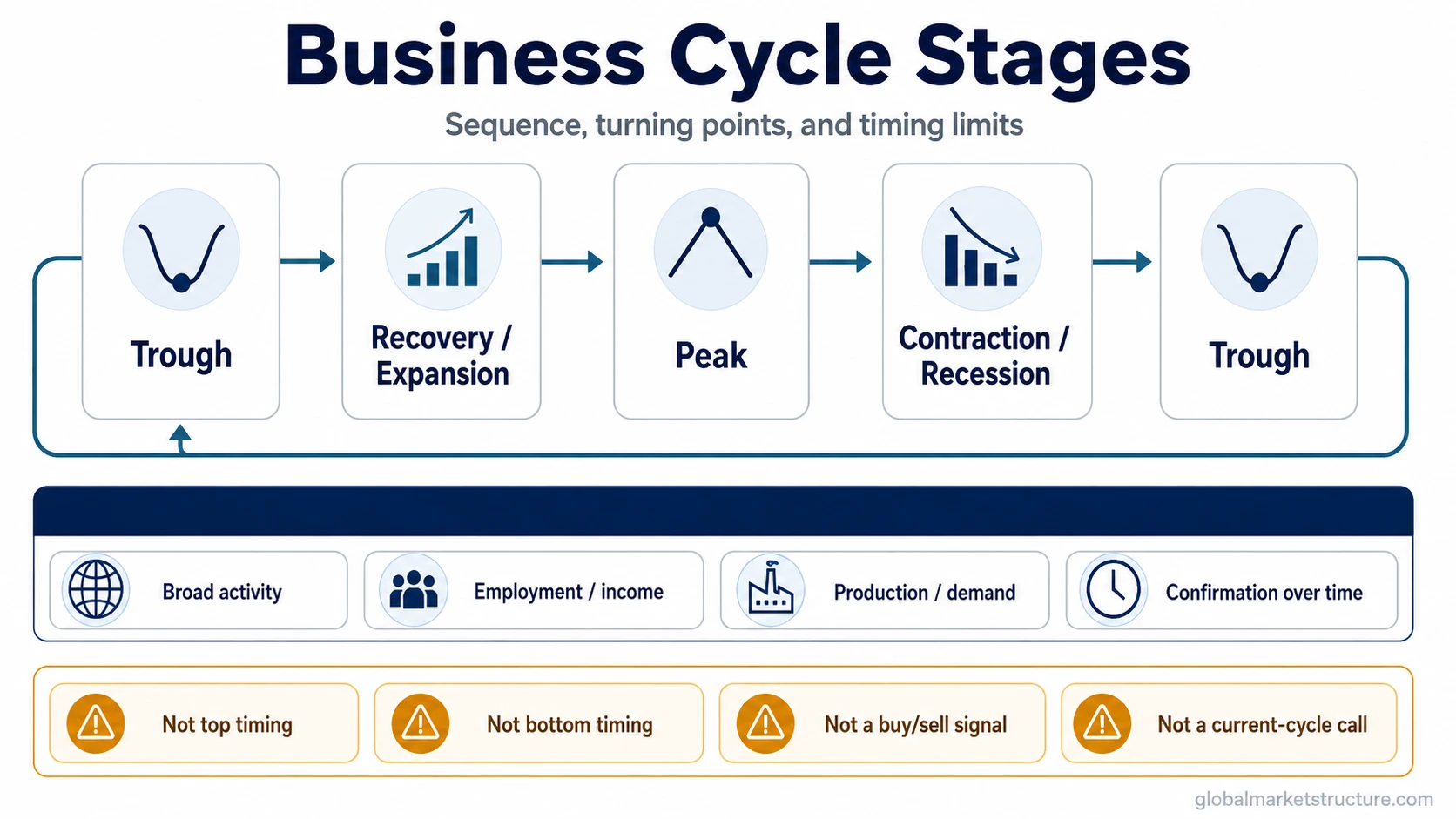
What are the stages of the business cycle?
The business cycle describes broad economic activity moving through growth, turning points, weakness, and renewed improvement. The stage labels provide a simple way to organize that sequence.
| Stage | Basic meaning | Common evidence | Timing limit |
|---|---|---|---|
| Expansion | Economic activity is generally growing. | Output, employment, income, production, and demand often improve together. | Expansion does not mean every market or sector performs well at the same time. |
| Peak | The cycle reaches a high point before economic activity begins to weaken. | Growth can still look strong, but the rate of improvement may begin to fade. | A peak is usually easier to identify after enough data confirms the turn. |
| Contraction or recession | Economic activity weakens after a peak. | Production, employment, income, credit conditions, or demand may deteriorate. | Contraction and recession are related, but public, market, and official usage can differ. |
| Trough | The cycle reaches a low point before economic activity begins improving again. | Weak data may stop getting worse before broad strength is obvious. | A trough does not establish where financial markets must bottom. |
| Recovery | Economic activity begins improving after a trough. | Some indicators stabilize or rebound before the expansion looks mature. | Some frameworks treat recovery as a separate stage, while others treat it as early expansion. |
The sequence does not run on a fixed schedule. Expansion and contraction can vary substantially in length and intensity, and different parts of the economy can turn at different times.
Why “four stages” is common but not universal
Many explanations simplify the business cycle into four stages: expansion, peak, contraction, and trough. This version separates two broad phases from the two turning points between them.
Other frameworks identify recovery separately, distinguish contraction from recession, or divide an expansion into early-, mid-, and late-cycle conditions. The labels change because the frameworks are designed for different analytical purposes.
| Framework | What it emphasizes | Main limitation |
|---|---|---|
| Four-stage model | Expansion, peak, contraction, and trough. | Early recovery is usually included within the next expansion. |
| Five-stage model | Expansion, peak, contraction or recession, trough, and recovery. | The boundary between recovery and expansion can depend on the framework. |
| Early-, mid-, and late-cycle model | Changes within an expansion as growth, policy, inflation, credit, and profits evolve. | These labels describe conditions within the broader cycle rather than universally defined official turning points. |
| Official cycle dating | Historical peaks and troughs in broad economic activity. | Confirmation can arrive after the economic turning point has already occurred. |
How business-cycle stages are identified
Business-cycle stages are usually assessed from several parts of the economy together. Useful evidence can include output, employment, income, industrial production, consumption, credit conditions, inflation pressure, interest-rate policy, and business confidence.
Turning points are the hardest part to identify in real time. One weak release rarely establishes a peak, and one stronger release rarely establishes a trough. The interpretation becomes stronger when several areas of activity begin moving in the same direction.
| Evidence area | What it can clarify | Why it is not enough alone |
|---|---|---|
| Output and production | Whether real activity is expanding or weakening. | Some industries can turn before the broader economy. |
| Labor market | Whether employment, hours, and income conditions are improving or deteriorating. | Labor conditions can respond later than production, credit, or financial conditions. |
| Income and consumption | Whether household demand continues to support economic activity. | Spending can remain resilient for a period even as other conditions weaken. |
| Credit and financial conditions | Whether financing is supporting activity or becoming more restrictive. | Financial stress can lead, coincide with, or follow broader economic weakness. |
| Policy and inflation | Whether monetary conditions are becoming easier or more restrictive. | Policy transmission takes time and does not map neatly to a single stage. |
Timing limits of business-cycle stages
Business-cycle stages provide economic context. Their timing can differ materially from financial-market turning points.
- Economic peaks and stock-market peaks can occur at different times.
- Economic troughs and market bottoms can occur at different times.
- Official cycle dating may confirm a turning point after investors, businesses, and households have already experienced the change.
- Any claim about the current stage needs dated economic evidence rather than an evergreen stage definition alone.
For market interpretation, the stage classification can be compared with credit, liquidity, market-cycle, and cross-asset evidence.
Which business-cycle concept fits the next question?
The stage map provides the orientation. Each phase and turning point has a separate page for the deeper definition and interpretation.
| If the question is… | Best next concept | Why it fits |
|---|---|---|
| What is the whole economic cycle? | Business cycle | The broader concept explains how economic activity moves through expansion and contraction over time. |
| What happens when economic activity is growing? | Expansion | Expansion focuses on the growth phase between a trough and a later peak. |
| What marks the upper turning point? | Business-cycle peak | A peak separates the end of expansion from the beginning of broad weakness. |
| What happens when activity weakens? | Contraction | Contraction focuses on the weakening phase after a peak. |
| When does weakness become broad and severe? | Recession | Recession focuses on a broad decline in economic activity rather than a mild slowdown. |
| What marks the lower turning point? | Business-cycle trough | A trough separates the end of contraction or recession from renewed improvement. |
| What happens after the trough? | Recovery | Recovery focuses on early improvement after a weak phase. |
| How is the economic cycle different from market behavior? | Market cycle vs business cycle | Economic activity and financial-market behavior can interact, but they are separate classification systems. |
Business-cycle stages vs market-cycle phases
Business-cycle stages describe broad economic activity. Market-cycle phases describe financial-market behavior, including changes in asset prices, participation, liquidity, sentiment, and risk appetite.
The timing can differ. Financial markets may weaken before an economic recession is confirmed and may begin recovering while economic data remains weak. Business-cycle stages therefore work best as an economic classification layer rather than a precise market-timing framework.