
A business-cycle trough is the low point in broad economic activity after a contraction or recession and before recovery or renewed expansion becomes visible. It marks a turning point in the business cycle, but it is usually easier to recognize after enough economic evidence shows that the decline has stopped and activity has begun to improve.
The term describes an economic-cycle classification, not a stock-market bottom, trade signal, allocation rule, or guarantee that conditions have fully normalized. A trough can help organize market-regime interpretation, but it should not be treated as proof that risk assets have already bottomed or that a smooth recovery is underway.
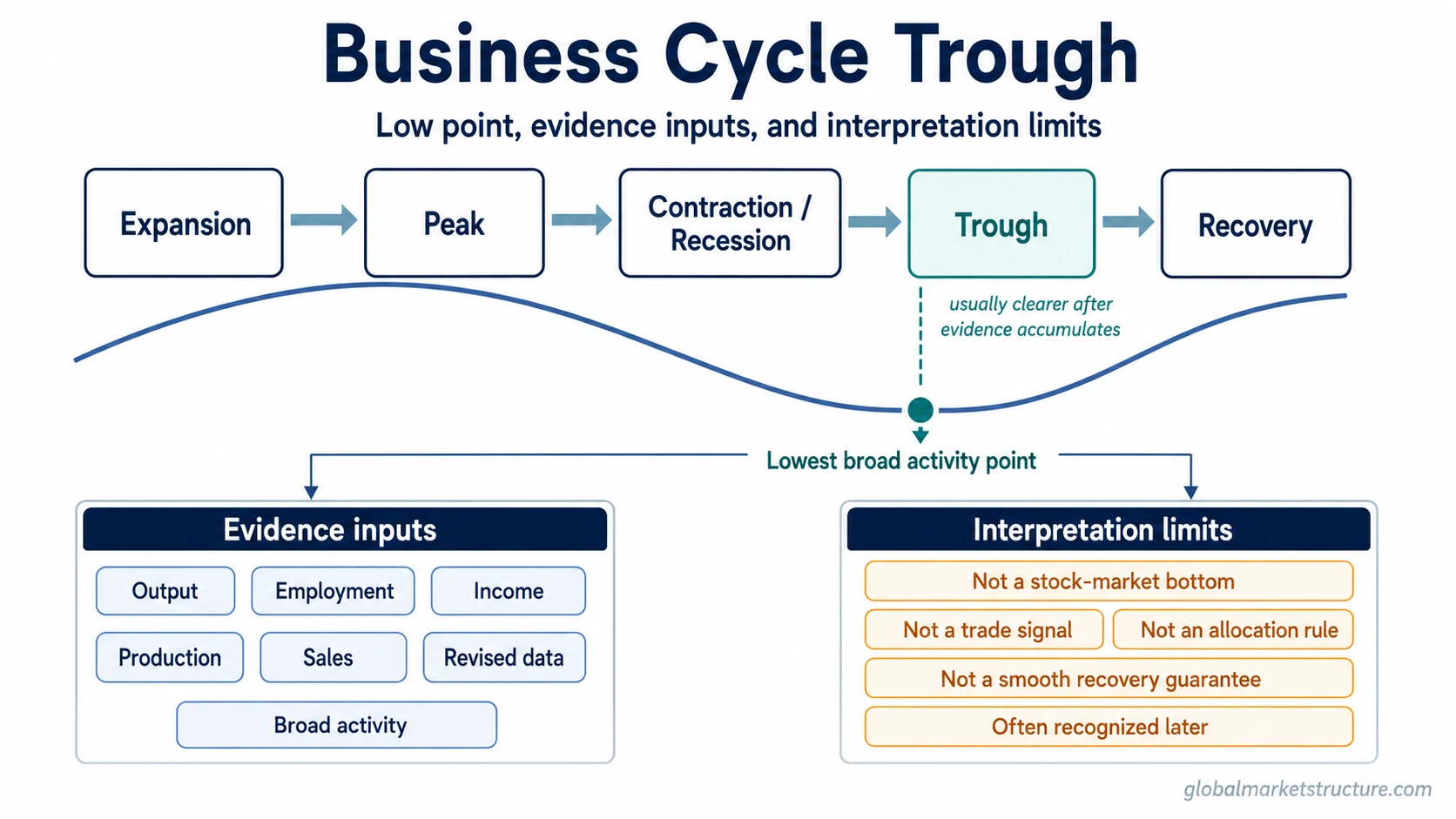
What a Business-Cycle Trough Means
A business-cycle trough is the lowest point in a cycle of broad economic activity. It appears near the end of a downturn, when contraction has reached its deepest point and the economy begins moving toward improvement.
The label separates the low point of the economic cycle from the broader recession period around it. A recession describes a period of declining activity. A trough marks the turning point where that decline reaches its bottom before the next recovery phase begins.
The trough is not always obvious while it is happening. Economic data can be revised, indicators can disagree, and early improvement can be uneven. For that reason, the trough is better understood as a classification supported by accumulated evidence rather than as a live signal that can be read from one chart or one data release.
Where the Trough Sits in the Business Cycle
The trough sits between the contraction phase and the recovery phase. In a simplified cycle sequence, the economy expands, reaches a business-cycle peak, contracts, reaches a trough, and then begins to recover.
| Cycle position | What is happening | How the trough relates |
|---|---|---|
| Expansion | Broad activity is rising. | The trough is already behind the economy in this simplified sequence. |
| Peak | Economic activity reaches a high point before weakening. | The peak is the opposite turning point from the trough. |
| Contraction or recession | Output, employment, income, production, sales, or other broad measures weaken. | The trough is approached as the downturn deepens. |
| Trough | Broad activity reaches its low point. | This is the turning point from decline toward improvement. |
| Recovery or renewed expansion | Activity begins improving from the low point. | The trough becomes clearer as later evidence supports the turn. |
A compact way to visualize the sequence is: expansion -> peak -> contraction or recession -> trough -> recovery or expansion.
What Evidence Can Support a Trough Label
A trough is not confirmed by one economic statistic. It normally requires a broader view of economic activity, because the business cycle is about the economy as a whole rather than a single market price, company result, or isolated data point.
Evidence may include broad measures such as output, employment, income, production, sales, and other activity indicators. The important point is not that every measure turns at the same time. The important point is whether the weight of the evidence supports the idea that the contraction has reached its low point and that activity has begun to improve.
| Evidence input | What it may support | What it cannot prove by itself |
|---|---|---|
| Output or production | Whether real economic activity has stopped weakening. | That the whole economy has fully recovered. |
| Employment | Whether labor-market deterioration is slowing or reversing. | That all labor-market damage has been repaired. |
| Income | Whether household or aggregate income conditions are stabilizing. | That purchasing power has returned to prior strength. |
| Sales | Whether demand is beginning to improve from depressed levels. | That demand will continue improving without interruption. |
| Broad activity indicators | Whether multiple parts of the economy support the same turning-point interpretation. | That one indicator should be treated as enough by itself. |
| Retrospective dating or later analysis | Whether the low point is clear after more complete data is available. | That the trough was obvious in real time. |
Why Different Indicators Can Trough at Different Times
A business-cycle trough describes the turning point in broad economic activity. Individual economic series can reach their own lows earlier or later. The economy therefore does not need every major indicator to bottom in the same month for a reference-cycle trough to be identified.
U.S. example: The National Bureau of Economic Research identified June 2009 as the U.S. business-cycle trough. Industrial production and real manufacturing and trade sales reached lows in June, while real personal income less transfers and aggregate hours of work reached their lows in October. Payroll and household employment reached their lows in December.
The example shows why an economy-wide trough and the trough of a single indicator are different concepts. The broader classification depends on the combined evidence across economic activity. A later low in employment, income, or another series does not by itself move the entire business-cycle trough to that later date.
Why Troughs Are Often Clearer After the Fact
A business-cycle trough can be difficult to identify in real time because the early phase of improvement may be uneven. Some indicators may stabilize while others continue weakening. Initial data can also be revised, which means a month that later looks like the low point may not have looked decisive when the first data was released.
This is why trough identification is usually stronger after a broader pattern has appeared. A single positive data release may suggest improvement, but it does not automatically establish a cycle trough. The interpretation becomes more reliable when several parts of the economy stop deteriorating and later data supports a transition from contraction toward recovery.
That timing lag is not a flaw in the concept. It is part of what the concept measures. A trough is a classification of the low point in a completed or emerging turn, not a real-time forecasting tool.
Business-Cycle Trough vs Nearby Concepts
A trough is easiest to misuse when it is blended with nearby cycle terms. The most important distinction is that the trough is the low point of broad economic activity, while other terms describe periods, phases, or market behavior around that low point.
| Concept | What it means | How it differs from a trough |
|---|---|---|
| Recession | A period of broad economic decline. | The trough is the low point near the end of that downturn, not the whole downturn period. |
| recovery | The phase when activity begins improving after the low point. | The trough is the turning point before recovery, not the recovery phase itself. |
| Business-cycle peak | The high point before economic activity begins contracting. | The peak is the opposite turning point. The trough is the low point before improvement. |
| Stock-market bottom | A low point in equity prices. | A business-cycle trough is based on economic activity, not equity-price timing. |
| Business-cycle stages | A broad map of phases such as expansion, peak, contraction, trough, and recovery. | The trough is one specific turning point inside that broader sequence. |
What a Business-Cycle Trough Does Not Prove
A trough label can improve economic-cycle interpretation, but it does not remove uncertainty. It should not be converted into a mechanical market rule.
| What it is | What it is not |
|---|---|
| An economic-cycle turning point. | A stock-market bottom. |
| A broad activity classification. | A single-indicator signal. |
| A label that often becomes clearer retrospectively. | Real-time certainty. |
| A boundary between contraction and recovery. | A guarantee that recovery is complete. |
| Context for macro and market-regime interpretation. | A buy signal, sell signal, or allocation rule. |
A business-cycle trough can describe a completed or emerging turn in broad economic activity, but it cannot prove that markets have bottomed, that recovery will be smooth, or that a specific portfolio decision is justified.
Practical Scenario
Consider a generic downturn where broad activity has been weakening for several months. Production declines, employment softens, income growth slows, and sales weaken. Later, several of those indicators stop deteriorating. New data begins to show that activity is improving from a low point rather than continuing to fall.
In that kind of scenario, the low point may later be classified as the business-cycle trough. The classification does not mean that the economy felt strong at the time. It means the broad decline reached its lowest point before the next phase of improvement began.
The same scenario also shows why the label should be used carefully. Early stabilization can be uneven, and the first signs of improvement can fail. The trough label becomes more useful when it is supported by broader evidence rather than by one encouraging data release.
How to Use the Concept Safely
A safer interpretation is to treat a business-cycle trough as a context label. It helps describe where the economy may sit in the cycle and how the transition from downturn to recovery is being interpreted.
It can be read alongside broader macro evidence, liquidity conditions, credit behavior, labor-market data, market breadth, and other regime inputs. Those inputs can help explain whether the economic backdrop is improving, but they still do not turn the trough into a deterministic signal.
The practical value is classification, not prediction. A trough can help organize the question, “Has the downturn reached its low point?” It should not be used as a shortcut for the separate question, “What should markets or portfolios do next?”
Related Concepts
The trough is only one turning point in the cycle. The opposite side of the sequence is the peak, where broad economic activity reaches a high point before contraction begins.
For the downturn side of the cycle, recession explains the broader period of declining activity. For the post-trough side, recovery explains the phase when activity starts improving from the low point.
For the broader foundation, the business cycle explains how expansions, peaks, contractions, troughs, and recoveries fit into a full economic-cycle framework.
FAQ
What is a business-cycle trough?
A business-cycle trough is the low point in broad economic activity after a contraction or recession and before recovery or renewed expansion begins. It is a turning-point label, not a market signal.
Does a business-cycle trough mean the recession is over?
It may mark the low point at the end of a recession period, but it is usually confirmed after broader evidence becomes clearer. It should not be treated as real-time certainty.
Is a business-cycle trough the same as a stock-market bottom?
No. A business-cycle trough refers to broad economic activity. A stock-market bottom refers to asset prices. The two can occur at different times.
Why are troughs often identified after the fact?
Troughs are often clearer after the fact because early data can be noisy, revised, or mixed across indicators. Later evidence can make the low point easier to classify.