
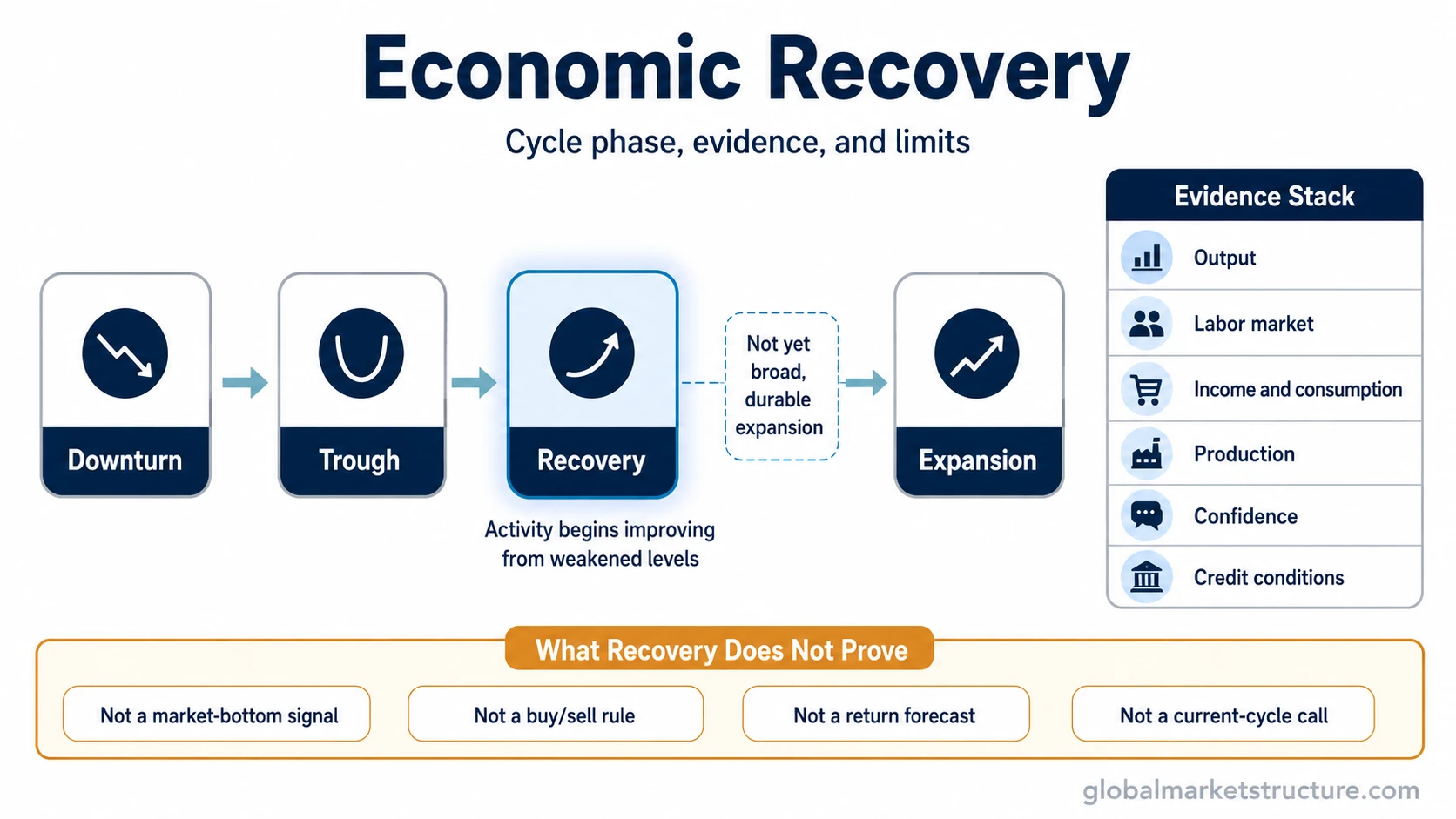
Economic recovery is the phase or process in which broad economic activity begins improving after a recession, contraction, or cycle trough. It is usually supported by evidence across output, employment, income, production, confidence, and financial conditions. Recovery can be difficult to confirm in real time, and the label does not by itself signal a stock-market bottom, an asset-return forecast, or a durable expansion.
Key Points
- Economic recovery means broad activity is improving after a downturn.
- Recovery is supported by accumulated evidence, not one isolated data point.
- Recovery is not the same as expansion.
- Recovery is not a market-timing signal or a buy/sell rule.
What Is Economic Recovery?
Economic recovery describes the improvement phase that begins after economic activity has weakened and a cycle trough is forming or has already passed. The concept is usually used in a business-cycle context, where contraction gives way to improving output, stabilizing demand, and gradually better labor or income conditions.
Recovery is a process, not a single report. A stronger GDP print, a rebound in confidence, or a brief improvement in financial markets may support the recovery case, but none of those signals is enough on its own. The label becomes more credible when several parts of the economy begin improving together.
Simple definition: Economic recovery is the period of improving economic activity after a downturn, before growth is broad and sustained enough to be treated as a more mature expansion.
Where Recovery Fits in the Business Cycle
Economic recovery usually follows a recession, contraction, or trough. The typical sequence is:
Recession or contraction: activity weakens across output, employment, income, production, or demand.
Trough: the cycle reaches a low point, although it may only be clear later.
Recovery: activity begins improving from depressed or weakened levels.
Expansion: growth becomes broader, more durable, and less dependent on early rebound effects.
The boundary is not always clean. Some parts of the economy may improve while others remain weak. That is why recovery is usually judged through a body of evidence rather than one turning point label.
Economic Recovery Indicators and Evidence
A recovery interpretation becomes stronger when improvement appears across several economic areas. Recovery evidence is usually cumulative, not mechanically threshold-based, so the label depends on the breadth, persistence, and consistency of the data rather than one fixed trigger.
| Evidence area | What can support a recovery label | What it cannot prove by itself |
|---|---|---|
| Output | Real activity begins rising after a period of contraction or stagnation. | One positive reading does not prove a durable recovery. |
| Labor market | Job losses slow, hiring improves, or unemployment pressure begins easing. | Labor data can lag the cycle and may improve after other signals turn. |
| Income and consumption | Household income, spending, or demand starts stabilizing after weakness. | Short-term spending rebounds can fade if income or credit remains weak. |
| Production and business activity | Industrial activity, orders, or business confidence begins improving. | Some sectors can recover while others remain under pressure. |
| Confidence | Businesses or households become less pessimistic after a downturn. | Sentiment can improve before hard activity data confirms the turn. |
| Credit and financial conditions | Credit stress stabilizes, financing access improves, or risk appetite stops deteriorating. | Financial-market improvement does not automatically confirm a full economic recovery. |
Recovery vs Expansion
Recovery and expansion are related, but they are not interchangeable. Recovery is the improvement phase after weakness. Expansion is the broader growth phase after the economy has moved beyond the early rebound and activity is more sustained.
| Concept | Main meaning | Typical evidence focus |
|---|---|---|
| Recovery | Activity is improving from a weakened or depressed base. | Stabilization, rebound, early improvement, mixed confirmation. |
| Expansion | Growth is broader, more sustained, and less dependent on rebound effects. | Durability, breadth, continued growth, stronger confirmation. |
The distinction matters because early recovery can still be fragile. Output may improve before hiring becomes strong, confidence may rebound before income fully recovers, and financial markets may move before the real economy is clearly expanding.
Why Recovery Can Be Hard to Recognize in Real Time
Economic recovery is often easier to identify after the fact than during the transition itself. Initial data can be revised, different indicators can turn at different times, and some sectors may remain weak even as the broader economy begins to stabilize.
Leading indicators may improve before employment or income confirms the turn. Lagging indicators may still look poor after the cycle has already stopped deteriorating. Coincident indicators can also send mixed signals when the economy is moving from contraction toward stabilization.
Common recognition problem: early recovery can look incomplete because improvement often appears unevenly. A recovery label becomes stronger when evidence accumulates across activity, labor, income, production, confidence, and financial conditions.
What Economic Recovery Cannot Prove
Economic recovery is a cycle classification, not a market rule. It can describe improving economic conditions, but it does not automatically prove that risk assets have bottomed, that a new expansion is durable, or that future returns will be positive.
- It is not a stock-market bottom signal.
- It is not a buy or sell rule.
- It is not an asset-return forecast.
- It is not a current-cycle call without current evidence.
- It is not proof that all sectors are improving at the same time.
- It is not confirmation that expansion is already durable.
A recovery label is most useful when it is treated as a way to classify improving economic activity, not as a shortcut for investment decisions or market timing.
Illustrative Scenario
Consider a downturn where output has fallen, business confidence is weak, and hiring has slowed. Later, production begins to improve, new orders stabilize, credit conditions stop tightening, and confidence starts recovering. At the same time, unemployment remains elevated and household income is still under pressure.
That mix can support an early recovery interpretation because several indicators have stopped deteriorating and some are improving. It still does not prove a durable expansion, and it does not forecast market returns. The stronger conclusion would require broader confirmation over time.
Related Cycle Concepts
Recovery is easiest to understand in relation to the phases around it. A recession describes the downturn or broad weakening phase that can precede recovery. Expansion describes the more sustained growth phase that can follow once improvement becomes broader and more durable.