
Risk-on risk-off describes a market-environment lens built around risk appetite, risk-seeking behavior, defensive behavior, safe-haven demand, and stress-sensitive capital flows. A single volatility move, dollar move, bond rally, gold move, or equity decline is not enough to diagnose the whole environment because risk appetite depends on confirmation across several markets and conditions.
Core distinction: Risk-on conditions usually describe stronger willingness to hold growth-sensitive or risk-sensitive assets, while risk-off conditions usually describe stronger demand for safety, liquidity, quality, or capital preservation. The label becomes more useful when it is supported by cross-asset behavior, liquidity context, credit conditions, yields, currencies, volatility, and market breadth rather than one isolated signal.
Important limitation: Risk-on and risk-off are not buy or sell signals. They are broad environment labels. A market can show a temporary risk-off move without a full risk-off regime, and one defensive asset can rise for reasons that have little to do with systemic stress.
Where to Start
- Use Risk Appetite when the question is about willingness to accept uncertainty and volatility.
- Use Risk On when the question is about risk-seeking market behavior.
- Use Risk Off when the question is about defensive behavior and lower tolerance for risk.
- Use Safe Haven Assets, Flight to Quality, or Safe Haven Currency when the question is about defensive-flow channels.
- Use cross-asset confirmation before treating one move as a full risk-environment diagnosis.
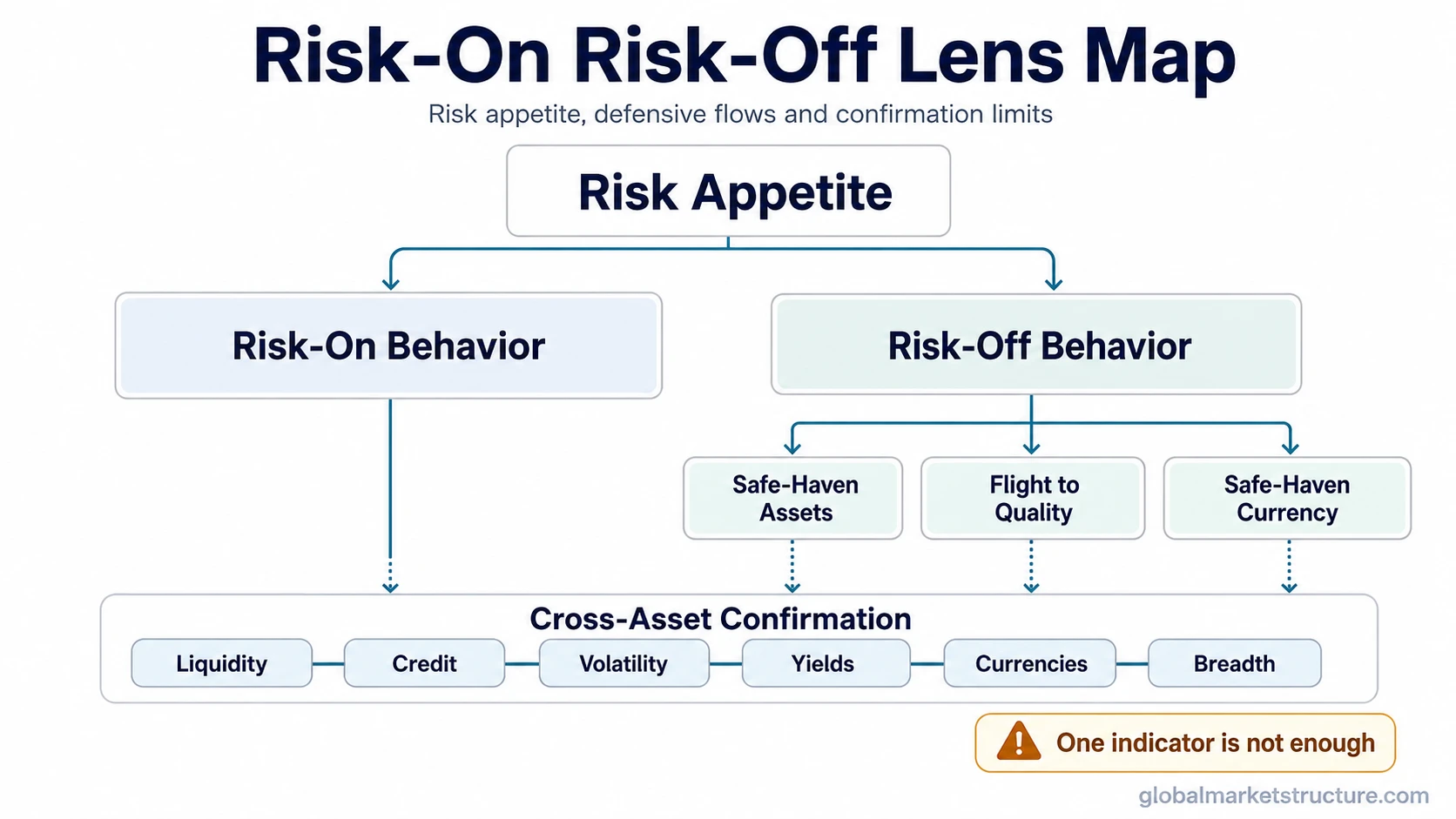
Choose the Right Risk-On / Risk-Off Lens
Risk-on risk-off separates a broad market-environment label from the more precise concepts that often get mixed together. The useful starting point depends on whether the question is about risk appetite, risk-seeking behavior, defensive behavior, safe havens, quality migration, currency-specific safety demand, the difference between risk-on and risk-off, or a rebound that follows a period of stress.
| Question | Best starting concept | Use when the focus is |
|---|---|---|
| What does risk-seeking behavior look like? | Risk On | Growth-sensitive assets, risk appetite, liquidity support, and stronger willingness to hold risk exposure. |
| What does defensive behavior look like? | Risk Off | Safety demand, deleveraging pressure, defensive rotation, stress behavior, and lower tolerance for risk. |
| What sits underneath both labels? | Risk Appetite | The willingness of market participants to accept uncertainty, volatility, liquidity risk, and drawdown risk. |
| Which assets are usually treated as defensive? | Safe Haven Assets | Assets that may attract demand during stress, uncertainty, liquidity pressure, or defensive repositioning. |
| What happens when capital moves toward quality? | Flight to Quality | Capital migration toward perceived safety, stronger balance sheets, higher liquidity, or lower credit risk. |
| How do currencies fit into defensive flows? | Safe Haven Currency | Currency behavior during stress, funding pressure, reserve demand, carry unwinds, or defensive positioning. |
| What is the difference between risk-on and risk-off? | Risk-On vs Risk-Off | A direct comparison of risk-seeking and defensive market environments, including what separates the two and how confirmation changes the classification. |
| Does a rebound after stress mean risk-on has returned? | Relief Rally | A rebound after selling pressure or stress that may occur without a durable shift into a broader risk-on environment. |
Risk Appetite Comes First
Risk appetite is the broader condition behind risk-on and risk-off labels. When risk appetite is stronger, markets are usually more willing to hold assets with higher uncertainty, longer duration, greater cyclical sensitivity, or weaker liquidity. When risk appetite weakens, markets often become more selective and may prefer liquidity, quality, shorter duration, stronger balance sheets, or assets perceived as safer.
The same asset move can mean different things under different conditions. A bond rally can reflect lower inflation expectations, recession concern, positioning pressure, or demand for safety. A stronger dollar can reflect US growth strength, global funding stress, rate differentials, or defensive demand. The risk-on or risk-off label becomes more reliable only when surrounding evidence points in the same direction.
Useful sequence: Start with risk appetite, then separate risk-on behavior from risk-off behavior, then check whether safe-haven demand, quality migration, currency behavior, volatility, credit, liquidity, and breadth confirm the same environment.
Risk-On Behavior
Risk-on behavior usually appears when markets show stronger tolerance for uncertainty and greater willingness to hold assets tied to growth, liquidity, earnings expansion, cyclical demand, or speculative exposure. It can involve stronger equity participation, tighter credit spreads, calmer volatility, stronger cyclical leadership, or broader participation across risk-sensitive assets.
Risk-on does not mean every risky asset must rise at the same time. Some assets can lag because of valuation, earnings weakness, liquidity constraints, policy pressure, or sector-specific problems. The label is strongest when the move is broad, persistent, and supported by several confirming markets rather than one strong index or one short burst of momentum.
Use Risk On when: the question is about the risk-seeking side of market behavior.
Risk-Off Behavior
Risk-off behavior usually appears when markets reduce exposure to uncertainty and move toward perceived safety, liquidity, quality, or defensive balance-sheet protection. It can involve wider credit spreads, rising volatility, weaker market breadth, defensive sector leadership, lower cyclical participation, demand for safe-haven assets, or pressure on funding-sensitive assets.
Risk-off does not automatically mean a crash, crisis, or recession is already confirmed. Short-lived risk-off moves can appear around positioning, policy surprises, geopolitical headlines, liquidity windows, or crowded trades. The label becomes more structural when multiple markets confirm that risk tolerance is weakening together.
Use Risk Off when: the question is about defensive behavior and lower tolerance for risk.
Safe Havens, Flight to Quality and Defensive Currencies
Safe-haven assets, flight-to-quality behavior, and safe-haven currencies often appear in the same conversation, but they describe different parts of defensive behavior. Safe-haven assets focus on instruments that may attract demand during stress. Flight to quality describes a broader migration toward perceived safety and stronger balance-sheet or liquidity characteristics. Safe-haven currency behavior focuses on currency-specific flows, funding conditions, reserve demand, and carry-trade pressure.
| Concept | Main meaning | Common confusion |
|---|---|---|
| Safe Haven Assets | Assets that may receive defensive demand during uncertainty, market stress, or liquidity pressure. | Assuming a safe-haven asset always rises during every risk-off move. |
| Flight to Quality | A broader move toward perceived safety, liquidity, stronger credit quality, or lower balance-sheet risk. | Treating every defensive rotation as the same type of quality migration. |
| Safe Haven Currency | Currency behavior linked to stress, funding demand, reserve preference, or carry-trade unwinds. | Assuming currency strength always means safety demand rather than rate, growth, or funding effects. |
Why One Indicator Is Not Enough
A single indicator can give a useful clue, but it can also create a false reading. A volatility spike can reflect stress, but it can also reflect event risk, positioning, options hedging, or a short-term liquidity gap. A stronger dollar can point to defensive demand, but it can also reflect rate differentials, relative growth, or funding pressure. A bond rally can show safety demand, but it can also reflect inflation expectations or duration demand.
False-reading risk: No single volatility, dollar, gold, bond, equity, or commodity move confirms the entire risk-on or risk-off environment. The diagnosis becomes stronger only when the move aligns with broader liquidity, credit, currency, volatility, breadth, yield, and leadership evidence.
Practical scenario: A sudden volatility spike may look like risk-off behavior, but the reading is weaker if credit spreads remain calm, market breadth does not deteriorate, safe-haven demand is limited, and liquidity conditions are stable. The same volatility move becomes more meaningful when credit stress, weaker breadth, defensive leadership, and funding pressure appear together.
Use the More Precise Risk Lens
Risk-on risk-off works best as a broad environment label, not as a replacement for more precise risk concepts. Risk appetite explains the underlying willingness to hold risk. Risk-on and risk-off describe the two broad behavior states. Safe-haven assets, flight to quality, and safe-haven currencies describe narrower defensive-flow channels.
| Do not use the label for | Use the more precise concept instead |
|---|---|
| General willingness to accept market uncertainty | Risk Appetite |
| Growth-sensitive or risk-seeking market behavior | Risk On |
| Defensive market behavior and lower tolerance for risk | Risk Off |
| Assets that may attract demand during stress | Safe Haven Assets |
| Capital migration toward perceived quality or safety | Flight to Quality |
| Currency-specific defensive or funding-sensitive behavior | Safe Haven Currency |