
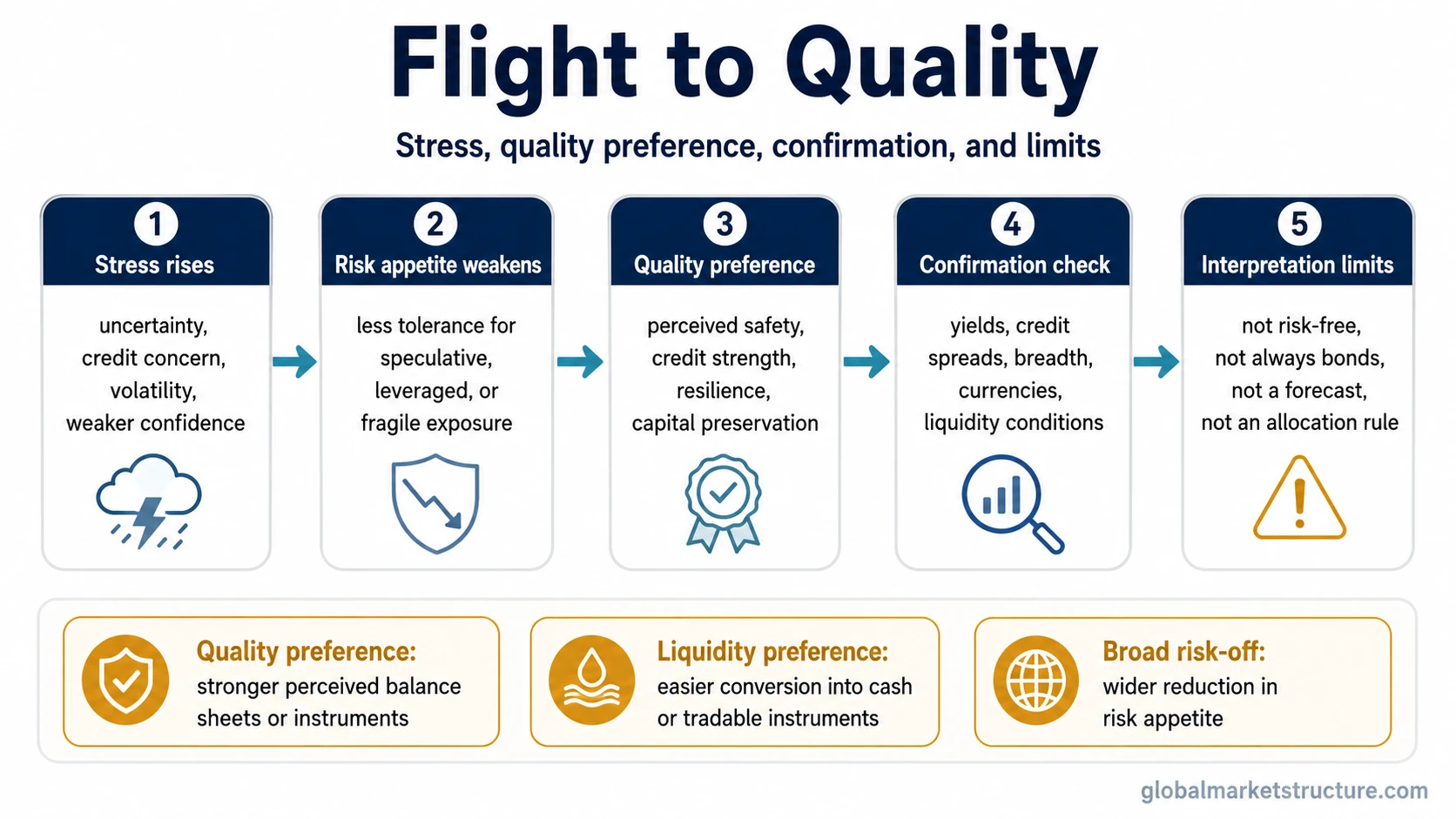
Flight to quality is a market-stress shift toward assets, issuers, or instruments perceived as safer, stronger, or more creditworthy. It usually appears when uncertainty rises, risk appetite weakens, and investors become more selective about balance-sheet strength, default risk, liquidity conditions, and capital preservation.
The concept is related to risk-off behavior, but it is narrower. Risk-off describes a broad reduction in risk appetite. Flight to quality describes the specific preference for perceived quality inside that defensive shift. It is also different from flight to liquidity, where the main objective is the ability to move into cash or highly tradable instruments quickly.
Key Points
- Flight to quality means a stress-period move toward perceived safety, credit quality, and resilience.
- It often appears when investors reduce exposure to weaker, speculative, leveraged, or less reliable assets.
- The destination can include high-quality sovereign bonds, cash-like instruments, stronger credit, defensive exposures, or safe-haven currencies, depending on the regime.
- It is related to risk-off behavior, but it is not the same as broad risk-off or pure liquidity preference.
- A flight-to-quality reading needs cross-market confirmation because one indicator can give a false signal.
What Flight to Quality Means
Flight to quality means that market participants are moving away from weaker or more uncertain exposures and toward assets or issuers they view as more durable during stress.
The word “quality” does not mean risk-free. It means that, relative to the alternatives, the asset or issuer is perceived as stronger under the conditions that currently matter. That perception can come from creditworthiness, reserve-currency status, balance-sheet strength, policy credibility, market depth, or the ability to preserve capital when uncertainty rises.
In market-structure terms, flight to quality is a behavior pattern. It shows that investors are not only reducing risk, but also becoming more selective about which risks they still trust. Lower-quality credit, speculative equities, cyclical exposures, and leveraged positions may weaken while perceived higher-quality instruments attract demand.
How Flight to Quality Differs From Nearby Concepts
Flight to quality is often used alongside risk-off, flight to safety, safe-haven demand, and flight to liquidity. These terms overlap, but they do not describe the same motive.
| Concept | Main focus | What it suggests |
|---|---|---|
| Flight to quality | Preference for perceived strength, credit quality, and resilience | Investors are becoming more selective about what they are willing to hold |
| Risk-off | Broad reduction in risk appetite | Riskier assets may come under pressure as defensive behavior rises |
| Flight to liquidity | Need for cash, tradability, and low transaction friction | Investors may prefer the most liquid instruments, even if quality is not the only concern |
| Flight to safety | Preference for assets perceived as protective | Demand may move toward defensive assets, but the exact assets depend on the shock |
The distinction is useful because a market can show more than one of these behaviors at the same time. A stress event can create both a flight to liquidity and a flight to quality. In that case, the question is whether investors are mainly demanding higher-quality exposure, easier exit liquidity, or both.
How a Flight to Quality Develops
A flight to quality usually starts when uncertainty changes the way market participants judge risk. The trigger can be a growth scare, credit stress, policy uncertainty, liquidity tightening, geopolitical risk, or a sudden loss of confidence in weaker balance sheets.
As uncertainty rises, investors often reduce exposure to assets whose future cash flows, financing conditions, or exit liquidity look less reliable. Lower-quality credit may be repriced. Speculative equities may weaken. Highly cyclical assets may lose support. Leveraged exposures may become harder to finance.
The preference then shifts toward perceived quality. That can mean stronger sovereign issuers, short-duration cash-like instruments, high-quality credit, defensive balance sheets, or currencies associated with safe-haven demand. The destination is not fixed. In a growth scare, high-quality bonds may attract demand. In an inflation shock, bonds may not behave like a clean safe haven.
The interpretation becomes stronger when several channels point in the same direction. A move in yields alone is not enough. A volatility spike alone is not enough. Flight to quality becomes more convincing when credit, breadth, liquidity, safe-haven behavior, and pressure on lower-quality assets align.
Common Signs of Flight to Quality
Credit spreads are often one of the most useful places to look because flight to quality is partly about credit discrimination. If lower-quality spreads widen while higher-quality debt holds up better, the market may be placing a larger premium on repayment certainty and balance-sheet strength.
Sovereign bond demand can also support the reading, especially when investors seek high-quality duration during a growth scare. The caveat is that falling yields can reflect several forces, including growth expectations, central-bank repricing, positioning, or liquidity pressure. Rising yields do not automatically disprove stress if the shock is inflation-led.
Volatility can rise during a flight to quality, but volatility alone does not define it. A volatility spike may come from event risk, option flows, positioning, or temporary uncertainty. The signal becomes more useful when volatility rises alongside weaker breadth, wider credit spreads, and pressure on lower-quality assets.
Currency behavior can add another layer. Demand for a safe-haven currency may show defensive demand for reserve quality, funding stability, or perceived safety. The interpretation still depends on the shock, interest-rate differentials, and funding conditions.
Why One Indicator Is Not Enough
A flight-to-quality reading is strongest when it is confirmed across markets. One asset can move for reasons that have little to do with broad stress. A bond rally may reflect rate-cut expectations. A stronger dollar may reflect yield differentials. A volatility spike may reflect event hedging. A credit move may reflect sector-specific pressure.
The cleaner reading comes from a pattern. Lower-quality assets weaken. Higher-quality assets hold up better or attract demand. Credit discrimination rises. Market breadth deteriorates. Liquidity-sensitive assets become more fragile. Safe-haven behavior appears in more than one place.
Interpretation rule: flight to quality should be treated as a cross-market condition, not a one-chart signal. The reading becomes stronger when credit, liquidity, yields, breadth, volatility, and safe-haven behavior tell the same story.
A Practical Scenario
A common scenario is that lower-quality credit spreads begin widening while speculative assets weaken and market breadth deteriorates. At the same time, high-quality sovereign bonds or cash-like instruments attract demand, and a safe-haven currency strengthens. That combination may suggest that investors are becoming more selective about quality and more cautious about weaker risk exposures.
The conclusion remains conditional. The same pattern can weaken if bond demand is driven mainly by rate-cut expectations, if currency strength reflects interest-rate differentials rather than stress, or if credit spreads widen only briefly without broader confirmation.
When Flight to Quality Can Be Misread
Flight to quality can be misread when investors treat one defensive-looking market move as complete proof. A Treasury rally, a stronger dollar, wider credit spreads, or higher volatility may support the interpretation, but none of them confirms it alone.
Key limitation: the assets that look safest in one regime may not behave the same way in another regime. Inflation pressure, forced selling, policy repricing, and liquidity stress can all distort normal safe-haven behavior.
Inflation shocks are one example. If stress comes from rising inflation and tighter policy, high-quality bonds may struggle even while risk appetite weakens. In that environment, the market may still be defensive, but the usual bond-led flight-to-quality pattern may be less reliable.
Forced selling is another complication. During a liquidity squeeze, investors may sell what they can sell rather than what they want to sell. That can temporarily pressure even high-quality assets. This is where flight to liquidity can dominate flight to quality.
Safe havens also depend on context. A safe-haven asset may behave differently when yields, inflation, currency pressure, and positioning are changing at the same time.
Commercial Real Estate Use Is Different
The phrase “flight to quality” also appears in commercial real estate, where it often describes tenant or investor preference for newer, better-located, or higher-grade properties. That is a valid vertical use, but it is not the controlling meaning for this page.
For Global Market Structure, flight to quality refers to capital behavior during market stress. The focus is risk appetite, credit quality, liquidity preference, safe-haven demand, and cross-asset confirmation, not Class A office demand or real estate amenities.
How to Interpret Flight to Quality in Market Structure
The useful question is not whether one asset rose or fell. The useful question is whether market participants are showing a broader preference for stronger, safer, or more resilient exposures. That requires checking the pattern across assets rather than isolating one chart.
A cleaner flight-to-quality interpretation usually has several features: weaker speculative risk, stronger demand for perceived quality, wider discrimination between stronger and weaker credit, defensive leadership, and confirmation from liquidity or safe-haven behavior.
The reading becomes weaker when the evidence is isolated, when the move is driven by one policy repricing channel, or when high-quality assets are being sold because investors need liquidity. In that case, the market may still be stressed, but the better label may be liquidity stress, policy repricing, or broad risk-off behavior rather than a clean flight to quality.
Related Concepts
Flight to quality sits inside the broader risk-on / risk-off framework, but its main value is narrower. It helps separate general defensive behavior from a more specific preference for quality, safety, and credit strength.
The concept connects naturally to risk appetite, because the shift toward quality usually appears when the willingness to hold uncertain or lower-quality risk declines. It also connects to safe-haven assets and safe-haven currency behavior, where perceived safety may become part of cross-market confirmation.
FAQ
What does flight to quality mean?
Flight to quality means a market-stress shift toward assets, issuers, or instruments perceived as safer, stronger, or more creditworthy. It usually appears when uncertainty rises and investors become less willing to hold weaker or more speculative exposures.
Is flight to quality the same as risk-off?
No. Risk-off describes a broad decline in risk appetite. Flight to quality is narrower because it focuses on the preference for perceived quality, safety, credit strength, or balance-sheet resilience during that risk reduction.
Is flight to quality the same as flight to liquidity?
No. Flight to quality emphasizes perceived safety and creditworthiness. Flight to liquidity emphasizes the ability to move into cash or highly tradable instruments quickly and with less transaction friction.
Which assets can respond during a flight to quality?
Assets perceived as higher quality may attract demand, but the exact behavior depends on the regime. High-quality sovereign bonds, cash-like instruments, stronger credit, defensive exposures, or safe-haven currencies may respond differently depending on inflation, policy, liquidity, and positioning.
Can one indicator confirm a flight to quality?
No. A single indicator can be misleading. The reading is stronger when credit spreads, breadth, liquidity conditions, volatility, yields, safe-haven behavior, and lower-quality asset pressure point in the same direction.