
Risk appetite means willingness to accept risk or uncertainty. In market analysis, it describes how willing participants are to hold riskier assets, remain exposed to uncertainty, or move away from defensive positioning, but it is not a standalone trading signal, forecast, or complete risk-on/risk-off reading.
Simple definition: Risk appetite describes how much risk market participants appear willing to accept under current conditions.
Market boundary: It is broader than individual risk tolerance and narrower than a full risk-on/risk-off regime. It helps describe participation and confidence, but it does not prove that a market move will continue.
What Risk Appetite Means in Market Structure
In market structure, risk appetite is the willingness to stay exposed to uncertainty when outcomes are not guaranteed. When risk appetite is higher, participants may be more willing to own equities, high-beta assets, credit-sensitive instruments, cyclical sectors, or other exposures that depend on confidence and liquidity. When risk appetite is lower, participants often become more selective, reduce exposure, or prefer defensive assets.
This market meaning is different from the corporate use of the term. In enterprise risk management, risk appetite often refers to how much risk an organization is willing to accept while pursuing objectives. On Global Market Structure, the term is used in a market-environment sense: how risk-taking behavior appears across asset classes, participation, credit, volatility, liquidity, and defensive demand.
Risk appetite is useful because it helps separate a narrow price move from broader participation. A single equity index can rise even when the wider market is cautious. A broader reading becomes more credible when equities, credit, volatility, breadth, leadership, liquidity, and defensive flows point in the same direction.
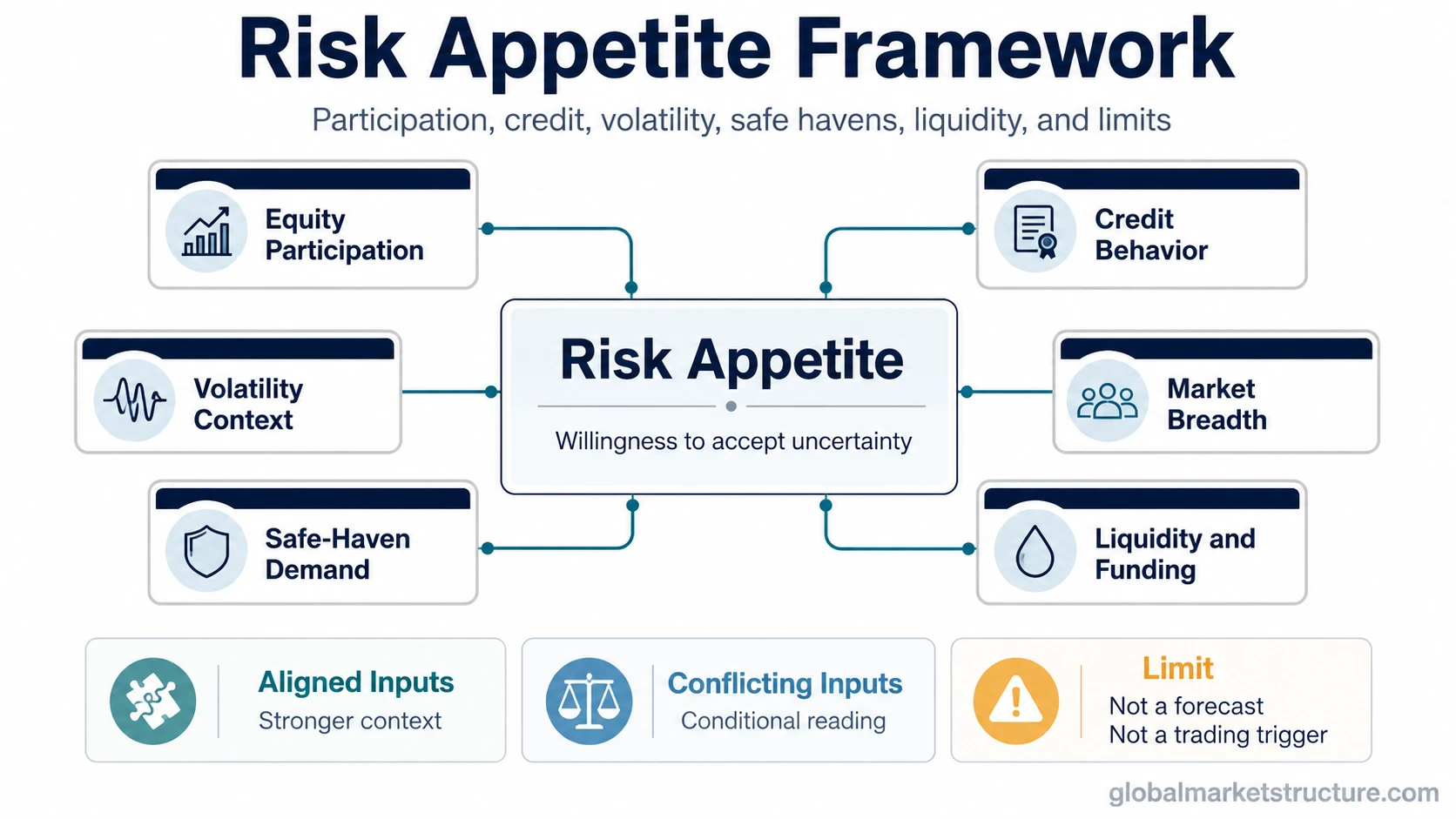
Risk Appetite vs Nearby Concepts
Risk appetite is often confused with risk tolerance, sentiment, volatility, and risk-on/risk-off conditions. These ideas overlap, but they do not describe the same thing.
| Concept | What it describes | How it differs from risk appetite |
|---|---|---|
| Risk appetite | Willingness to accept uncertainty or hold riskier exposure. | Focuses on risk-taking behavior across the market environment. |
| Risk tolerance | The amount of risk an individual, institution, or strategy can tolerate. | More about capacity or limit. Risk appetite is more about willingness. |
| Market sentiment | The tone of market opinion, confidence, fear, or optimism. | Sentiment can shift quickly. Risk appetite needs confirmation through behavior. |
| Volatility | The size and speed of price movement. | Volatility can reflect stress, repricing, or opportunity. It does not measure risk appetite by itself. |
| Risk-on/risk-off | A broader market environment where risk-taking or defensive behavior dominates. | Risk appetite is one input. A full regime reading needs broader confirmation. |
How Risk Appetite Shows Up Across Markets
Risk appetite is strongest as a cross-market reading when different parts of the market confirm each other. The same equity move can mean different things depending on whether credit, volatility, breadth, safe-haven demand, and liquidity are also aligned.
| Market input | Higher risk appetite may appear as | Lower risk appetite may appear as |
|---|---|---|
| Equities | Broader participation, cyclical strength, and willingness to hold risk exposure. | Narrow leadership, defensive rotation, or pressure in risk-sensitive areas. |
| Credit | Tighter credit spreads and easier access to financing. | Wider spreads, rising default concern, or weaker demand for lower-quality credit. |
| Volatility | Lower perceived stress when volatility is contained and liquidity remains stable. | Higher stress when volatility rises alongside weaker liquidity or forced selling. |
| Market breadth | More sectors, industries, or stocks participating in the move. | Fewer stocks supporting the headline index, creating participation risk. |
| Safe-haven assets | Less urgent demand for defensive assets when confidence is stronger. | Greater demand for safe-haven assets when participants seek protection. |
| Liquidity and funding | Easier market functioning and more willingness to extend risk. | Tighter funding, weaker market depth, or reduced willingness to provide liquidity. |
A higher risk appetite reading is more credible when several inputs move together. It becomes weaker when one part of the market looks confident while another part is defensive. For example, equities may rise while credit spreads widen or market breadth deteriorates. That combination does not automatically create a negative conclusion, but it reduces confidence in the risk appetite reading.
Higher and Lower Risk Appetite
Higher risk appetite usually means participants are more comfortable accepting uncertainty. It can be associated with stronger demand for growth-sensitive, cyclical, high-beta, or credit-sensitive assets. It may also appear when volatility is contained, credit markets are calm, and market breadth is improving.
Lower risk appetite usually means participants are less willing to accept uncertainty. It can appear through defensive rotation, wider credit spreads, higher volatility, reduced breadth, pressure in speculative assets, or stronger demand for assets perceived as defensive. Lower risk appetite does not always mean a crisis is present. It can also reflect caution, valuation sensitivity, policy uncertainty, or a pause after earlier risk-taking.
Important limitation: Risk appetite is not a directional command. Higher risk appetite does not mean prices must rise, and lower risk appetite does not mean prices must fall. It describes willingness to accept risk, not the full balance of valuation, liquidity, earnings, positioning, policy, and market structure.
Risk Appetite and Risk-On / Risk-Off Conditions
Risk appetite is closely related to risk-on/risk-off analysis, but it should not be treated as the same thing. Risk appetite is one layer of evidence. A risk-on or risk-off environment requires a broader assessment of market behavior across assets, liquidity, credit, volatility, rates, defensive demand, and participation.
A market can show rising risk appetite without becoming a clean risk-on regime. For example, equities may recover while credit remains cautious, volatility remains elevated, or defensive assets continue to attract demand. That kind of mixed behavior matters because regime labels are more reliable when multiple market inputs confirm the same message.
The reverse is also true. A market can show lower risk appetite in one area without entering a broad risk-off environment. Speculative assets may weaken while core equity indices, credit conditions, and liquidity remain stable. In that case, the signal may describe narrower risk reduction rather than a full defensive shift.
Why Risk Appetite Can Be Misread
Risk appetite is often misread when analysts rely on one visible market instead of checking confirmation. A strong stock index, a falling volatility index, or a rally in high-beta assets can all suggest greater willingness to take risk, but each signal can be incomplete by itself.
One common mistake is treating price strength as proof of broad confidence. A narrow rally can occur because a few large stocks are carrying the index. Another mistake is treating volatility alone as the full risk appetite signal. Volatility can fall because stress has eased, but it can also fall temporarily while liquidity and positioning risks remain under the surface.
| Misread | Why it is incomplete | Better check |
|---|---|---|
| Equities are up, so risk appetite is strong. | The move may be narrow or concentrated. | Check breadth, leadership, credit, and defensive demand. |
| Volatility is down, so risk appetite is high. | Low volatility does not always mean strong participation. | Check liquidity, credit spreads, and market depth. |
| One speculative asset is rallying, so the whole market is risk-on. | Speculation can be isolated. | Check whether the move is confirmed across sectors and asset classes. |
| Safe havens are firm, so risk appetite must be low. | Safe-haven demand can reflect rates, currency effects, or hedging needs. | Check credit stress, volatility, liquidity, and equity participation. |
How to Use Risk Appetite as Context
Risk appetite is best used as a context layer. It helps describe whether market behavior is becoming more confident, more selective, or more defensive. It should sit beside other market-structure inputs rather than replace them.
A practical reading starts with participation. If more sectors, industries, and assets are joining the move, the reading is stronger. Then credit should be checked because credit markets often show whether investors are becoming more or less comfortable with default and funding risk. Volatility and liquidity help show whether the move is happening in a stable environment or under fragile conditions.
Risk appetite also needs a limitation check. If signals conflict, the reading should stay conditional. Mixed evidence is common. That does not make the framework useless. It simply means the market environment is not sending one clean message.
Framework rule: Treat risk appetite as a market context reading, not as a prediction. The reading becomes stronger when participation, credit, volatility, defensive demand, and liquidity align. It becomes weaker when those inputs conflict.
Where Risk Appetite Fits in a Broader Market Framework
Risk appetite belongs inside a broader market regime framework. It helps describe how willing participants are to accept uncertainty, but regime analysis also needs growth conditions, inflation conditions, monetary policy, liquidity, credit, rates, currency pressure, market breadth, positioning, and cross-asset confirmation.
This is why risk appetite should not be used as a shortcut for asset allocation or market timing. It can support interpretation, but it does not settle the full market picture. A strong framework separates what is observed from what is inferred. Observed evidence may include credit spreads, breadth, volatility, safe-haven demand, and liquidity behavior. The interpretation is the conclusion drawn from those inputs.
The useful question is not whether risk appetite is simply high or low. The better question is whether enough independent market inputs confirm the same reading. If they do, the context is clearer. If they do not, the market may be in a mixed, transitional, or fragile state.
Risk Appetite FAQ
What is risk appetite in markets?
Risk appetite is the willingness of market participants to accept uncertainty or hold riskier exposure. In market analysis, it helps describe whether participants are becoming more comfortable with risk or more defensive.
Is risk appetite the same as risk tolerance?
No. Risk tolerance is more about how much risk an individual, institution, or strategy can withstand. Risk appetite is more about willingness to accept risk under current conditions.
Does higher risk appetite mean markets will rise?
No. Higher risk appetite can support risk-taking behavior, but it does not guarantee a market rise. It must be interpreted with credit, liquidity, breadth, valuation, positioning, and other market conditions.
How can risk appetite be observed?
Risk appetite can be observed through a combination of equity participation, credit spreads, volatility, breadth, high-beta leadership, defensive asset demand, and liquidity conditions. No single indicator is enough by itself.
Can risk appetite be mixed?
Yes. A market can show risk appetite in one area while other areas remain defensive. For example, a headline index can rise while credit markets or breadth still show caution.