
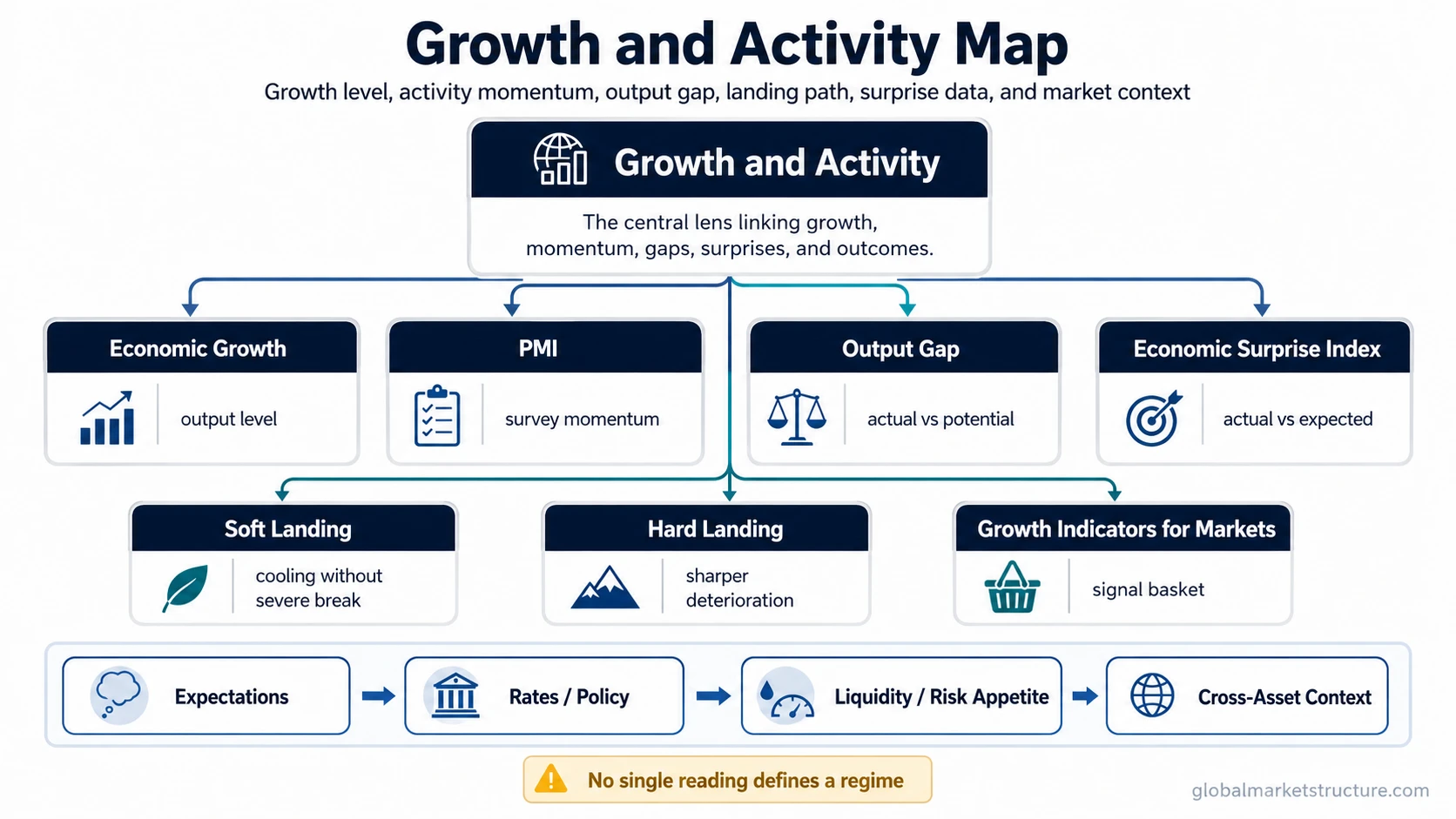
Growth and activity in macro markets separates several related questions: whether the economy is expanding, whether activity is accelerating or slowing, whether output is above or below potential, whether the cycle is moving toward a soft or hard landing, and whether data are beating or missing expectations.
Use economic growth for the core expansion or contraction concept, output gap for actual output versus potential output, PMI for survey-based activity momentum, and Economic Surprise Index for whether reported data are beating or missing expectations.
Landing-path questions belong with soft landing and hard landing. Broader indicator grouping belongs with growth indicators for markets after the core concepts are clear.
Key Points
- Growth and activity is not one indicator. It is a macro concept group covering output, momentum, landing path, expectations, and indicator aggregation.
- Economic growth, PMI, output gap, and economic surprise answer different questions and should not be collapsed into one signal.
- Market interpretation often depends on expectations, inflation, rates, credit, liquidity, DXY, breadth, and cross-asset confirmation.
- Current readings, forecasts, and country-level data require official or high-quality dated sources.
Growth and Activity Concept Map
The cleanest way to use growth and activity language is to start with the question being asked. A growth question usually concerns the direction or pace of economic output. An activity question usually concerns whether current business conditions are improving, slowing, or diverging from expectations.
| Concept route | Question answered | Role in macro interpretation | Use when |
|---|---|---|---|
| Economic Growth | Is the economy expanding or contracting? | Core growth definition and expansion or contraction framing. | The question is about output, growth rate, expansion, slowdown, or contraction. |
| Soft Landing | Can growth cool without a severe downturn? | Landing-path interpretation when inflation, policy, and demand are adjusting. | The question is about slower growth without a major cycle break. |
| Hard Landing | What does sharper growth deterioration mean? | Downside landing-path interpretation when growth pressure becomes more severe. | The question is about abrupt slowdown, demand stress, or recession-risk interpretation. |
| Output Gap | Is actual output above or below potential? | Actual-vs-potential lens for capacity pressure, slack, and overheating risk. | The question is about whether growth is strong relative to the economy’s sustainable capacity. |
| Purchasing Managers Index | What do surveys say about current activity momentum? | Survey-based activity signal for business conditions and momentum. | The question is about activity breadth, current business momentum, or survey-based cycle signals. |
| Economic Surprise Index | Are data beating or missing expectations? | Actual-vs-expectations lens for interpreting why data can matter differently from the headline result. | The question is why markets can react differently from the headline direction of the data. |
| Growth Indicators for Markets | Which growth indicators matter together? | Broad indicator aggregation across several growth and activity measures. | The question requires a basket of signals rather than one concept. |
Which Growth Signal Are You Trying to Understand?
Core growth level: Economic growth is the starting point when the question is whether output is expanding, slowing, or contracting. It should not absorb every activity signal because survey momentum, expectations gaps, and capacity pressure answer narrower questions.
Cycle landing path: Soft landing and hard landing language belongs to cycle-path interpretation. A soft landing reading usually depends on cooling pressure without severe growth damage, while a hard landing reading concerns sharper deterioration. Neither label should be inferred from one release alone.
Actual output versus potential: Output gap analysis asks whether the economy is operating above or below estimated potential. This lens can matter when growth appears strong, but the more important issue is whether the strength creates inflation pressure, capacity strain, or slack.
Survey-based activity: The Purchasing Managers Index is useful when the question concerns business activity momentum. Survey data can move earlier than some hard data, but survey weakness or strength still needs confirmation from broader macro and market conditions.
Actual data versus expectations: The Economic Surprise Index belongs to a different problem. A strong data release can still disappoint if expectations were higher, and a weak release can matter less if markets had already priced in weakness.
Broad indicator aggregation: Growth indicators for markets are useful after the main concept is clear. A broad indicator basket can help organize GDP, PMI, labor, consumption, production, credit, and surprise data, but aggregation should not blur the distinct job of each signal.
How Growth and Activity Enter Market Interpretation
Growth and activity data become market-relevant only after the data are compared with expectations and the wider macro setting. The same activity reading can carry different meaning when inflation pressure, policy rates, credit spreads, DXY, liquidity, and market breadth point in different directions.
Interpretation sequence: data release → expectations comparison → policy and rates context → liquidity and risk appetite context → cross-asset confirmation.
A firm activity reading may fit a stronger-growth interpretation when inflation pressure is contained and credit conditions are stable. The same reading may create pressure if it increases rate-risk concerns, conflicts with liquidity conditions, or arrives when markets expected faster cooling.
A weak activity reading can also have different meanings. It may reduce policy pressure if inflation is easing, but it may raise cycle-risk concerns if credit, breadth, and risk appetite are deteriorating at the same time. Growth interpretation is therefore conditional, not mechanical.
Common False Readings
One indicator is not a regime call. GDP, PMI, output gap, economic surprise, or landing-path language can support a macro view, but none of them proves a recession, expansion, soft landing, hard landing, risk-on regime, risk-off regime, or asset-price direction by itself.
| False reading | Why it is weak | Better check |
|---|---|---|
| Strong data automatically means stronger markets. | Market interpretation often depends on expectations, rates, inflation, liquidity, and positioning, not only on the headline data. | Compare the release with expectations and the policy-rate backdrop. |
| Weak data automatically means risk-off. | Weak data can reduce policy pressure if inflation is falling, but it can also signal cycle stress. | Check credit, breadth, liquidity, and cross-asset confirmation. |
| PMI and GDP measure the same thing. | PMI is survey-based activity momentum. GDP is an output measure and is released on a different basis. | Use each signal for its own question instead of treating them as interchangeable. |
| A landing label can be assigned from one release. | Soft landing and hard landing readings require a sequence of growth, inflation, labor, credit, and policy evidence. | Look for persistence across several macro channels. |
| Economic surprise equals economic strength. | Surprise measures the gap between actual data and expectations, not the absolute health of the economy. | Separate level, momentum, and expectation gap before interpreting the signal. |
Example of a Growth and Activity Reading
A common scenario is that activity data remain firm while the market response is uneven. The headline can look resilient, but the interpretation changes if the release beats expectations and increases concern that policy rates may stay restrictive for longer.
The signal is more constructive when credit spreads stay calm, liquidity conditions remain stable, DXY pressure is contained, and breadth improves. The same activity data become less supportive when credit weakens, liquidity tightens, the dollar strengthens, and market leadership narrows.
Official Data and Forecast Boundary
Current GDP figures, PMI readings, recession references, country-level growth status, and landing-path forecasts require dated official or high-quality sources. A concept route can explain how to think about growth and activity, but current numbers and live forecasts belong to the relevant data releases, official statistical agencies, central banks, or institutional outlook sources.
For evergreen market-structure interpretation, the safer distinction is stable: growth level, activity momentum, output gap, survey data, economic surprise, and landing path are related but separate lenses. Market interpretation improves when those lenses are compared rather than compressed into a single growth signal.